Corporate Tax for Foreign Shareholders – Explained
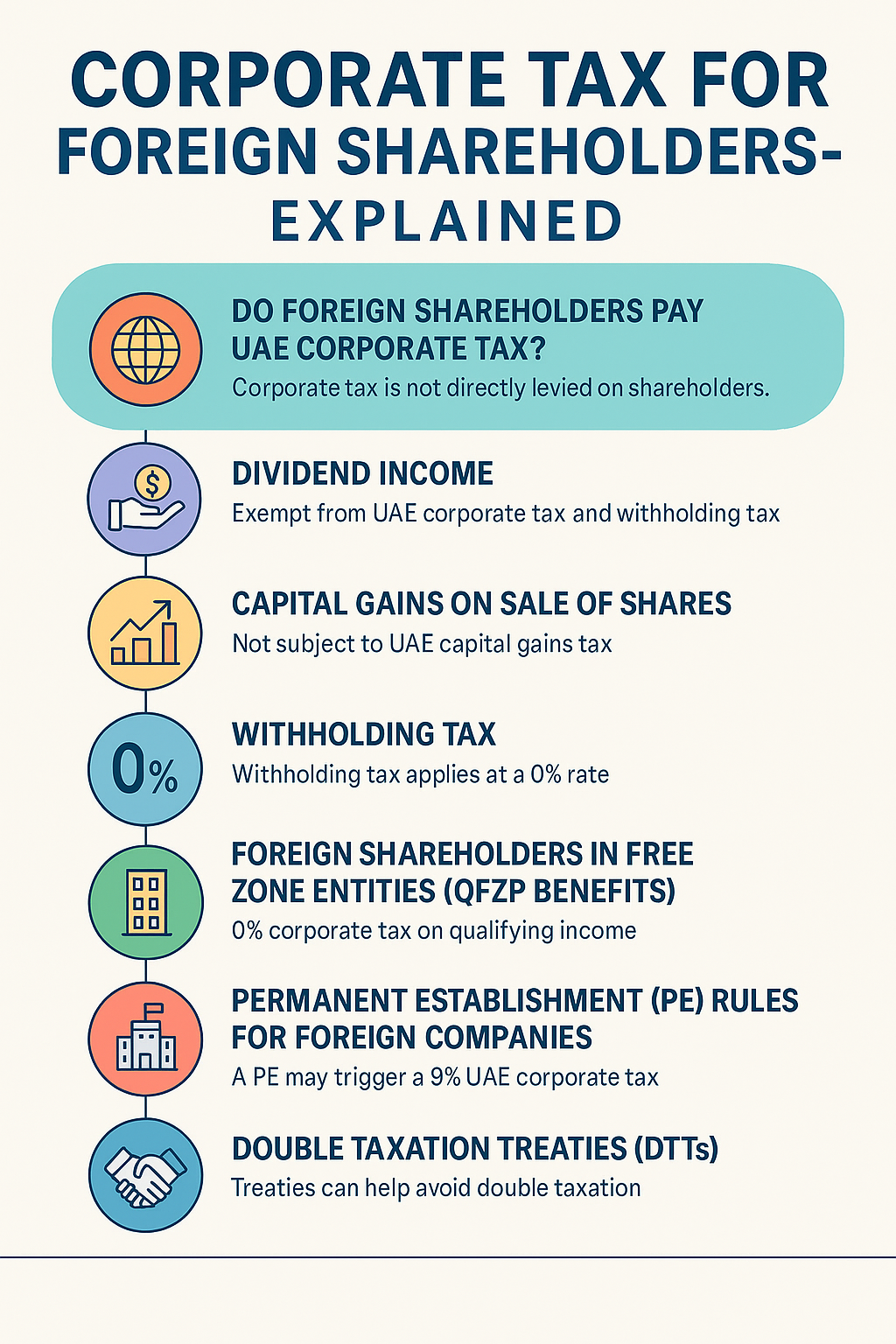
The UAE has long been an attractive destination for international investors. With the introduction of Corporate Tax (CT) effective June 2023, many foreign shareholders are seeking clarity on how the new regime affects them.
It explains in detail the tax treatment of foreign shareholders, covering profits, dividends, capital gains, and compliance requirements.
________________________________________
📌 1. Do Foreign Shareholders Pay UAE Corporate Tax?
The Corporate Tax is levied on the business profits of UAE entities, not on shareholders directly. This means:
• The company pays corporate tax on its taxable income.
• Shareholders, whether UAE nationals or foreigners, are not directly subject to corporate tax on dividends received from UAE companies.
________________________________________
📌 2. Dividend Income
• Exempt for Foreign Shareholders: Dividends distributed by a UAE company to foreign shareholders are not subject to withholding tax.
• Exempt for Local Companies: If a UAE company receives dividends from another UAE company, such income is also exempt from corporate tax.
• Impact: This ensures that foreign investors continue to enjoy tax-free repatriation of profits.
________________________________________
📌 3. Capital Gains on Sale of Shares
• Foreign investors selling shares in a UAE company are not subject to capital gains tax, provided the gains are not connected to a UAE Permanent Establishment (PE).
• Example: If a German shareholder sells 30% of shares in a Dubai Free Zone company, no UAE corporate tax applies to the gain (unless the investor has a taxable PE in UAE).
________________________________________
📌 4. Withholding Tax
The UAE CT Law specifically states:
• 0% withholding tax applies to dividends, interest, royalties, and other payments made to non-residents.
• This makes the UAE one of the most tax-efficient jurisdictions for profit repatriation.
________________________________________
📌 5. Foreign Shareholders in Free Zone Entities (QFZP Benefits)
Foreign shareholders who own companies in Free Zones may benefit from the Qualifying Free Zone Person (QFZP) regime:
• 0% tax on qualifying income (e.g., income from holding shares, dividends, capital gains, and qualifying intercompany transactions).
• 9% tax on non-qualifying income (e.g., mainland trading without conditions).
• Companies must maintain adequate substance and audited accounts to enjoy the regime.
________________________________________
📌 6. Permanent Establishment (PE) Rules for Foreign Companies
If a foreign company operates in the UAE through a branch, office, or dependent agent, it may create a Permanent Establishment (PE) in the UAE. In such cases:
• The PE’s profits will be subject to UAE Corporate Tax at 9%.
• However, if the foreign shareholder only holds passive shares in a UAE company (without a PE), no CT liability arises.
________________________________________
📌 7. Double Taxation Treaties (DTTs)
The UAE has over 140 Double Taxation Agreements (DTAs).
• These treaties ensure that foreign shareholders do not face double taxation in their home country and the UAE.
• Relief may be available in the home jurisdiction for taxes paid (if applicable).
________________________________________
📊 Practical Case Study
Scenario:
A French shareholder owns 40% of a UAE mainland trading company.
• The company earns AED 10 million in taxable profits.
• After applying the 0% and 9% thresholds, the company pays AED 862,500 in UAE corporate tax.
• The remaining AED 9.137 million is distributed as dividends to shareholders.
• The French shareholder receives AED 3.655 million (40% share).
Result:
• No withholding tax is deducted in the UAE.
• Dividend may be taxable in France, but UAE-France DTT provides for relief.
________________________________________
⚖️ Key Takeaways
• Corporate Tax applies at the company level, not at the shareholder level.
• Dividends and capital gains for foreign shareholders are exempt from UAE Corporate Tax and withholding tax.
• Foreign shareholders benefit significantly from QFZP status in Free Zones.
• PE rules and DTTs must be carefully reviewed to avoid unintended tax exposure.
________________________________________
🏢 About Us
At Sheikh Anwar Accounting & Auditing LLC (MOE Reg. Entry No. 5817 | LC4695-01), we assist multinational investors and foreign shareholders in:
• Structuring their UAE entities for maximum tax efficiency.
• Understanding Free Zone and QFZP benefits.
• Ensuring compliance with UAE Corporate Tax law and international tax treaties.
📩 Email: info@sa-auditors.com
🌐 Website: www.sa-auditors.com