Corporate Tax for Education Institutions
Introduction
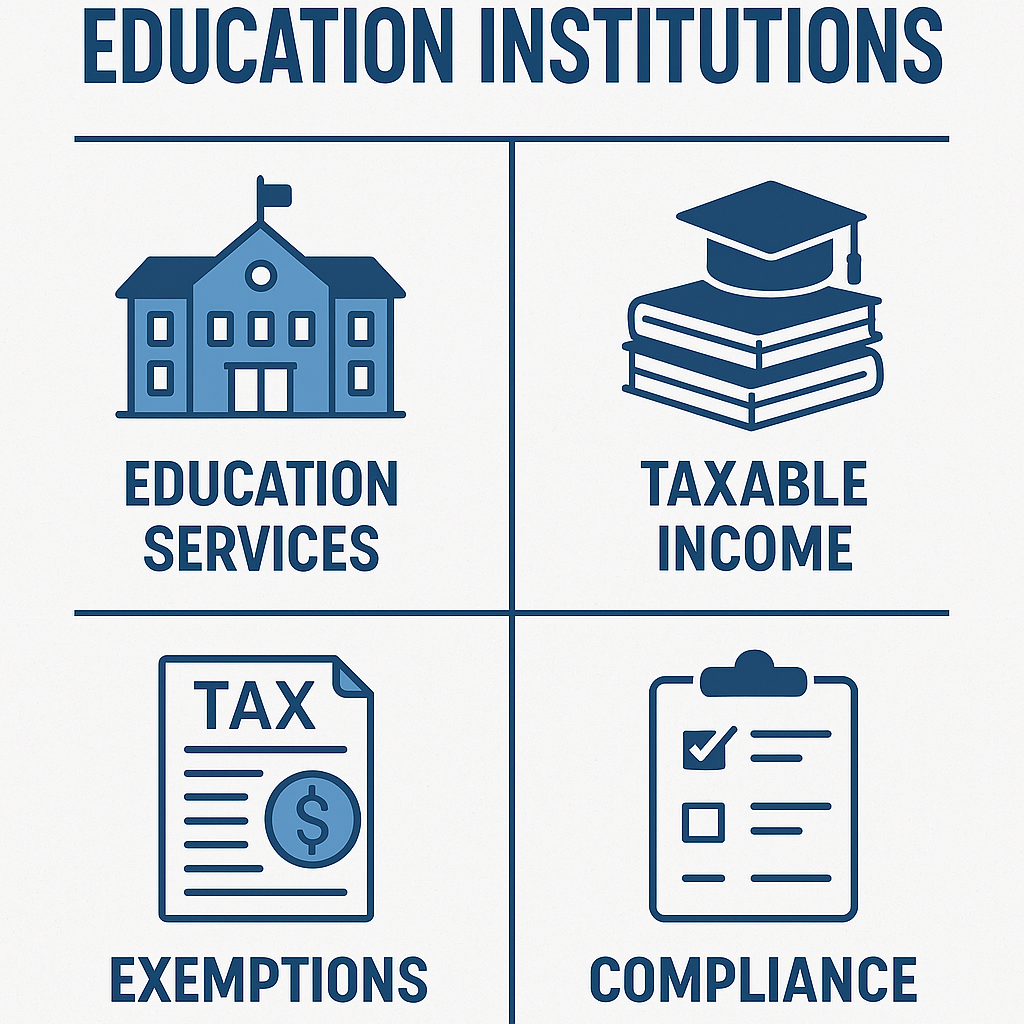
Education is one of the UAE’s most vital sectors, supporting economic growth and human development. Schools, universities, training institutes, and edtech platforms play a critical role in the country’s knowledge economy. With the implementation of the UAE Corporate Tax (Federal Decree-Law No. 47 of 2022), education providers must assess how taxation applies to their income, operations, and exemptions.
Although education is a socially beneficial service, the tax law recognizes it as a business activity if conducted for profit, making compliance and tax planning essential.
________________________________________
1. Applicability of Corporate Tax to Education Institutions
Corporate Tax applies to all institutions engaged in educational services, except where specific exemptions apply:
• Private Schools, Colleges & Universities – subject to Corporate Tax on net profits.
• Training & Professional Institutes – taxable on tuition fees, certification programs, and advisory services.
• EdTech Companies – taxable on software subscriptions, e-learning platforms, and online training services.
• Foreign-Owned Institutions – taxable if they operate a branch, subsidiary, or permanent establishment (PE) in the UAE.
• Government-Owned or Recognized Non-Profit Schools – may be exempt if approved as public benefit entities.
________________________________________
2. Corporate Tax Rates
• 0% on taxable income up to AED 375,000.
• 9% on taxable income above AED 375,000.
• Free Zone Education Providers: 0% on qualifying cross-border income (e.g., e-learning exports, Free Zone-to-Free Zone services), but mainland tuition fees taxed at 9%.
________________________________________
3. Taxable Income for Education Providers
Revenue streams considered taxable for educational institutions include:
• Tuition Fees (primary, secondary, higher education).
• Training & Certification Programs.
• Boarding & Hostel Services (if part of school operations).
• Cafeteria & Transportation Services.
• Textbook & Uniform Sales.
• EdTech Licensing & Online Courses.
• Research Grants & Sponsorships (if linked to business activities).
________________________________________
4. Deductible vs. Non-Deductible Expenses
Education providers incur significant operational and infrastructure costs.
• Deductible Expenses:
o Teacher and staff salaries.
o Rent, utilities, and maintenance of educational facilities.
o Classroom equipment, IT systems, and e-learning tools.
o Training, seminars, and faculty development costs.
o Depreciation of buildings and equipment.
o Marketing, advertising, and student recruitment.
• Non-Deductible Expenses:
o Regulatory fines.
o Non-educational personal expenses.
o Certain entertainment costs.
________________________________________
5. VAT Implications in Education
• Exempt: School tuition fees (for kindergarten to secondary, approved by UAE authorities).
• Zero-Rated: Exports of online educational services to non-UAE residents.
• Standard 5% VAT: University tuition (unless specifically exempt), training institutes, and non-essential services such as catering or transportation.
Educational institutions must ensure VAT and Corporate Tax filings align.
________________________________________
6. Free Zone Opportunities for Education Institutions
Educational entities established in Free Zones such as DIFC Academy, Dubai Knowledge Park, and Abu Dhabi Global Market (ADGM) benefit from:
• 0% Corporate Tax on qualifying cross-border services.
• Access to international collaborations and students.
• Lower operational costs and regulatory benefits.
• Condition: Must meet economic substance rules (local office, staff, and management presence in UAE).
________________________________________
7. Transfer Pricing in Education Groups
Large educational groups operating multiple schools, colleges, or training centers must comply with Transfer Pricing rules:
• Intercompany charges for shared services (HR, IT, administration).
• Licensing of educational brands or curricula.
• Loans and financing arrangements between group entities.
All related-party transactions must follow the arm’s length principle and may require TP documentation.
________________________________________
8. Compliance Requirements
• Corporate Tax Registration with the Federal Tax Authority (FTA).
• Annual Tax Return within 9 months of year-end.
• VAT Returns (quarterly/monthly depending on revenue).
• Audited Financial Statements required for medium and large institutions.
• Record-Keeping: Contracts, tuition invoices, and expense records must be maintained for at least 7 years.
________________________________________
9. Strategic Tax Planning for Education Institutions
• Apply for Exemption if eligible as a public benefit entity.
• Optimize Expense Deductions for salaries, IT systems, and facility costs.
• Leverage Free Zone Benefits for cross-border or online education services.
• Loss Relief: Carry forward operational losses to offset future taxable profits.
• ERP & EduTech Integration: Adopt systems that integrate accounting, student billing, VAT, and Corporate Tax compliance.
________________________________________
Conclusion
The UAE’s Corporate Tax regime has a direct impact on education institutions, from schools and universities to training centers and EdTech platforms. While exemptions exist for government-owned and public benefit entities, private education providers must ensure robust tax compliance, VAT reconciliation, and expense optimization.
With strategic planning and proper structuring, education providers can remain competitive, compliant, and aligned with the UAE’s long-term vision of becoming a global education hub.
________________________________________
✍️ By Sheikh Anwar Accounting and Auditing LLC (SA-Auditors)
📍 Dubai, United Arab Emirates
🌐 www.sa-auditors.com | ✉️ info@sa-auditors.com