Corporate Tax for E-Commerce Businesses
Introduction
The UAE has emerged as one of the fastest-growing e-commerce markets in the Middle East, with rising demand for online retail, digital marketplaces, and cross-border trade. With the introduction of UAE Corporate Tax (Federal Decree-Law No. 47 of 2022), e-commerce businesses — from online retailers to large global platforms — must understand their tax obligations, compliance requirements, and planning opportunities.
Unlike VAT, which is transaction-based, Corporate Tax is profit-based, making accurate financial reporting and strategic planning essential for digital businesses.
________________________________________
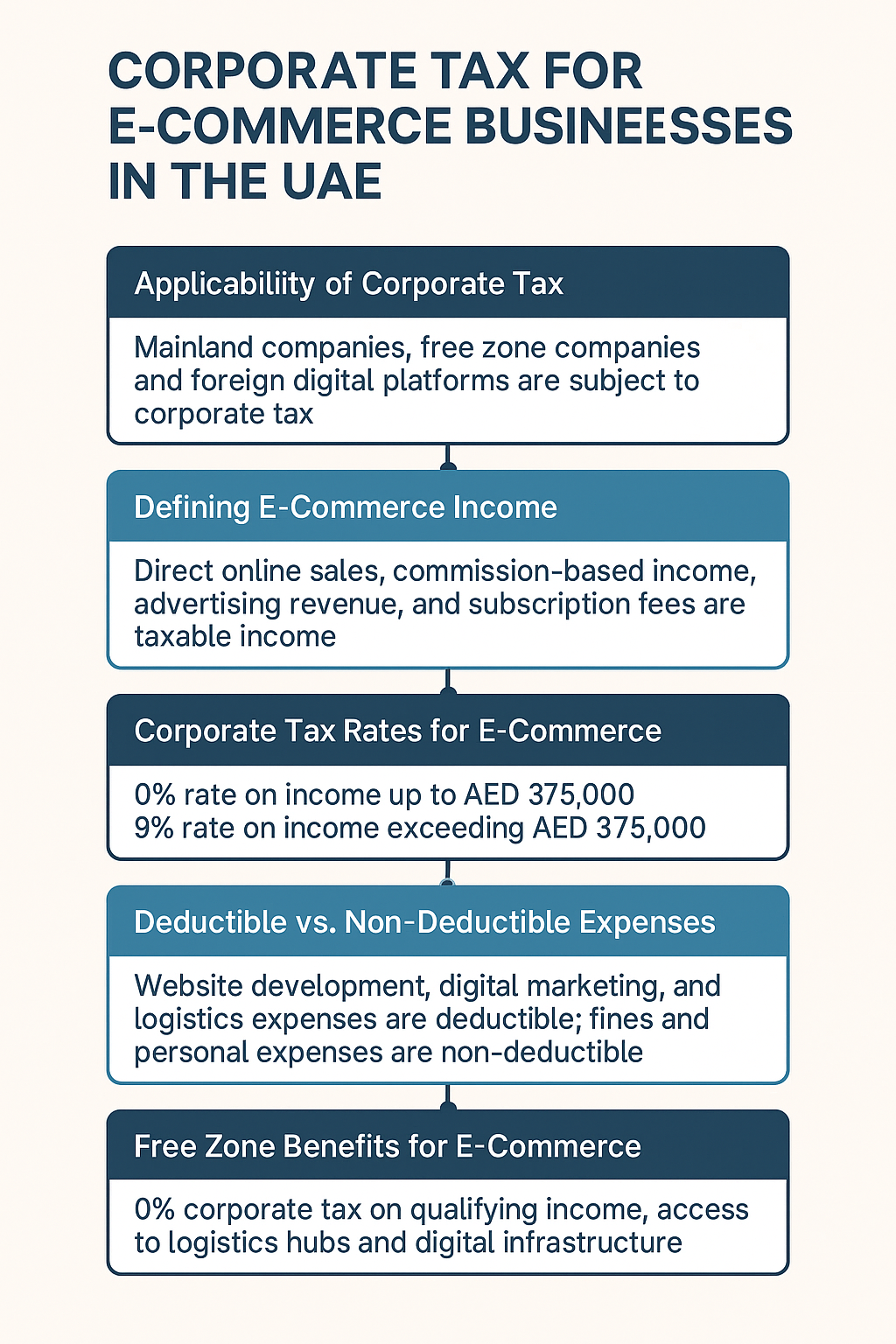
1. Applicability of Corporate Tax to E-Commerce
Corporate Tax applies to all businesses engaged in e-commerce activities, whether operating through:
• Mainland Companies – subject to 9% Corporate Tax on taxable income above AED 375,000.
• Free Zone Companies – may benefit from 0% Corporate Tax on qualifying income if substance requirements are met.
• Foreign Digital Platforms – subject to UAE Corporate Tax if they have a permanent establishment or nexus in the UAE (e.g., local servers, warehouses, or significant digital presence).
________________________________________
2. Defining E-Commerce Income
E-commerce businesses typically generate multiple types of income streams, including:
• Direct Online Sales of goods or services.
• Commission-Based Income from operating marketplaces.
• Advertising Revenue from online platforms.
• Subscription Fees for digital services or memberships.
• Logistics & Fulfillment Income if bundled into the digital offering.
All such income is considered taxable unless specifically exempt.
________________________________________
3. Corporate Tax Rates for E-Commerce
• 0% rate on taxable income up to AED 375,000.
• 9% rate on taxable income exceeding AED 375,000.
• Free Zone E-Commerce Companies may enjoy 0% CT on qualifying income (cross-border sales, transactions with other Free Zone Persons), but mainland sales typically attract 9%.
________________________________________
4. Deductible vs. Non-Deductible Expenses
E-commerce businesses incur significant digital, logistical, and marketing expenses. Tax treatment is as follows:
• Deductible Expenses:
o Website development and hosting costs.
o Digital marketing, advertising, and SEO costs.
o Payment gateway and platform fees.
o Staff salaries, rent, and logistics expenses.
o Depreciation of IT infrastructure.
• Non-Deductible Expenses:
o Fines, penalties, and donations not meeting tax criteria.
o Personal expenses recorded in business accounts.
________________________________________
5. Free Zone Benefits for E-Commerce
Free Zones such as Dubai CommerCity, DIFC, ADGM, and DMCC attract e-commerce businesses by offering:
• 0% Corporate Tax on qualifying cross-border transactions.
• Access to logistics hubs and digital infrastructure.
• Exemption on customs duties for re-exports.
To maintain Qualifying Free Zone Person (QFZP) status:
• The business must have adequate economic substance in the UAE.
• Transactions with mainland customers are either excluded or subject to 9% CT.
________________________________________
6. Transfer Pricing and Digital Businesses
Many e-commerce businesses operate through group structures (parent companies abroad with UAE subsidiaries).
• Transfer Pricing (TP) rules apply to related-party transactions such as:
o Intercompany licensing of software.
o Shared IT and marketing costs.
o Royalty payments and IP usage fees.
• TP compliance requires Local File, Master File, and Benchmarking documentation.
________________________________________
7. Digital Presence and Permanent Establishment (PE) Risk
Foreign e-commerce companies may be taxed in the UAE if they have:
• Servers or Warehouses in the UAE.
• Significant Customer Base or Digital Nexus in the UAE.
• Dependent Agents operating in the UAE on their behalf.
This concept ensures that digital businesses without a physical store but with significant UAE activity are brought into the tax net.
________________________________________
8. Compliance and Record-Keeping Requirements
E-commerce businesses must maintain:
• Audited financial statements prepared under IFRS/IFRS for SMEs.
• Complete records of sales, commissions, and advertising income.
• Contracts with third-party logistics and payment providers.
• Documentation for all cross-border digital service transactions.
Records must be retained for 7 years for Corporate Tax audit purposes.
________________________________________
9. Strategic Tax Planning for E-Commerce
• Free Zone Structuring: Optimize use of Free Zones for cross-border sales.
• IP Holding Companies: Locate intellectual property in favorable jurisdictions to minimize royalty tax leakage.
• Cost Allocation: Correctly allocate global marketing and IT costs for TP compliance.
• Loss Relief: Utilize carried-forward losses to offset future taxable profits.
• ERP Integration: Implement accounting systems that seamlessly track both VAT and Corporate Tax.
________________________________________
Conclusion
The UAE’s Corporate Tax regime significantly impacts the e-commerce industry, requiring businesses to align financial reporting, digital operations, and cross-border structures with the new tax rules. While Free Zones offer attractive benefits, compliance with economic substance, transfer pricing, and record-keeping obligations is essential.
With proactive planning and robust compliance, e-commerce businesses can remain competitive while meeting their obligations under the UAE Corporate Tax framework.
________________________________________
✍️ By Sheikh Anwar Accounting and Auditing LLC (SA-Auditors)
📍 Dubai, United Arab Emirates
🌐 www.sa-auditors.com | ✉️ info@sa-auditors.com