Corporate Tax for Cryptocurrency Businesses
Introduction
The UAE has positioned itself as a global hub for blockchain and cryptocurrency businesses, with regulatory frameworks in Free Zones such as ADGM (Abu Dhabi Global Market) and VARA (Dubai Virtual Assets Regulatory Authority). From exchanges and trading platforms to mining operations and crypto funds, the sector is rapidly expanding.
With the introduction of the UAE Corporate Tax (Federal Decree-Law No. 47 of 2022), cryptocurrency businesses must carefully assess how their activities fall under the scope of taxation, given the unique challenges of digital assets, valuation, and cross-border transactions.
________________________________________
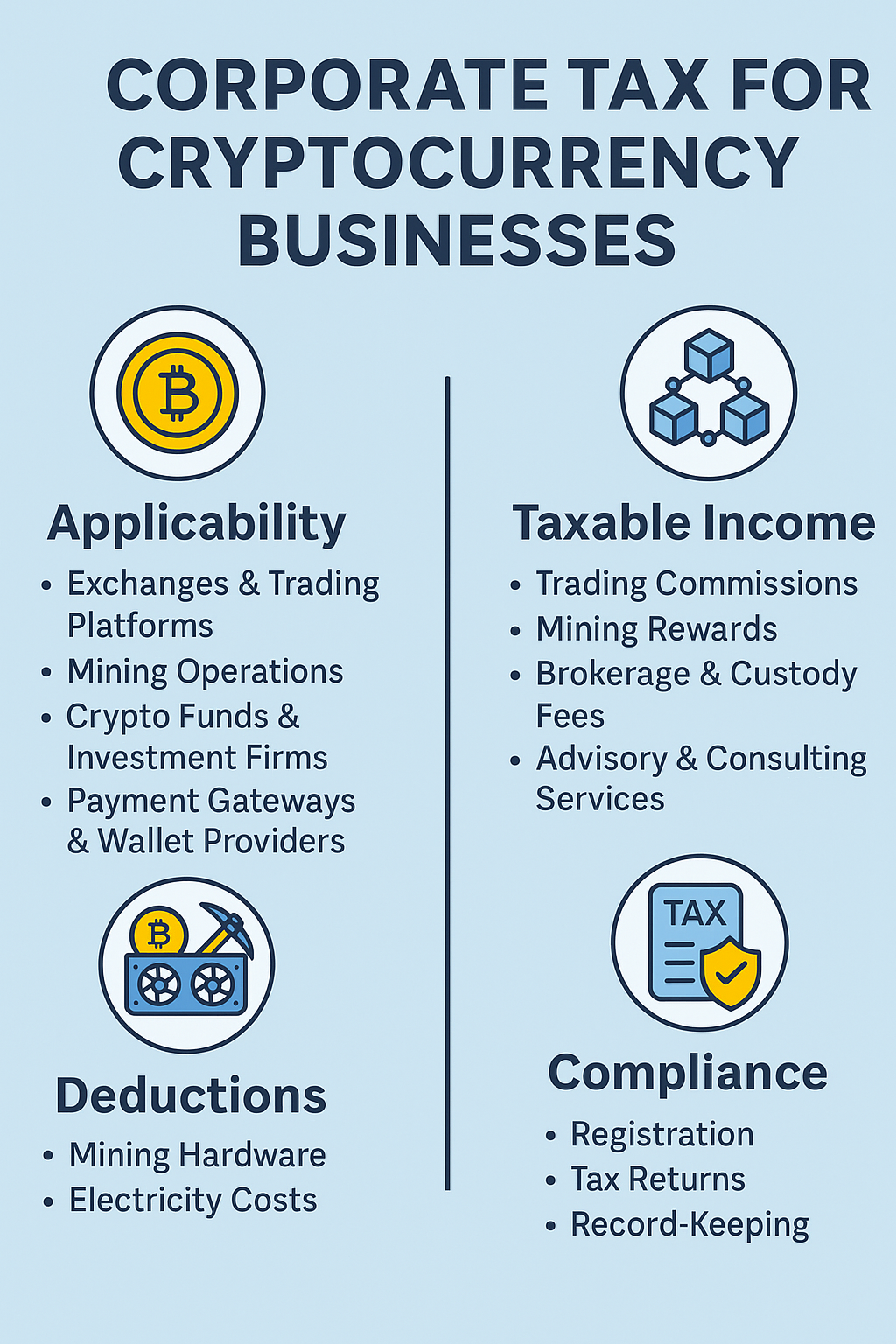
1. Applicability of Corporate Tax to Crypto Businesses
Corporate Tax applies to all entities carrying on business in the UAE, including crypto-related activities:
• Exchanges & Trading Platforms – subject to tax on trading commissions, spreads, and service income.
• Mining Operations – taxable on mining rewards if conducted as a business activity.
• Crypto Funds & Investment Firms – taxable on management/advisory fees, and possibly on realized gains.
• Payment Gateways & Wallet Providers – taxable on transaction processing fees.
• Foreign Crypto Businesses – taxable if they have a permanent establishment (PE) in the UAE (e.g., office, data center, or dependent agent).
________________________________________
2. Corporate Tax Rates
• 0% on taxable income up to AED 375,000.
• 9% on taxable income above AED 375,000.
• Free Zone Crypto Firms: Entities operating under ADGM, DIFC, or Dubai VARA-approved zones may benefit from 0% Corporate Tax on qualifying income, but mainland transactions attract 9%.
________________________________________
3. Taxable Income for Cryptocurrency Businesses
Crypto firms generate revenue from various sources:
• Trading Commissions & Transaction Fees.
• Mining Rewards & Staking Income.
• Brokerage & Custody Fees.
• Advisory & Consulting Services for crypto investments.
• NFT Sales or Licensing Income (if part of commercial activity).
• Cross-Border Services (depending on source and nexus rules).
________________________________________
4. Deductible vs. Non-Deductible Expenses
Crypto businesses often face high technology and compliance costs.
• Deductible Expenses:
o Salaries of developers, traders, and compliance officers.
o Rent, IT infrastructure, and data centers.
o Mining hardware depreciation and electricity costs.
o Blockchain licensing and regulatory fees.
o Marketing and customer acquisition costs.
o Professional services (audit, tax, legal).
• Non-Deductible Expenses:
o Penalties from regulatory breaches.
o Personal crypto investment losses not linked to business.
o Non-business-related entertainment.
________________________________________
5. VAT Implications for Crypto Businesses
VAT treatment of crypto transactions is still evolving globally, but in the UAE:
• Standard 5% VAT: Applies on service fees (commissions, advisory, wallet services).
• Zero-Rated: Cross-border crypto services may be eligible.
• Exempt: Pure crypto-to-crypto exchanges may fall outside VAT scope depending on classification by FTA.
Agencies must ensure proper VAT reporting alongside Corporate Tax filings.
________________________________________
6. Free Zone Benefits for Crypto Firms
The UAE has introduced special regulatory environments for digital assets:
• ADGM & DIFC: Regulated frameworks for crypto exchanges, custody, and funds.
• VARA (Dubai Virtual Assets Regulatory Authority): Oversees crypto licensing and compliance in Dubai.
• Benefits:
o 0% Corporate Tax on qualifying Free Zone transactions.
o Access to global crypto investors.
o Regulatory clarity for blockchain projects.
• Firms must satisfy economic substance requirements to enjoy Free Zone benefits.
________________________________________
7. Transfer Pricing in Global Crypto Groups
Crypto groups often involve multiple entities across jurisdictions.
• Transfer Pricing (TP) rules apply to:
o Intercompany licensing of blockchain IP.
o Shared data centers and IT infrastructure.
o Management and advisory fees between group entities.
• Documentation (Local File, Master File, Benchmarking) required where thresholds apply.
________________________________________
8. Compliance Requirements
• Corporate Tax Registration with the Federal Tax Authority (FTA).
• Annual Tax Returns within 9 months of year-end.
• Audited Financial Statements for medium and large crypto firms.
• Record-Keeping: Maintain transaction logs, smart contract records, and crypto wallets for 7 years.
________________________________________
9. Strategic Tax Planning for Crypto Firms
• Free Zone Structuring: Locate exchanges and funds in ADGM/DIFC to benefit from regulatory clarity and 0% tax on qualifying income.
• Optimize Deductible Costs: Claim depreciation on mining rigs and IT systems.
• Valuation Policies: Adopt IFRS-compliant methods for crypto assets.
• Loss Relief: Carry forward trading or mining losses to offset future profits.
• Tech & ERP Adoption: Use blockchain-integrated ERP for compliance reporting.
________________________________________
Conclusion
The UAE’s Corporate Tax framework is designed to include digital asset businesses within its scope, while offering competitive rates and Free Zone opportunities. For cryptocurrency firms, compliance requires robust reporting, valuation discipline, and alignment with VAT and Transfer Pricing rules.
By structuring operations strategically, leveraging Free Zone benefits, and maintaining strong compliance systems, cryptocurrency businesses can thrive in the UAE’s rapidly growing digital economy.
________________________________________
✍️ By Sheikh Anwar Accounting and Auditing LLC (SA-Auditors)
📍 Dubai, United Arab Emirates
🌐 www.sa-auditors.com | ✉️ info@sa-auditors.com