Corporate Tax for Beauty & Salon Services
Introduction
The beauty and personal care industry in the UAE is rapidly expanding, with salons, spas, and wellness centers catering to residents and tourists. With the introduction of the UAE Corporate Tax (Federal Decree-Law No. 47 of 2022), salon and beauty service providers must now evaluate how their operations are affected.
Since many beauty businesses operate on service-based models with daily cash transactions, proper tax planning and compliance are essential to ensure smooth operations and profitability.
1. Applicability of Corporate Tax to Beauty & Salon Services
Corporate Tax applies to all entities engaged in salon and beauty services:
Mainland Salons & Spas: Fully subject to Corporate Tax on their net profits.
Free Zone Businesses: Eligible for 0% Corporate Tax on qualifying cross-border income, but services to mainland clients are subject to 9% Corporate Tax.
Franchise Chains: Income from royalties and brand licensing is taxable.
Foreign-Owned Salons: Taxable if they operate through a branch or permanent establishment (PE) in the UAE.
2. Corporate Tax Rates
0% on taxable income up to AED 375,000.
9% on taxable income above AED 375,000.
Free Zone businesses: 0% on qualifying Free Zone transactions, 9% on mainland services.
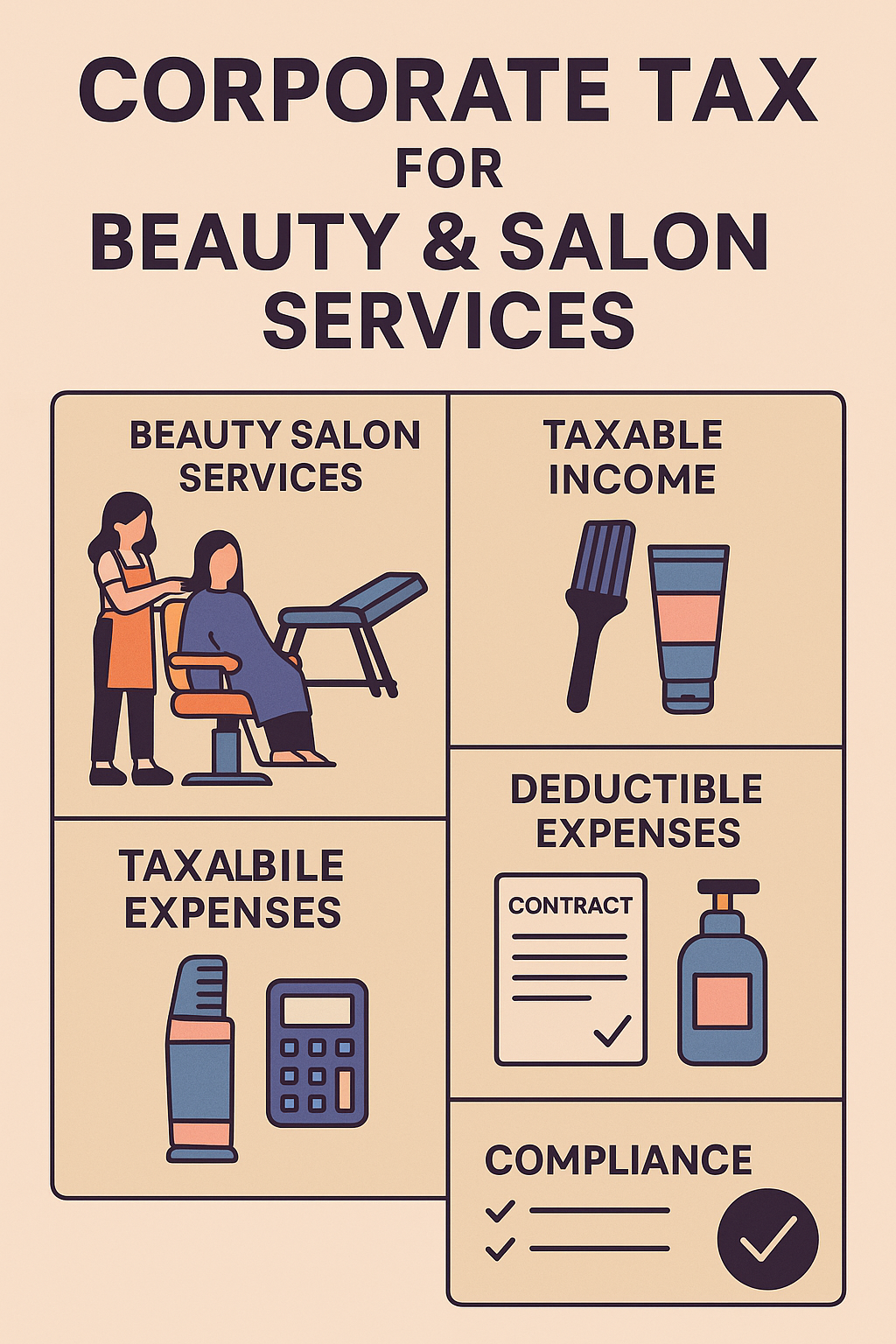
3. Taxable Income for Beauty & Salon Businesses
Income sources for beauty and salon service providers include:
Hair & Beauty Services (haircuts, coloring, styling, facials, treatments).
Spa & Wellness Services (massage, therapy, skincare).
Retail Sales of beauty and skincare products.
Franchise & Royalty Income (for chain salons).
Training & Workshops on beauty techniques.
4. Deductible vs. Non-Deductible Expenses
Salon businesses incur daily operational costs, which must be managed carefully.
Deductible Expenses:
Staff salaries and commissions.
Rent, utilities, and salon maintenance.
Purchase of cosmetics, skincare, and salon equipment.
Training and certification programs.
Marketing, advertising, and influencer collaborations.
Depreciation of salon furniture and tools.
Non-Deductible Expenses:
Fines for regulatory violations.
Personal or non-business-related expenses.
Certain excessive entertainment costs.
5. VAT Implications for Salons
Standard 5% VAT: Applies on beauty and salon services, spa treatments, and retail product sales.
Zero-Rated/Exempt: Not typically applicable, except for cross-border consultancy/training services.
Salons must maintain accurate VAT and Corporate Tax reconciliation for compliance.
6. Free Zone Opportunities for Salon & Beauty Businesses
Some beauty businesses may be structured within Free Zones (e.g., DIFC, RAKEZ, Dubai South).
0% Corporate Tax on qualifying cross-border income.
9% Tax on mainland salon operations.
Benefits include lower operational costs, simplified licensing, and access to international partnerships.
Condition: Must meet economic substance requirements such as having a local office, staff, and management in the UAE.
7. Transfer Pricing for Franchise Beauty Chains
Large beauty groups and franchise chains often involve related-party transactions:
Royalties for brand/franchise usage.
Management service fees.
Shared procurement of salon products and cosmetics.
These transactions must comply with Transfer Pricing (TP) rules under the UAE Corporate Tax regime.
8. Compliance Requirements
Corporate Tax Registration with the Federal Tax Authority (FTA).
Annual Corporate Tax Return within 9 months of the financial year-end.
VAT Filings (monthly or quarterly).
Audited Financial Statements required for medium and large salon groups.
Record-Keeping: Invoices, sales logs, supplier contracts, and receipts must be retained for 7 years.
9. Strategic Tax Planning for Beauty & Salon Firms
Expense Optimization: Properly claim staff commissions, marketing, and product purchases as deductible expenses.
Leverage Free Zones: For brand management, training centers, or cross-border product sales.
Loss Relief: Carry forward business losses to offset future profits.
ERP & POS Systems: Adopt salon ERP/POS systems that integrate VAT and Corporate Tax compliance.
Franchise Structuring: Ensure brand royalty arrangements comply with Transfer Pricing standards.
Conclusion
The UAE Corporate Tax regime directly impacts beauty and salon service providers, making compliance and financial planning essential. With multiple revenue streams — from services to retail and franchises — the sector must adopt robust accounting practices, VAT reconciliation, and expense management.
By leveraging Free Zone incentives, optimizing expense deductions, and maintaining proper compliance systems, beauty and salon businesses can remain profitable and competitive in the UAE’s growing personal care market.
✍️ By Sheikh Anwar Accounting and Auditing LLC (SA-Auditors)
📍 Dubai, United Arab Emirates
🌐 www.sa-auditors.com
| ✉️ info@sa-auditors.com