Corporate Tax for Auto Dealerships
Introduction
The UAE is one of the world’s leading financial hubs, with banks, insurance companies, investment firms, and fintech players serving both domestic and international markets. With the introduction of the UAE Corporate Tax (Federal Decree-Law No. 47 of 2022), financial institutions face a major shift in regulatory compliance and profitability planning.
Unlike other sectors, financial institutions handle regulated activities, large-scale capital flows, and complex cross-border transactions, making Corporate Tax compliance especially important.
________________________________________
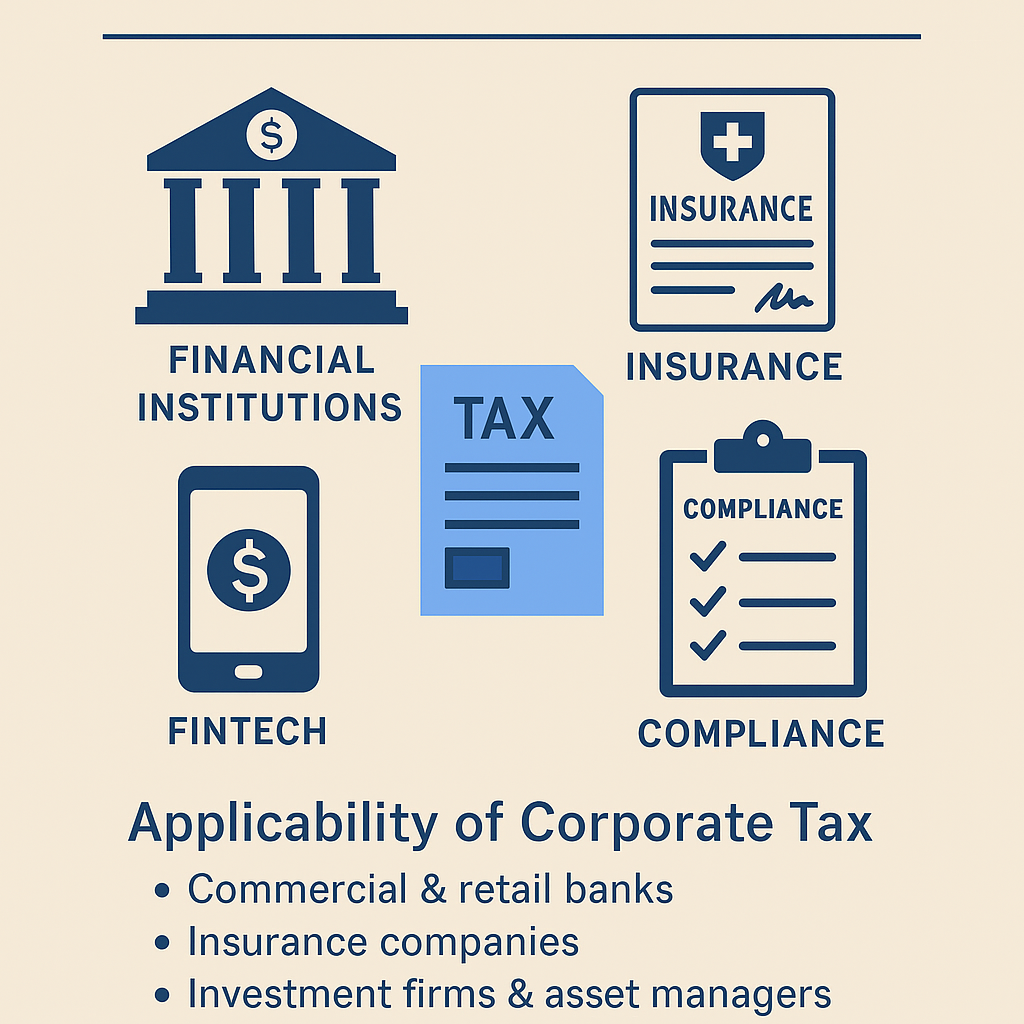
1. Applicability of Corporate Tax in the Financial Sector
Corporate Tax applies broadly to financial service providers, including:
• Commercial & Retail Banks – fully taxable on interest, lending, and service fees.
• Insurance Companies – premiums and investment income are taxable.
• Investment Firms & Asset Managers – taxable on management fees, advisory income, and trading profits.
• Fintech Companies – taxable on digital payment services, lending platforms, and other financial technology services.
• Foreign Financial Institutions – taxable if they operate through a branch, office, or permanent establishment in the UAE.
________________________________________
2. Corporate Tax Rates for Financial Institutions
• 0% on taxable income up to AED 375,000.
• 9% on taxable income above AED 375,000.
• Free Zone Financial Entities: Firms in DIFC or ADGM may qualify for 0% Corporate Tax on qualifying income, but regulated financial activities provided to mainland UAE customers are subject to 9%.
________________________________________
3. Taxable Income for Financial Institutions
Financial institutions earn from multiple sources, all of which are generally taxable:
• Interest Income from loans and deposits.
• Trading & Investment Gains.
• Management & Advisory Fees.
• Insurance Premiums (life, general, health, reinsurance).
• Wealth & Asset Management Income.
• Cross-Border Financial Services (depending on nexus and source rules).
________________________________________
4. Deductible vs. Non-Deductible Expenses
Financial firms incur high operational and compliance costs.
• Deductible Expenses:
o Staff salaries and bonuses.
o Office rent, IT systems, and software subscriptions.
o Regulatory compliance costs.
o Interest expense (subject to thin capitalization and interest limitation rules).
o Depreciation of IT and office infrastructure.
o Professional services and advisory fees.
• Non-Deductible Expenses:
o Fines and regulatory penalties.
o Certain entertainment expenses beyond allowable thresholds.
o Non-business-related costs.
________________________________________
5. VAT Considerations for Financial Institutions
• Exempt Services: Many core financial services (e.g., lending, deposit-taking, life insurance).
• Standard 5% VAT: Applies to explicit fee-based services (e.g., advisory, account management).
• Zero-Rated: Cross-border services may qualify.
• VAT and Corporate Tax compliance must be carefully aligned for consistency.
________________________________________
6. Free Zone Opportunities – DIFC & ADGM
Dubai International Financial Centre (DIFC) and Abu Dhabi Global Market (ADGM) are global financial centers offering:
• 0% Corporate Tax on qualifying Free Zone income.
• Independent regulatory frameworks for financial services.
• Access to global investors and fintech ecosystems.
• Restrictions: Regulated financial services provided to mainland clients are subject to 9%.
________________________________________
7. Transfer Pricing in Financial Institutions
Financial institutions often operate within international groups.
• Transfer Pricing rules apply to:
o Intercompany loans and financing arrangements.
o Shared services such as IT, compliance, and advisory.
o Royalties for use of proprietary systems and software.
• Must follow the arm’s length principle and maintain Local File, Master File, and Benchmarking reports where thresholds apply.
________________________________________
8. Compliance Requirements
• Corporate Tax Registration with the Federal Tax Authority (FTA).
• Annual Tax Returns submitted within 9 months of financial year-end.
• Audited Financial Statements mandatory for financial institutions.
• Record-Keeping: Contracts, loan agreements, insurance policies, and client records must be retained for at least 7 years.
________________________________________
9. Strategic Tax Planning for Financial Institutions
• Optimize Deductible Costs: Record regulatory, compliance, and IT expenses properly.
• Leverage Free Zones: Use DIFC or ADGM for global operations while maintaining compliance for mainland income.
• Capital Structuring: Manage interest deduction limits for financing activities.
• Loss Relief: Carry forward losses to offset future profits.
• ERP & RegTech Solutions: Use compliance-driven software to integrate accounting, VAT, and Corporate Tax.
________________________________________
Conclusion
The UAE’s Corporate Tax regime brings significant implications for banks, insurers, fintechs, and investment firms. While the 9% rate remains competitive, financial institutions must address complex income streams, regulatory reporting, and Transfer Pricing challenges.
By adopting robust compliance practices, leveraging Free Zone benefits, and optimizing expense structures, financial institutions can remain competitive while aligning with the UAE’s evolving tax framework.
________________________________________
✍️ By Sheikh Anwar Accounting and Auditing LLC (SA-Auditors)
📍 Dubai, United Arab Emirates
🌐 www.sa-auditors.com | ✉️ info@sa-auditors.com