Corporate Tax for Accounting & Auditing Firms
Introduction
Accounting and auditing firms are the backbone of business transparency, compliance, and financial integrity in the UAE. With the introduction of Corporate Tax (Federal Decree-Law No. 47 of 2022), firms that provide auditing, assurance, bookkeeping, and consultancy services must carefully assess how the new tax regime impacts their operations.
As service providers who also guide clients on compliance, accounting and auditing firms must themselves act as role models of tax readiness and governance.
________________________________________
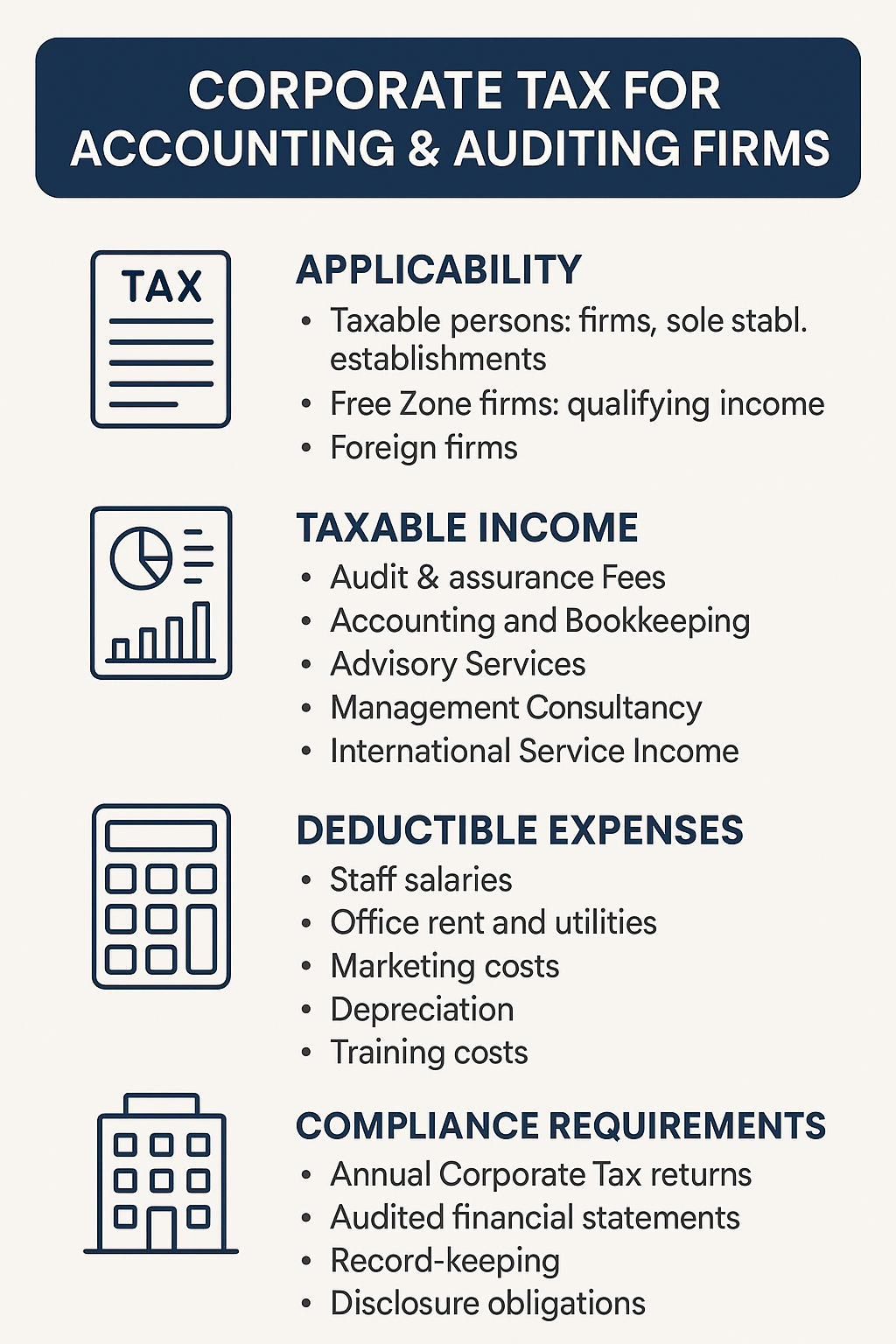
1. Applicability of Corporate Tax to Accounting & Auditing Firms
• Taxable Persons:
o Firms registered as LLCs, private companies, or partnerships with legal personality are subject to Corporate Tax.
o Sole practitioners (sole establishments) are taxed on business income if classified as a business activity.
• Foreign Firms: Branches of international networks in the UAE are taxable on UAE-sourced income.
• Free Zone Firms: Entities in Free Zones (e.g., DIFC, DMCC, ADGM) may benefit from 0% Corporate Tax on qualifying income, provided they meet substance requirements. Mainland service income is subject to 9%.
________________________________________
2. Corporate Tax Rates for Accounting & Auditing Firms
• 0% on taxable income up to AED 375,000.
• 9% on taxable income above AED 375,000.
• Free Zone firms may enjoy 0% tax on qualifying income (cross-border and Free Zone-to-Free Zone services).
________________________________________
3. Taxable Income for Accounting & Auditing Firms
Income subject to Corporate Tax includes:
• Audit & Assurance Fees from statutory audits, reviews, and agreed-upon procedures.
• Accounting & Bookkeeping Services fees.
• Advisory Services including VAT, Corporate Tax, and AML compliance advisory.
• Management Consultancy Fees earned from business support services.
• Training & Certification Income if provided as a business service.
• International Service Income if linked to UAE permanent establishment or nexus.
________________________________________
4. Deductible and Non-Deductible Expenses
Accounting firms incur significant operational costs. The Corporate Tax law distinguishes:
• Deductible Expenses:
o Staff salaries, partner remuneration (subject to policy).
o Office rent, utilities, and professional subscriptions.
o Marketing and client development costs.
o Depreciation of office equipment and IT systems.
o Training and continuing professional development costs.
• Non-Deductible Expenses:
o Fines, penalties, and violations imposed by regulators.
o Personal expenses charged to business.
o Certain entertainment expenses beyond thresholds.
________________________________________
5. Free Zone Considerations for Accounting Firms
Free Zones like DIFC, ADGM, DMCC, and RAKEZ are popular for professional firms due to their client base and infrastructure.
• Firms classified as Qualifying Free Zone Persons (QFZP) may enjoy 0% tax on qualifying income.
• Income from mainland clients is taxable at 9%.
• Firms must demonstrate economic substance: active staff, proper office, and management presence in the UAE.
________________________________________
6. Transfer Pricing and International Networks
Many auditing and consulting firms are part of global networks.
• Transfer Pricing (TP) applies to intercompany recharges, management fees, and shared service arrangements.
• Firms must ensure compliance with the arm’s length principle.
• Documentation may include Local File, Master File, and Benchmarking studies (depending on thresholds).
________________________________________
7. Compliance Requirements for Accounting & Auditing Firms
• Annual Corporate Tax Returns: To be filed within 9 months of financial year-end.
• Audited Financial Statements: Required for most firms.
• Record-Keeping: Maintain accounting records, contracts, and client invoices for at least 7 years.
• Disclosure Obligations: Related-party transactions and exempt income must be clearly reported.
________________________________________
8. Strategic Tax Planning for Accounting & Auditing Firms
• Optimize Expense Management: Ensure all deductible costs are recorded accurately.
• Leverage Free Zone Incentives: Structure cross-border service income to remain within qualifying income.
• Partner Remuneration Planning: Clearly define partner draws and profit allocations for tax clarity.
• Loss Relief: Carry forward tax losses to offset against future profits.
• Technology Integration: Implement ERP and tax software to align VAT, Corporate Tax, and IFRS reporting.
________________________________________
Conclusion
Corporate Tax in the UAE introduces a new compliance layer for accounting and auditing firms. While the 9% rate is competitive, firms must maintain strict governance, accurate financial reporting, and efficient tax planning to remain compliant.
By embracing early preparation, Free Zone opportunities, and Transfer Pricing compliance, accounting and auditing firms can lead by example — demonstrating the highest standards of financial discipline while guiding their clients through the Corporate Tax regime.
________________________________________
✍️ By Sheikh Anwar Accounting and Auditing LLC (SA-Auditors)
📍 Dubai, United Arab Emirates
🌐 www.sa-auditors.com | ✉️ info@sa-auditors.com