Construction Industry and VAT Challenges
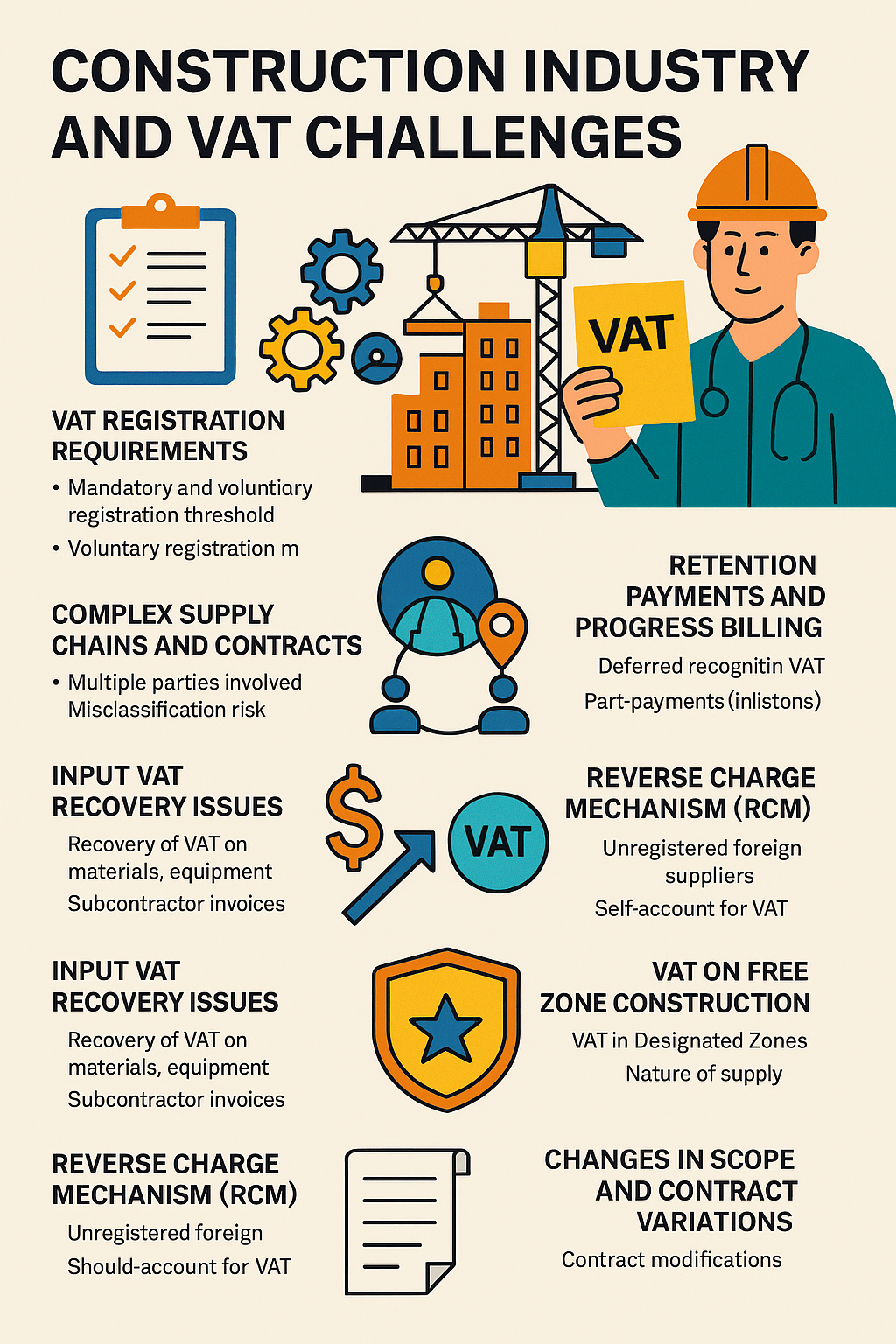
Introduction
The UAE construction industry plays a crucial role in the nation's economic development, contributing significantly to GDP and infrastructure growth. However, when it comes to Value Added Tax (VAT) compliance, the construction sector faces unique challenges due to the complex nature of its contracts, supply chains, and payment structures.
Here we explores the major VAT challenges construction businesses face and how to address them effectively.
________________________________________
1. VAT Registration Requirements
Construction companies involved in supplying goods or services in the UAE must register for VAT if:
• Annual taxable turnover exceeds AED 375,000 (mandatory threshold)
• Voluntary registration is allowed if turnover exceeds AED 187,500
Registration applies to:
• Main contractors
• Subcontractors
• Engineering and consultancy firms
• Real estate developers
________________________________________
2. Complex Supply Chains and Contracts
Construction projects often involve multiple parties—developers, main contractors, subcontractors, consultants, and suppliers.
VAT Implications:
• Each party is responsible for their own VAT compliance
• Supplies between parties are typically standard-rated at 5%
• Misclassification of contract types or services can lead to incorrect VAT treatment
________________________________________
3. Determining the Place of Supply
The place of supply determines VAT applicability. In construction:
• Supply of services related to real estate is taxed where the property is located
• Goods delivered to the site are taxed based on location
If the property is in the UAE, VAT is applicable at 5%, even for services provided by foreign suppliers.
________________________________________
4. Retention Payments and Progress Billing
Construction contracts often include:
• Retention amounts (held until completion)
• Milestone-based billing (progress payments)
VAT Challenges:
• VAT must be accounted for at the earlier of invoice or payment receipt
• Retention VAT must be reported even if payment is deferred
• Discrepancies in recognizing VAT on part-payments can trigger FTA scrutiny
________________________________________
5. Input VAT Recovery Issues
Construction companies incur significant input VAT on:
• Building materials
• Machinery and equipment
• Subcontractor invoices
• Consultancy fees
Challenges:
• Ensuring invoices are valid and meet FTA requirements
• Allocating input VAT accurately to taxable and exempt projects
• Delays in project completion may defer input VAT recovery
________________________________________
6. Reverse Charge Mechanism (RCM)
If a UAE construction company receives services from a foreign supplier (e.g., architectural design or consultancy):
• The recipient must apply Reverse Charge Mechanism
• VAT is self-accounted and paid by the UAE company
Common errors include:
• Not recognizing the reverse charge obligation
• Failing to report it in VAT returns (Box 3 and 10)
________________________________________
7. VAT on Free Zone Construction
Construction activities in Designated Zones (DZs) have unique rules:
• Supplies of goods within DZs may be out of scope
• However, services are still taxable at 5%
• Construction companies must analyze the nature of supply and location before applying VAT
________________________________________
8. Changes in Scope and Contract Variations
Projects may involve:
• Change orders
• Variations in pricing
• Delays and penalties
All changes must be reflected in VAT calculations and invoicing. If VAT is not re-evaluated with the revised contract terms, it may result in underpayment or overstatement.
________________________________________
9. Common VAT Mistakes in Construction Industry
Mistake Risk
Charging VAT on zero-rated supplies Penalties & client disputes
Failing to issue VAT-compliant invoices Fines from FTA
Delayed VAT on retention invoices Late payment penalties
Not reconciling subcontractor invoices Input VAT loss
Ignoring reverse charge compliance Underreporting VAT
________________________________________
10. Best Practices for VAT Compliance in Construction
✅ Classify each supply correctly (goods/services, local/export, standard/zero-rated)
✅ Maintain VAT-compliant contracts and milestone-based invoicing
✅ Regularly reconcile input and output VAT
✅ Review subcontractor VAT filings
✅ Ensure proper documentation for exports, imports, and designated zone activities
________________________________________
📌 Conclusion
The construction sector’s multi-layered operations, complex billing systems, and long project timelines make VAT compliance challenging but critical. Failure to address VAT risks can result in penalties, lost input VAT, and strained client relationships.
________________________________________
💼 Need VAT Support for Your Construction Projects?
At Sheikh Anwar Accounting and Auditing LLC, we help construction firms:
• Register for VAT
• Design compliant billing systems
• Manage VAT on retention and subcontractor payments
• Handle FTA audits and disputes
📞 Contact us today for tailored VAT advisory for the construction sector.
📧 info@sa-auditors.com
🌐 www.sa-auditors.com