Compliance Cost vs. Tax Risk Management
Introduction
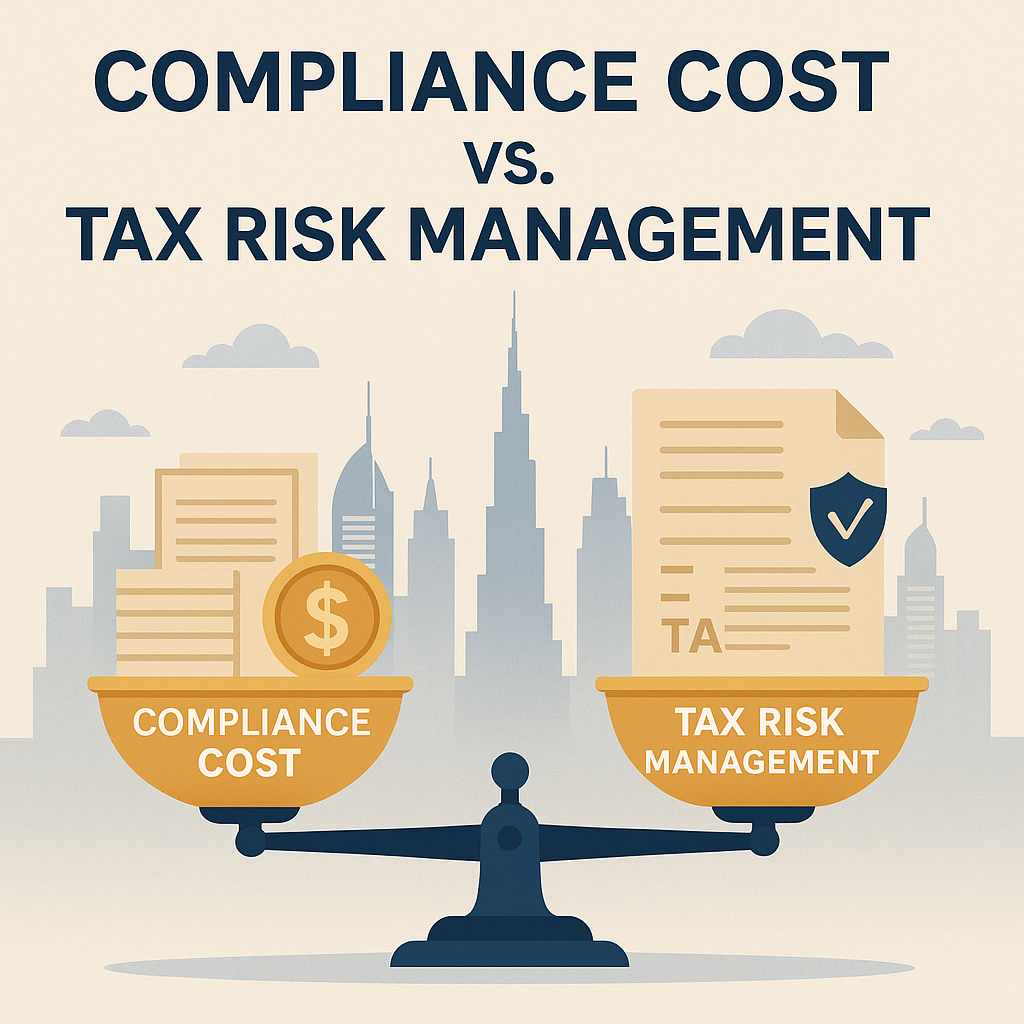
With the introduction of Corporate Tax (CT), Transfer Pricing (TP) rules, and ongoing VAT regulations, businesses in the UAE face increasing compliance obligations. While compliance comes at a cost—both financial and administrative—the alternative of ignoring or underestimating compliance requirements can expose companies to significant tax risks, penalties, and reputational damage.
This explores the balance between compliance costs and tax risk management, and how businesses can adopt a strategic approach to maximize efficiency while minimizing risks.
________________________________________
Understanding Compliance Costs
Compliance costs are the expenses businesses incur to meet regulatory requirements. These include:
• Corporate Tax Compliance
o Tax registration, tax return filing, and financial audits.
o Preparation of Transfer Pricing documentation (Local & Master File).
o Maintenance of accounting systems aligned with CT law.
• VAT Compliance
o VAT registration, periodic filing, and refunds.
o Maintaining transaction-level documentation.
• Economic Substance Regulations (ESR)
o Filing ESR notifications and reports.
o Ensuring adequate substance (employees, premises, board meetings).
• Other Governance Costs
o Legal advisory, internal controls, ERP/software integration.
o Staff training and compliance certifications.
Typical compliance cost range: For SMEs, annual compliance costs may range from AED 20,000 – 100,000, while for large multinational groups, the costs can run into millions due to TP and global reporting obligations.
________________________________________
Understanding Tax Risks
Tax risks arise when a business fails to comply with tax laws or structures its affairs in a way that could be challenged by authorities. These risks include:
• Financial Risks
o Administrative penalties for late filing, inaccurate reporting, or underpayment of tax.
o Interest on unpaid taxes.
o Transfer Pricing adjustments leading to higher tax liabilities.
• Operational Risks
o Disruption of cash flow due to tax assessments or audits.
o Additional workload for finance teams to address queries and disputes.
• Reputational Risks
o Public disclosure of tax disputes can damage investor and customer confidence.
o Non-compliance may affect relationships with regulators and banks.
• Legal Risks
o Severe breaches could lead to prosecution under UAE tax laws.
o Potential blacklisting of entities for aggressive tax avoidance.
________________________________________
Balancing Compliance Costs vs. Tax Risks
1. Short-Term Cost vs. Long-Term Risk
• Businesses may be tempted to minimize compliance costs by adopting a “bare minimum” approach.
• However, this can result in higher penalties and disputes in the long run.
• Example: Skipping a TP study to save costs may lead to tax adjustments of millions in audits.
2. Technology and Automation
• Investing in ERP systems, tax software, and digital accounting solutions reduces compliance burden.
• Automation ensures accuracy and efficiency, cutting long-term costs.
3. Proactive vs. Reactive Approach
• A proactive compliance approach (regular tax health checks, advisory support) is more cost-efficient than reacting to disputes and penalties.
• Example: Filing VAT returns on time avoids administrative penalties of AED 1,000–10,000.
4. Tailored Compliance for Business Size
• SMEs should focus on streamlined compliance to avoid unnecessary costs.
• Large MNEs must invest heavily in TP documentation, global reporting, and governance to avoid international scrutiny.
________________________________________
Strategic Tax Risk Management
1. Regular Tax Risk Assessments
o Identify high-risk areas (TP, intercompany loans, VAT on mixed-use properties).
2. Transfer Pricing Compliance
o Maintain arm’s length documentation to avoid disputes with FTA.
3. Strong Internal Controls
o Segregation of duties, system-based approvals, and periodic reconciliations.
4. Leveraging Double Tax Treaties (DTTs)
o Reduce withholding taxes abroad through treaty planning.
5. Professional Advisory & Training
o Outsourcing tax functions to experts.
o Training in-house finance teams for ongoing compliance.
________________________________________
Conclusion
Compliance costs are an investment in stability and risk reduction. While they may seem burdensome in the short term, they are significantly lower than the financial, operational, and reputational risks of non-compliance. The key is to strike a balance—optimizing compliance spending while ensuring robust tax risk management.
At Sheikh Anwar Accounting & Auditing LLC (MOE Registered Auditor, Entry No. 5817), we help businesses design cost-effective compliance frameworks, assess tax risks, and implement governance structures that ensure efficiency and long-term protection.
📩 Email: info@sa-auditors.com
🌐 Website: www.sa-auditors.com