Difference Between Commercial Invoice and Tax Invoice
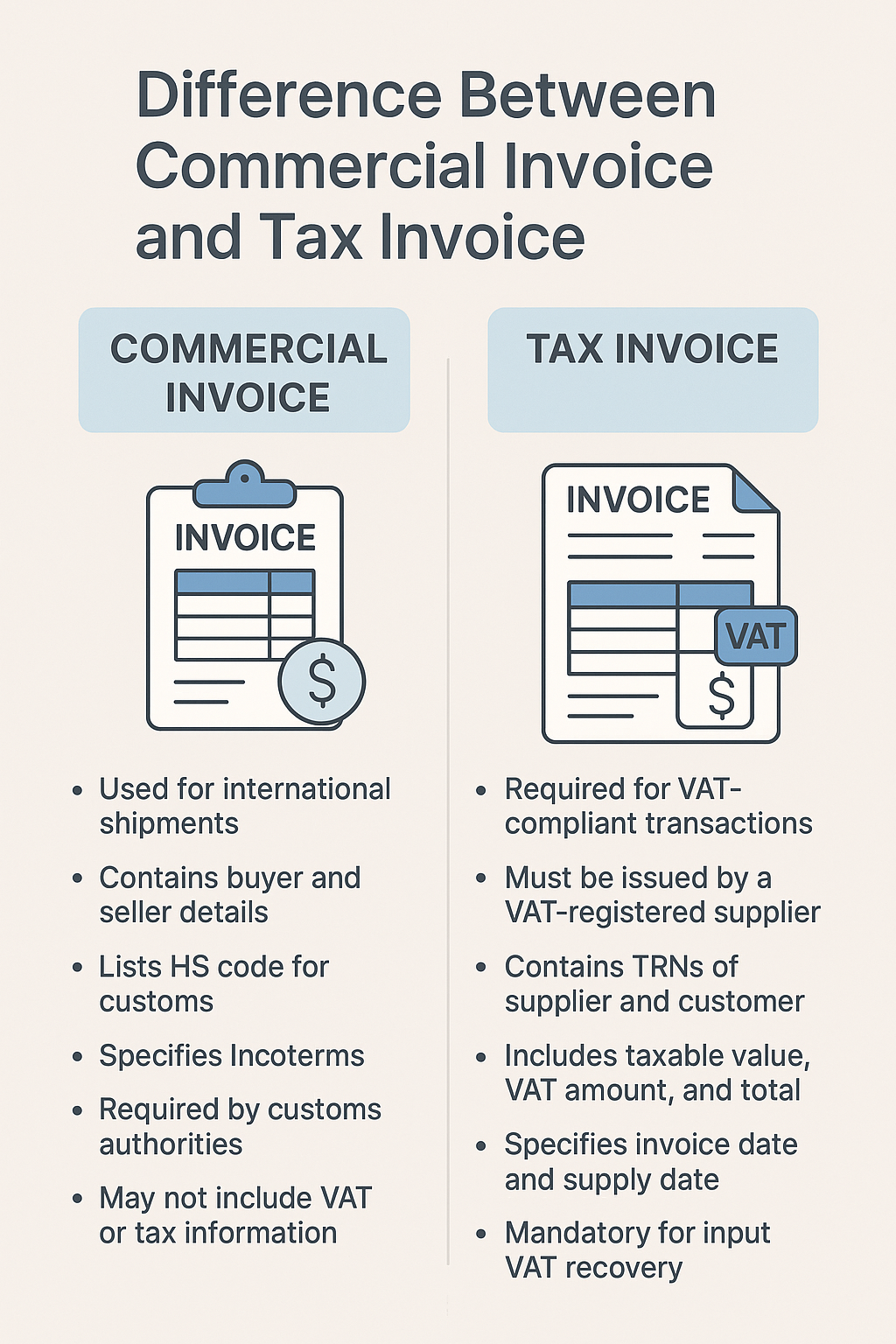
📄 Difference Between Commercial Invoice and Tax Invoice: A Detailed Guide for UAE Businesses
In the world of business transactions, especially in import/export and domestic trade, the terms "commercial invoice" and "tax invoice" are often used. While both are essential documents for sales and shipment, they serve different purposes and are governed by different regulatory frameworks.
If you’re doing business in the UAE or globally, understanding the difference between a commercial invoice and a tax invoice is critical for compliance, accounting accuracy, and smooth logistics.
________________________________________
✅ What Is a Commercial Invoice?
A commercial invoice is a document primarily used in international trade. It serves as a customs declaration provided by the exporter to the importer and customs authorities. This document provides details about the goods being exported, including their description, value, and destination.
🔍 Key Features of a Commercial Invoice:
• Used for international shipments
• Contains buyer and seller details
• Lists the HS code (Harmonized System code) for customs
• Provides description, quantity, unit value, and total value
• Specifies Incoterms (e.g., FOB, CIF)
• Required by customs authorities for import/export clearance
• May not include VAT or tax information
• Not necessarily a legally valid tax document for claiming input VAT
________________________________________
✅ What Is a Tax Invoice?
A tax invoice, on the other hand, is used for domestic or cross-border transactions within VAT-registered entities. It is issued by a VAT-registered supplier to the buyer and is necessary for claiming input VAT and complying with UAE VAT Law.
🔍 Key Features of a Tax Invoice:
• Required for VAT-compliant transactions in the UAE
• Must be issued by a VAT-registered supplier
• Contains the supplier’s and customer’s TRN (Tax Registration Number)
• Includes taxable value, VAT amount, and total amount including VAT
• Specifies the invoice date, supply date, and sequential invoice number
• Mandatory for input VAT recovery by the buyer
• Format governed by Federal Decree-Law No. 8 of 2017 on VAT
________________________________________
📊 Commercial Invoice vs. Tax Invoice: Comparison Table
Aspect Commercial Invoice Tax Invoice
Purpose Used for customs and shipment documentation Used for VAT compliance and accounting
Usage Primarily in international trade Domestic and cross-border sales under VAT regime
VAT Details Usually not included Must include VAT breakdown and TRNs
Recipient Customs authorities and foreign buyer Buyer (customer)
Required by Law For customs clearance Mandated by UAE VAT Law
Format & Content Flexible, trade-specific Strict format defined by VAT regulations
Legal Relevance for VAT Not valid for VAT credit Valid document for input VAT claim
TRN (Tax Reg. No.) Not required Mandatory
Language Usually English or local language of trade Must be in Arabic or bilingual in UAE
________________________________________
🏗️ Real-Life Example:
1. Commercial Invoice Example:
ABC Electronics (UAE) exports LED screens to XYZ Traders (Kenya). A commercial invoice is created listing the goods, unit prices, total amount, HS code, and Incoterms (e.g., CIF Mombasa). This is submitted to customs for clearance and foreign exchange purposes.
2. Tax Invoice Example:
ABC Electronics sells the same LED screens to a local business in Dubai. A tax invoice is issued with the supplier and buyer TRN, taxable amount, 5% VAT amount, and total invoice value. This invoice is then used by the buyer to claim input VAT.
________________________________________
⚠️ Compliance Tip for UAE Businesses:
In the UAE, all VAT-registered businesses must issue a tax invoice for all taxable supplies exceeding AED 1,000. Using only a commercial invoice without VAT details can lead to non-compliance penalties and disallowance of input VAT.
For export sales, it’s common to issue both:
• A tax invoice for internal records and VAT accounting, and
• A commercial invoice for shipping and customs purposes
________________________________________
🧾 Can You Use One Invoice for Both Purposes?
While it is possible to combine elements of both in a single document, it is advisable to separate the tax invoice (for legal and accounting purposes) and commercial invoice (for logistics and customs), especially in international transactions.
________________________________________
📌 Conclusion
Understanding the difference between commercial and tax invoices is essential for staying compliant with UAE VAT laws and ensuring smooth international trade operations. While both serve different functions, using them correctly protects your business from regulatory issues and ensures efficient record-keeping.
________________________________________
🔍 Need Help with Invoice Compliance?
At Sheikh Anwar Accounting & Auditing LLC, we help businesses in the UAE ensure their invoicing practices align with FTA guidelines. Whether you're exporting goods or issuing VAT invoices, we can review and structure your documents for maximum compliance.
📞 Contact us today at www.sa-auditors.com to schedule a consultation.