Choosing the Right Legal Entity for Tax Planning
Introduction
When starting or expanding a business, one of the most important decisions is choosing the right legal entity. The choice you make will directly affect your tax obligations, liability exposure, compliance requirements, and ability to grow. Selecting the right entity is therefore not just a legal necessity—it is a key part of tax planning.
________________________________________
Why Your Business Structure Matters
Your legal entity influences:
• Tax Rates & Incentives – Different structures can qualify for tax exemptions, reliefs, or preferential rates.
• Liability Protection – Some entities shield your personal assets, while others expose you to unlimited liability.
• Operational Flexibility – Ownership, transfer of shares, and fundraising options vary by entity type.
• Compliance Costs – Audits, reporting, and government fees differ based on the legal form.
Making the right choice at the start can help you reduce risks, optimize tax outcomes, and ensure compliance.
________________________________________
Common Legal Entities and Their Tax Impact
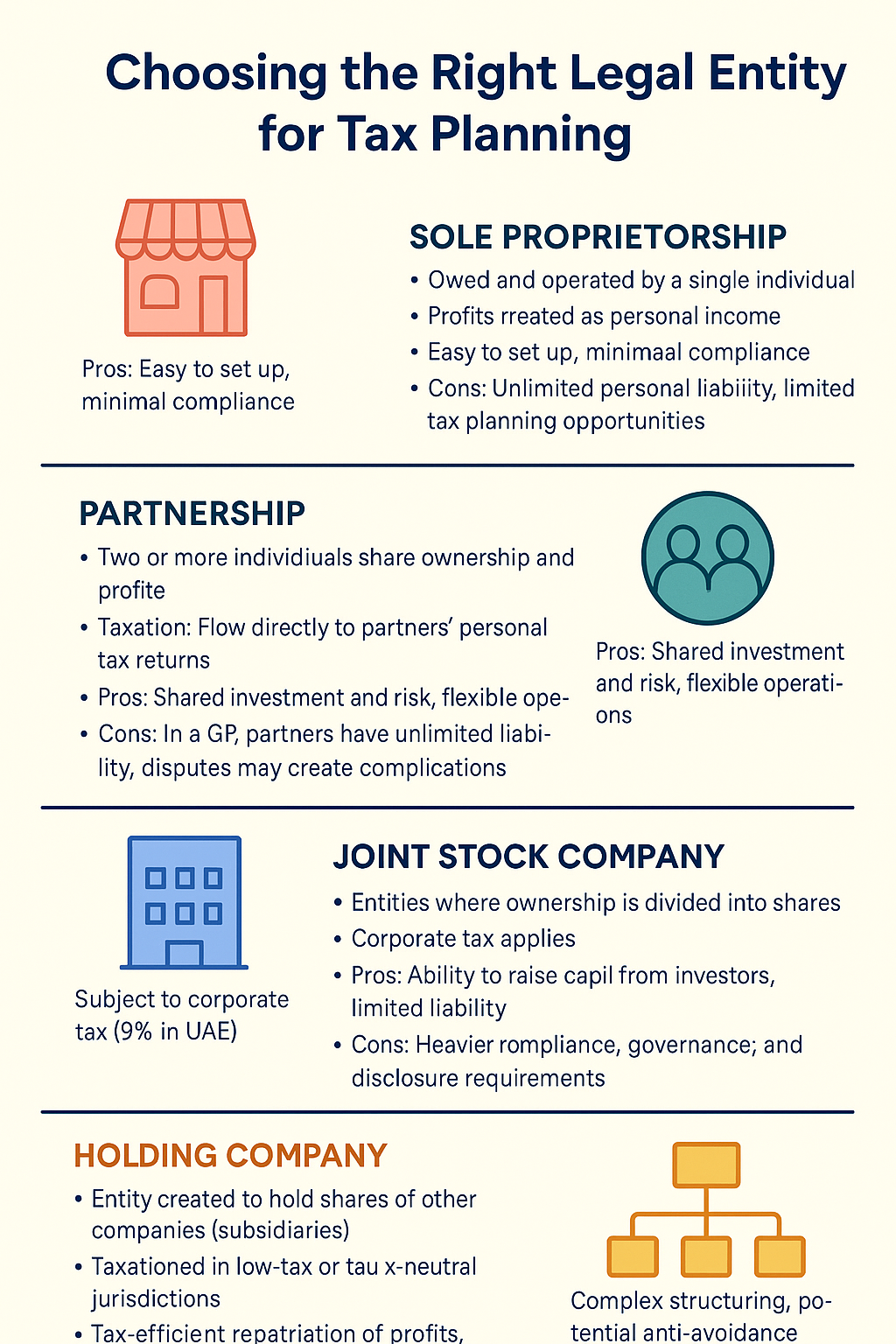
1. Sole Proprietorship
• Tax Treatment: Profits are taxed as personal income of the owner.
• Pros: Simple setup, minimal cost.
• Cons: Unlimited personal liability, limited tax benefits.
• Best for: Freelancers and micro-businesses with low risk.
________________________________________
2. Partnership (General or LLP)
• Tax Treatment: Profits are distributed and taxed in the hands of partners.
• Pros: Shared responsibility and investment.
• Cons: In general partnerships, liability is unlimited.
• Best for: Professional firms such as consultancies or law/accounting practices.
________________________________________
3. Limited Liability Company (LLC)
• Tax Treatment: Subject to UAE Corporate Tax at 9%, with exemptions up to the AED 375,000 threshold and potential Free Zone benefits.
• Pros: Limited liability, flexibility in management, eligibility for tax benefits.
• Cons: Licensing and compliance requirements can be higher.
• Best for: SMEs and businesses looking to scale while protecting owners.
________________________________________
4. Joint Stock Company (Private or Public)
• Tax Treatment: Fully subject to corporate tax; can benefit from international tax treaties.
• Pros: Ability to raise capital via shares; limited liability.
• Cons: High governance and reporting requirements.
• Best for: Large-scale businesses and companies seeking IPOs.
________________________________________
5. Holding Company
• Tax Treatment: Can be structured in tax-friendly jurisdictions for efficient dividend and capital gains planning, subject to Economic Substance Regulations (ESR).
• Pros: Efficient profit repatriation, centralized control of subsidiaries, succession planning.
• Cons: Requires careful structuring to avoid anti-avoidance scrutiny.
• Best for: Groups with multiple subsidiaries or international operations.
________________________________________
Key Considerations in Choosing the Right Entity
1. Business Nature & Risk – Service vs trading vs manufacturing.
2. Tax Exposure – Free Zone eligibility, treaty benefits, and cross-border taxation.
3. Liability Protection – Higher-risk industries benefit from stronger legal shields.
4. Growth Plans – Fundraising, mergers, and international expansion.
5. Compliance Burden – Balancing cost of audits, ESR filings, and regulatory reporting.
6. Substance & Residency – Ensuring the company meets UAE substance rules and avoids PoEM (Place of Effective Management) risks.
________________________________________
Tax Planning Strategies Using Entity Selection
• Leverage Free Zone Incentives: Apply for Qualifying Free Zone Person (QFZP) status to benefit from 0% tax on eligible income.
• Holding Structures: Use a UAE or offshore holding company for tax-efficient profit repatriation.
• Remuneration Mix: Optimize between salary, dividends, and management fees.
• Cross-Border Planning: Avoid double taxation through careful structuring and use of treaties.
• Maintain Substance: Ensure board meetings, management, and decision-making are genuinely carried out in the UAE.
________________________________________
Conclusion
Choosing the right legal entity is a strategic tax planning decision. The wrong structure can increase taxes, expose you to unnecessary risks, and raise compliance costs. The right one, however, can secure liability protection, optimize tax efficiency, and support long-term business growth.
Before finalizing, always consult with experienced tax and legal advisors to align your entity choice with both your immediate needs and future ambitions.
________________________________________
📌 Sheikh Anwar Accounting & Auditing LLC
📧 info@sa-auditors.com
🌐 www.sa-auditors.com