Challenges in AML Risk Scoring
Introduction
In the modern compliance environment, AML (Anti-Money Laundering) risk scoring is one of the most crucial components of an organization’s risk-based approach (RBA). It enables businesses—especially Designated Non-Financial Businesses and Professions (DNFBPs) such as auditors, real estate agents, lawyers, and gold traders—to assess, quantify, and manage their exposure to money laundering (ML) and terrorist financing (TF) risks.
Under Federal Decree-Law No. (20) of 2018, Cabinet Decision No. (10) of 2019, and Cabinet Decision No. (109) of 2023, the UAE mandates all DNFBPs to adopt risk-based procedures, including structured risk scoring methodologies for customers, products, transactions, and geographies.
However, despite its importance, many entities struggle to develop or apply effective AML risk scoring systems. This explores the key challenges in AML risk scoring and provides insights into overcoming them.
________________________________________
1. Understanding AML Risk Scoring
AML risk scoring is a quantitative and qualitative process used to assign a risk level (Low, Medium, or High) to customers, products, services, and transactions based on specific criteria.
Typical factors include:
• Customer risk (type, residency, occupation, ownership structure)
• Product/service risk (cash-intensive, high-value, or complex services)
• Geographic risk (exposure to FATF grey-listed or sanctioned countries)
• Delivery channel risk (face-to-face vs. online transactions)
The overall score determines the level of due diligence to be applied—Simplified, Standard, or Enhanced Due Diligence (EDD).
________________________________________
2. Key Challenges in AML Risk Scoring
Despite widespread awareness, several operational and technical challenges limit the effectiveness of AML risk scoring systems.
________________________________________
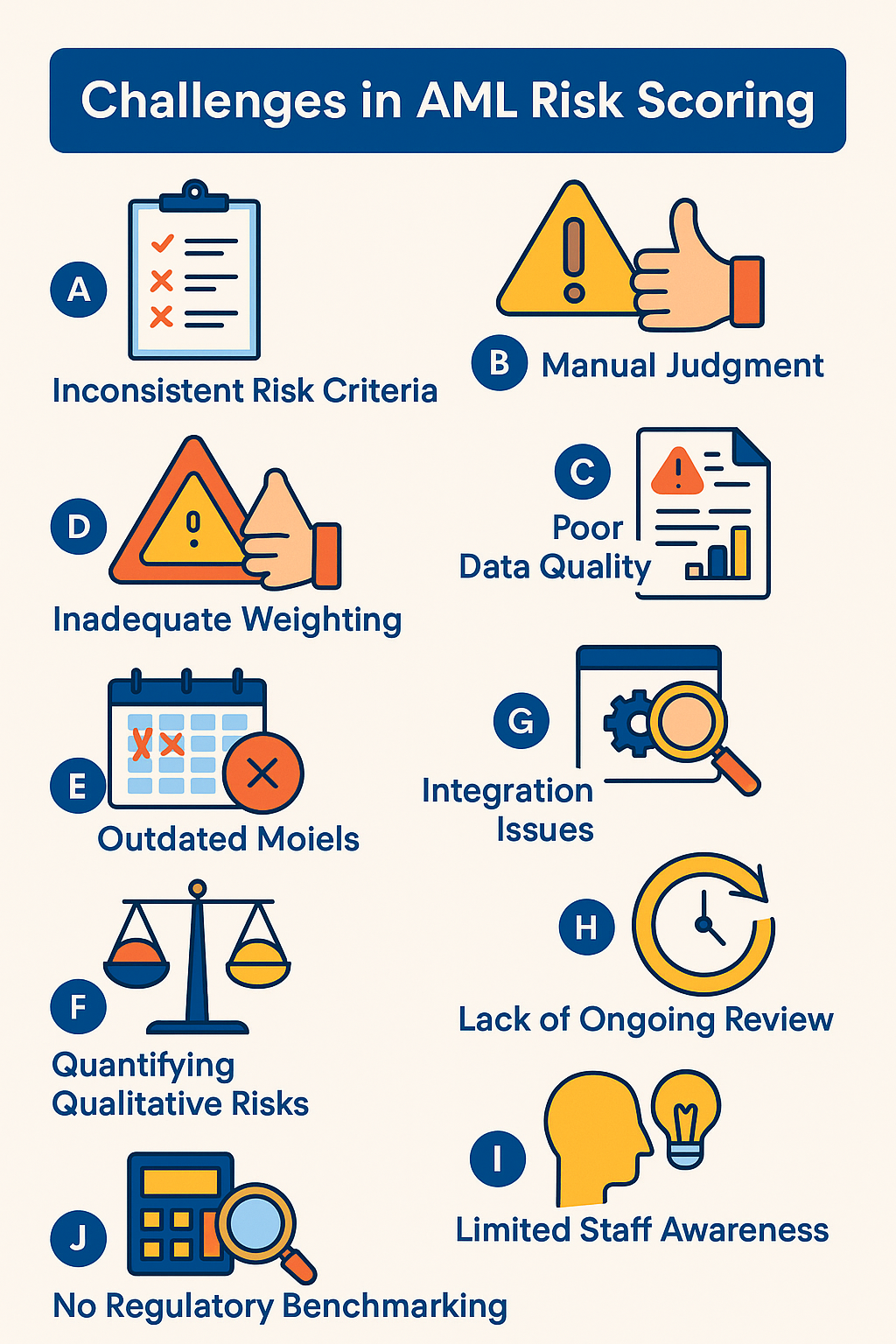
A. Inconsistent Risk Criteria Across Entities
Many businesses lack standardized criteria for assessing risks. For example, one company may treat a politically exposed person (PEP) as automatically high-risk, while another may not have a clear definition.
Impact:
Inconsistent scoring leads to unreliable assessments and weak risk differentiation, undermining compliance integrity.
Best Practice:
Develop a uniform, documented risk-scoring framework approved by senior management and reviewed periodically.
________________________________________
B. Over-Reliance on Manual Judgment
Some firms rely heavily on staff judgment rather than defined scoring models. This leads to subjective interpretation of risks and inconsistent outcomes across customers or departments.
Impact:
Manual scoring increases the chance of human error, bias, and regulatory non-compliance.
Best Practice:
Introduce automated or semi-automated risk scoring tools with built-in logic to ensure objectivity and consistency.
________________________________________
C. Lack of Data Quality and Availability
Accurate risk scoring requires reliable data on customers, transactions, and jurisdictions. Many DNFBPs face issues like incomplete KYC data, missing beneficial ownership details, or outdated customer profiles.
Impact:
Poor data quality produces inaccurate risk scores, making monitoring and reporting ineffective.
Best Practice:
Implement data validation checks, centralized databases, and periodic KYC refresh processes to maintain data accuracy.
________________________________________
D. Inadequate Weighting of Risk Factors
Not all risk factors carry equal importance. However, many organizations apply uniform weights to all categories (customer, geography, product, etc.), which can distort overall risk levels.
Example:
Giving “delivery channel” the same weight as “FATF country risk” can produce unrealistic results.
Best Practice:
Use a weighted scoring system that assigns higher value to risk areas with greater ML/TF exposure, supported by clear justification.
________________________________________
E. Static Models That Don’t Evolve
Money laundering typologies evolve rapidly. Yet, many DNFBPs continue to use outdated models that don’t account for emerging risks such as virtual assets, trade-based laundering, or cross-border digital payments.
Impact:
Static models fail to capture new threats, exposing entities to undetected high-risk activities.
Best Practice:
Review and update AML risk scoring parameters at least annually or upon significant business/regulatory changes.
________________________________________
F. Difficulty in Quantifying Qualitative Risks
Certain AML risk factors—like customer reputation, transaction behavior, or business purpose—are difficult to quantify numerically.
Impact:
Such qualitative risks often receive arbitrary scores, reducing the model’s reliability.
Best Practice:
Combine quantitative scoring (e.g., transaction thresholds) with qualitative narrative assessments for a balanced evaluation.
________________________________________
G. Integration Challenges with Technology Systems
Many organizations use multiple systems (accounting software, CRM, compliance databases) that aren’t integrated, resulting in fragmented data and inconsistent scoring.
Impact:
Risk assessment becomes time-consuming and error-prone, especially during AML inspections or audits.
Best Practice:
Adopt integrated AML solutions—such as MyAML.io or Finabooks.com—that consolidate customer profiles, transaction data, and risk scoring into a single platform.
________________________________________
H. Lack of Ongoing Monitoring and Review
Some firms treat risk scoring as a one-time exercise conducted only at customer onboarding. In reality, risk profiles can change over time due to new transactions, ownership changes, or geopolitical developments.
Impact:
Failure to refresh scores regularly leads to outdated risk classifications and missed red flags.
Best Practice:
Perform periodic risk reviews (at least annually) and update scores dynamically based on new information or events.
________________________________________
I. Limited Staff Awareness and Training
AML risk scoring often fails because employees don’t fully understand its importance or the underlying methodology.
Impact:
Inaccurate risk entry, lack of rationale in risk documentation, and poor STR decision-making.
Best Practice:
Provide regular AML training programs explaining risk scoring parameters, examples, and regulatory expectations.
________________________________________
J. Lack of Regulatory Benchmarking
Some DNFBPs develop internal scoring systems without aligning them to UAE Ministry of Economy or FATF standards.
Impact:
During inspections, regulators may reject or question unsupported scoring methods.
Best Practice:
Benchmark your scoring methodology against MOE AML inspection checklists, FATF guidance, and sector-specific DNFBP advisories.
________________________________________
3. Example of an Effective AML Risk Scoring Model
Risk Factor Description Weight (%) Example Rating
Customer Risk Type, ownership, PEP status 40% Medium
Geographic Risk FATF or sanctioned country 25% High
Product/Service Risk Gold trading, real estate, consulting 20% Medium
Delivery Channel Risk Non face-to-face or via agent 10% High
Transaction Risk Frequency and volume 5% Low
Overall Score: 0.4×Medium + 0.25×High + 0.2×Medium + 0.1×High + 0.05×Low = High
This example shows how weighted risk scoring provides a more realistic evaluation of overall exposure.
________________________________________
4. The Role of Technology in Risk Scoring
Modern compliance software, such as MyAML.io and Finabooks.com, provides:
• Automated risk scoring based on live data inputs.
• Real-time screening against sanctions and PEP lists.
• Centralized dashboards for entity-wide risk visibility.
• Dynamic updates when new FATF or MOE advisories are released.
Technology reduces manual effort, increases accuracy, and ensures regulatory alignment.
________________________________________
5. Conclusion
AML risk scoring is the engine of a risk-based compliance framework. Yet, many DNFBPs in the UAE face operational and data challenges that weaken their ability to apply risk ratings accurately.
To overcome these challenges, businesses should:
• Adopt data-driven, weighted scoring models,
• Leverage automation and AI-based AML tools,
• Train their teams on consistent application of scoring parameters, and
• Continuously review and refine their methodologies.
By addressing these gaps, DNFBPs can ensure their AML programs remain compliant, transparent, and inspection-ready — reinforcing their commitment to the UAE’s national AML/CFT objectives.
________________________________________
Sheikh Anwar Accounting & Auditing LLC
Licensed Auditor – Ministry of Economy (Entry No. 5817)
📍 Dubai Creek Tower, Office M35, Dubai, UAE
🌐 www.sa-auditors.com
✉️ info@sa-auditors.com