Challenges Faced by Startups in First Tax Year
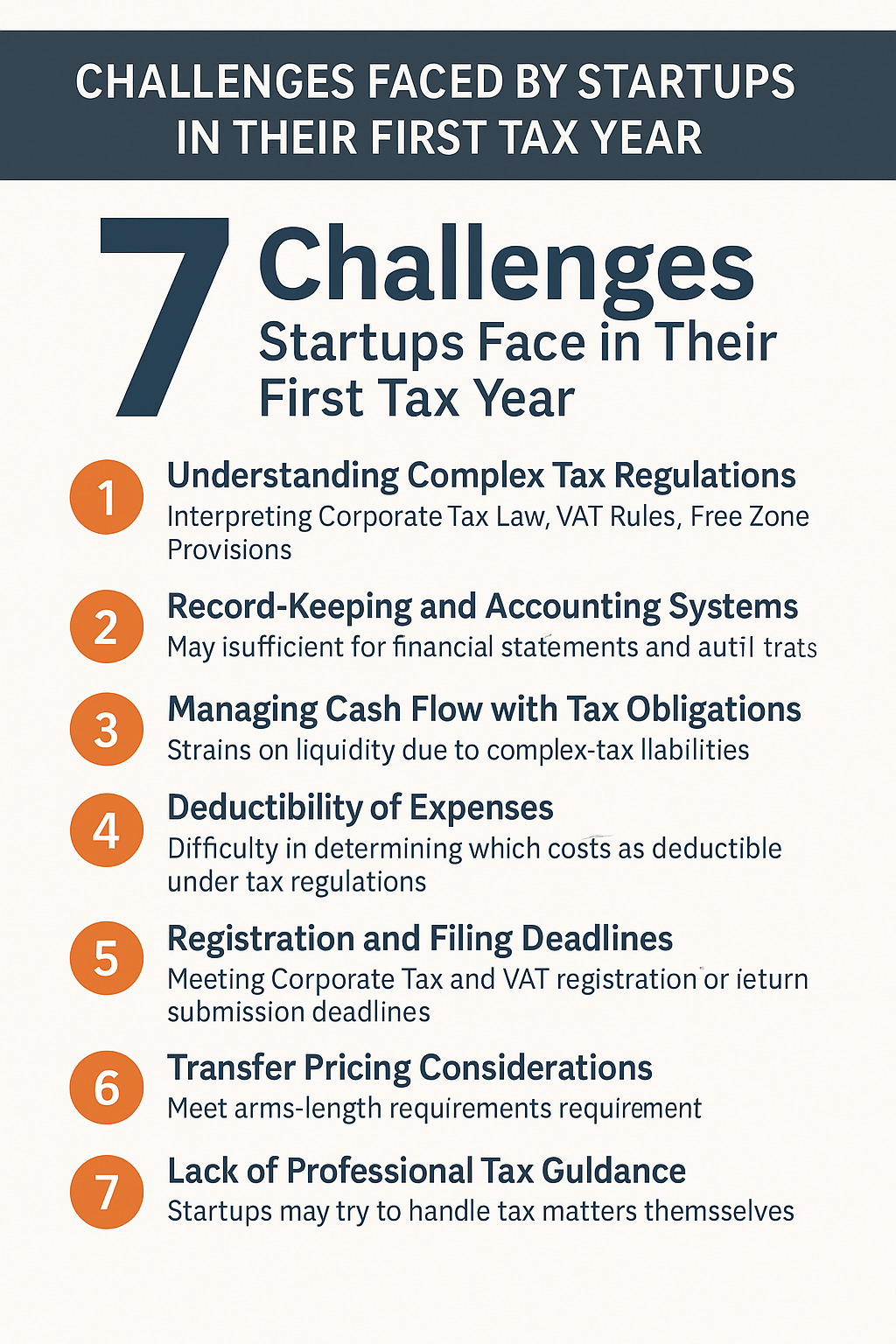
Introduction
The first tax year is a critical milestone for any startup. While entrepreneurs are focused on building products, raising funds, and attracting customers, compliance with tax laws often becomes a complex challenge. With the introduction of UAE Corporate Tax (CT) alongside existing VAT regulations, startups now face a host of new obligations that can significantly impact financial stability and future growth.
It highlights the key challenges startups encounter in their first tax year and provides practical insights for founders to navigate these effectively.
________________________________________
1. Understanding Complex Tax Regulations
Startups often lack in-house tax expertise, making it difficult to interpret:
• Corporate Tax Law – Determining taxable income, deductible expenses, and available exemptions.
• VAT Rules – Differentiating between zero-rated, exempt, and standard-rated transactions.
• Free Zone Provisions – Clarifying eligibility for 0% Corporate Tax under Qualifying Free Zone Person (QFZP) status.
Why it matters: Incorrect interpretation can lead to underpayment, overpayment, or even penalties for non-compliance.
________________________________________
2. Record-Keeping and Accounting Systems
Startups may rely on basic spreadsheets or manual systems that are insufficient for:
• Preparing accurate financial statements aligned with IFRS (a requirement for Corporate Tax).
• Maintaining audit trails for VAT returns and expense claims.
• Tracking related-party transactions for Transfer Pricing compliance.
Why it matters: Weak record-keeping exposes startups to audit risks and makes tax filings inaccurate.
________________________________________
3. Managing Cash Flow with Tax Obligations
The first tax year often coincides with limited revenues and high initial expenses. However:
• VAT payments on sales are due quarterly, even when customer payments are delayed.
• Corporate Tax is payable within nine months of year-end, which may strain liquidity.
• Tax refunds (e.g., input VAT) are often delayed, creating temporary cash shortages.
Why it matters: Poor cash planning can push startups into working capital crunches.
________________________________________
4. Deductibility of Expenses
Startups incur significant early-stage costs such as marketing, R&D, and financing. Many struggle to determine:
• Which costs qualify as deductible expenses under CT rules.
• Limits on interest deductions (30% of EBITDA cap).
• Non-deductible categories (penalties, certain entertainment expenses, etc.).
Why it matters: Misclassification reduces legitimate tax savings and increases liabilities.
________________________________________
5. Registration and Filing Deadlines
Compliance calendars are often overlooked. Startups must ensure:
• Corporate Tax Registration within FTA deadlines.
• VAT Registration if turnover exceeds AED 375,000.
• Timely filing of returns to avoid administrative penalties.
Why it matters: Missing deadlines leads to penalties and reputational damage with regulators.
________________________________________
6. Transfer Pricing (TP) Considerations
Startups with investors or group structures may have related-party dealings. Even small firms may face:
• Arm’s length requirements for management fees, intercompany loans, or IP charges.
• The need for Transfer Pricing documentation if revenue crosses thresholds.
Why it matters: Failure to comply with TP rules can lead to adjustments and fines up to AED 500,000.
________________________________________
7. Lack of Professional Tax Guidance
Many founders try to handle tax matters themselves to save costs. However:
• Tax law is technical and evolving.
• Missteps in the first year create cumulative issues in later years.
• Strategic planning opportunities (like tax loss carry-forward or free zone structuring) are often missed.
Why it matters: A reactive approach increases compliance risks and future correction costs.
________________________________________
Conclusion
The first tax year sets the foundation for a startup’s financial and compliance journey. From navigating new regulations to managing cash flow and filing obligations, the challenges are substantial. However, with the right planning, robust record-keeping, and professional guidance, startups can turn these challenges into opportunities—optimising taxes, safeguarding compliance, and building investor confidence.
________________________________________
How We Help
At Sheikh Anwar Accounting & Auditing LLC, we support startups in the UAE with Corporate Tax registration, VAT compliance, Transfer Pricing documentation, and tax-efficient structuring. Our tailored solutions ensure that new businesses remain compliant while focusing on growth.
📩 Contact us at info@sa-auditors.com | 🌐 www.sa-auditors.com

