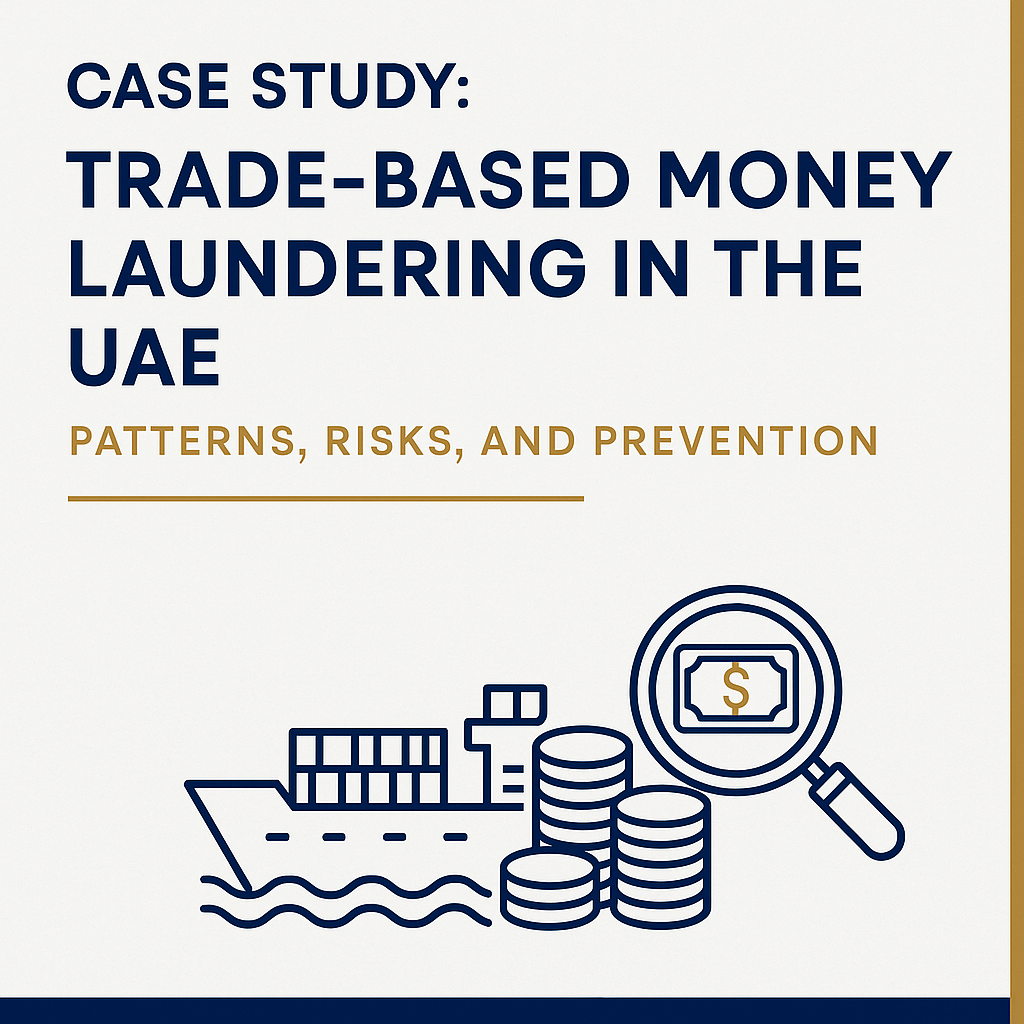
Case Study: Trade-Based Money Laundering in UAE
Introduction
Trade-Based Money Laundering (TBML) is one of the most complex and least detected forms of financial crime worldwide. It exploits international trade systems to disguise illicit funds as legitimate business proceeds.
The United Arab Emirates (UAE), as a global hub for trade, logistics, and commodities (especially gold and precious metals), faces a heightened risk of TBML activities. Recognizing this, UAE authorities — including the Ministry of Economy (MOE), Central Bank of the UAE (CBUAE), Financial Intelligence Unit (FIU), and Customs Departments — have made TBML a national AML/CFT enforcement priority..
________________________________________
1. Understanding Trade-Based Money Laundering (TBML)
According to the Financial Action Task Force (FATF), TBML involves the process of moving illicit funds across borders through trade transactions to disguise their origin and ownership.
Criminals use TBML to:
• Misrepresent the price, quantity, or quality of imports/exports.
• Create false invoices or over/under-invoicing to shift value across borders.
• Use third-party intermediaries and shell companies to hide beneficiaries.
• Comingle legitimate trade flows with illegal ones, making detection difficult.
In short, trade becomes the vehicle for laundering, not just the business activity.
________________________________________
2. TBML Methods Observed Globally and in the UAE
a. Over-Invoicing
An exporter inflates the value of goods on an invoice to justify excessive payments from a foreign buyer — effectively transferring illicit funds disguised as trade payments.
b. Under-Invoicing
The exporter undervalues the goods so the buyer pays less, allowing the difference to remain offshore as undeclared income.
c. Multiple Invoicing
The same shipment is invoiced multiple times to different banks or jurisdictions, generating multiple payments for one transaction.
d. Phantom Shipments
Goods are never shipped, yet false customs documents and bills of lading are used to simulate trade activity.
e. Misclassification and False Description
Goods are deliberately mislabeled to conceal their true nature or to take advantage of tariff or export control loopholes.
________________________________________
3. Case Study: Gold and Precious Metal Trade in the UAE
Background
The UAE is one of the world’s largest gold trading centers, handling billions of dollars in gold annually through Dubai Multi Commodities Centre (DMCC), Dubai Gold Souk, and other free zones.
This legitimate trade ecosystem has, in some cases, been misused by criminal networks for TBML.
Scenario Example
A gold trader in Dubai imported gold from a high-risk jurisdiction and exported it to another country with significant pricing discrepancies.
How it worked:
• The trader over-invoiced imports and under-invoiced exports.
• Payments were made via layered offshore accounts.
• The difference in pricing represented laundered funds disguised as trade profit.
• The company also failed to file Designated Precious Metal and Stones Reports (DPMSRs) for large cash transactions exceeding AED 55,000.
Regulatory Response:
The Ministry of Economy fined multiple gold trading companies in 2023 for AML non-compliance, including:
• Failure to maintain AML policies.
• Non-registration on goAML platform.
• Inadequate customer due diligence and transaction monitoring.
________________________________________
4. Case Study: Textile Trading Company in the UAE Free Zone
A trading company based in a UAE free zone was suspected of moving funds through fictitious textile shipments.
Scheme Overview:
• The company issued multiple invoices for goods never shipped.
• Funds were received in UAE accounts and quickly remitted abroad.
• Customs data revealed discrepancies between declared goods and actual cargo.
• Beneficial ownership traced back to high-risk jurisdictions under FATF scrutiny.
Outcome:
The case led to account freezes, administrative penalties, and investigation by the UAE Financial Intelligence Unit (FIU).
Lesson:
Even non-financial businesses in free zones are subject to AML oversight and must conduct due diligence on trading partners.
________________________________________
5. Key Red Flags for TBML in UAE Trade Activities
Transactional Red Flags
• Inconsistent trade values with market pricing.
• Repeated transactions with the same counterparty without clear business rationale.
• Large or complex payments from unrelated third parties.
• Unusual movement of funds between trading partners without physical shipment.
Operational Red Flags
• Customers unwilling to provide shipping or customs documentation.
• Use of offshore jurisdictions or shell companies.
• Frequent amendments to invoices, bills of lading, or letters of credit.
• Discrepancies between declared and observed goods.
Behavioral Red Flags
• Reluctance to share company ownership or source of funds.
• High use of cash or informal payments.
• Customers avoiding face-to-face verification or using intermediaries.
________________________________________
6. The UAE’s Regulatory Framework Against TBML
The UAE’s approach integrates cross-agency cooperation and international best practices.
Key Authorities:
• Ministry of Economy (MOE): Supervises DNFBPs and ensures compliance with AML obligations.
• Central Bank of UAE (CBUAE): Oversees financial institutions and correspondent banking channels.
• Financial Intelligence Unit (FIU): Receives and analyzes suspicious transaction reports (STRs).
• Customs Authorities: Collaborate in monitoring trade documentation and shipment integrity.
Legal Framework:
• Federal Decree-Law No. (20) of 2018 – Defines ML/TF offenses.
• Cabinet Decision No. (10) of 2019 – Details CDD, EDD, and record-keeping obligations.
• Cabinet Decision No. (16) of 2021 – Prescribes AML fines for non-compliance (up to AED 5 million).
________________________________________
7. Lessons for UAE DNFBPs and Trading Companies
✅ Lesson 1: Conduct Trade Risk Assessments
Businesses must perform AML risk assessments considering:
• Nature of goods traded,
• Counterparty risk,
• Jurisdictional exposure, and
• Transaction size.
The assessment must be documented and reviewed annually.
________________________________________
✅ Lesson 2: Strengthen Due Diligence on Trade Partners
• Verify beneficial ownership of counterparties.
• Review trade licenses and registration documents.
• Screen against sanctions and adverse media lists.
________________________________________
✅ Lesson 3: Monitor Trade Transactions for Anomalies
Integrate financial data with logistics and customs records to identify inconsistencies in:
• Price, quantity, and shipping routes.
• Payments not aligned with trade terms.
• Third-party involvement without justification.
________________________________________
✅ Lesson 4: Ensure goAML Compliance
All DNFBPs and traders must register on goAML and file:
• Suspicious Transaction Reports (STRs) for unusual payments.
• DPMSRs for cash transactions exceeding AED 55,000.
________________________________________
✅ Lesson 5: Build Internal Controls and Training
Train employees on TBML typologies and reporting procedures.
Maintain records for at least five years and appoint a Compliance Officer (MLRO) to oversee AML operations.
________________________________________
8. The Way Forward – Technology and Data Integration
The future of TBML detection lies in data-driven compliance:
• AI-based transaction monitoring to identify unusual patterns.
• Blockchain-based trade verification to authenticate shipment and invoice data.
• Public-private partnerships between regulators and industry to share red-flag typologies.
The UAE’s efforts to digitize customs, financial, and trade systems make it a global model for combating TBML through innovation and regulatory alignment.
________________________________________
Conclusion
Trade-Based Money Laundering represents a sophisticated, evolving threat that blends commerce, finance, and crime.
For UAE businesses — particularly those in gold, textile, logistics, and free-zone trade — the key to resilience lies in vigilance, risk assessment, and technology adoption.
By understanding TBML patterns and implementing robust AML frameworks, UAE entities can ensure both regulatory compliance and global trust in their trade integrity.
________________________________________
About Sheikh Anwar Accounting & Auditing LLC
Sheikh Anwar Accounting & Auditing LLC (MOE Entry No. 5817) is a UAE Ministry of Economy–licensed firm providing AML/CFT compliance, risk assessments, AML audits, and training for DNFBPs and trading companies.
Our experts assist in developing customized AML policies, conducting TBML risk assessments, and ensuring goAML compliance readiness for inspections.
📍 Office: Dubai Creek Tower, M-35, Dubai, UAE
📞 Phone: +971 4 000 0000
📧 Email: info@sa-auditors.com
🌐 Website: www.sa-auditors.com