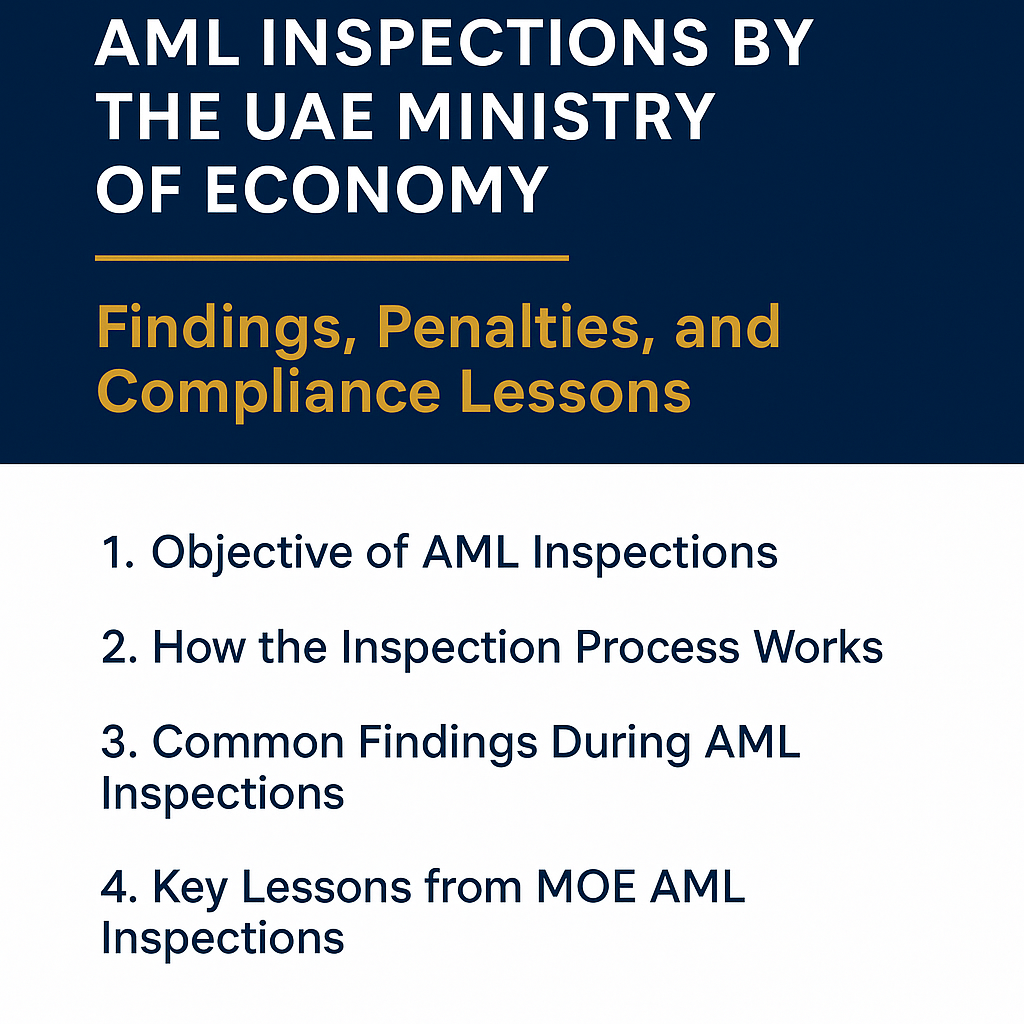
Case Study: AML Inspections by Ministry of Economy
Introduction
The Ministry of Economy (MOE) is the designated supervisory authority for Designated Non-Financial Businesses and Professions (DNFBPs) in the United Arab Emirates. These include real estate brokers, gold and jewellery traders, auditors, accountants, and corporate service providers.
As part of the UAE’s broader effort to strengthen its Anti-Money Laundering and Countering the Financing of Terrorism (AML/CFT) framework, the MOE has conducted extensive AML inspections across the DNFBP sector since 2022.
These inspections have resulted in substantial penalties, warnings, and remedial actions — making it essential for every DNFBP to understand what regulators look for, where businesses are failing, and how to build a robust compliance culture.
________________________________________
1. Objective of AML Inspections by the Ministry of Economy
The MOE’s AML inspections are designed to assess the effectiveness of AML/CFT compliance frameworks implemented by DNFBPs.
The inspections focus on evaluating:
• Risk assessment and AML policy adequacy.
• Customer Due Diligence (CDD) and Enhanced Due Diligence (EDD) practices.
• goAML registration and reporting readiness.
• Governance structure, including appointment of MLRO or Compliance Officer.
• Training, awareness, and record-keeping systems.
These inspections ensure businesses comply with Federal Decree-Law No. (20) of 2018, Cabinet Decision No. (10) of 2019, and the Administrative Penalties under Cabinet Decision No. (16) of 2021.
________________________________________
2. How the Inspection Process Works
a. Pre-Inspection Phase
Businesses are notified through official correspondence or email that an AML inspection is scheduled. They must prepare:
• Updated AML Risk Assessment Report.
• Copies of policies, procedures, and training records.
• List of clients, transactions, and STR/DPMSR reports filed via goAML.
b. On-Site / Remote Review
Inspectors evaluate:
• Whether the company has registered on goAML.
• The effectiveness of AML controls in daily operations.
• Whether senior management is aware of compliance obligations.
In many cases, interviews are conducted with owners, compliance officers, or accountants.
c. Post-Inspection Reporting
The MOE issues a compliance rating — Compliant, Partially Compliant, or Non-Compliant.
If deficiencies are found, businesses receive Corrective Action Plans and must respond within a specified period (typically 30 to 60 days).
________________________________________
3. Common Findings During AML Inspections
a. Non-Registration on the goAML Platform
Many DNFBPs were found unregistered or inactive on the UAE Financial Intelligence Unit’s (FIU) goAML portal, which is mandatory for reporting Suspicious Transaction Reports (STRs) and Designated Precious Metal and Stone Reports (DPMSRs).
⚠️ Penalty: AED 50,000 to AED 200,000 depending on the delay or repetition.
________________________________________
b. Absence of AML Risk Assessment
Inspectors found several firms without documented AML risk assessments, or those using generic templates not tailored to their business model.
⚠️ Penalty: AED 100,000 for failing to identify or document ML/TF risks.
________________________________________
c. Weak Customer Due Diligence (CDD)
Many firms only retained basic identification documents (passport or trade license) without assessing beneficial ownership, source of funds, or PEP status.
⚠️ Penalty: Up to AED 1 million for repeated or intentional non-compliance.
________________________________________
d. No Appointed Compliance Officer or MLRO
Some entities lacked a formally designated Compliance Officer or Money Laundering Reporting Officer (MLRO) — a key requirement under UAE AML law.
⚠️ Penalty: AED 50,000 and mandatory appointment within a specified timeframe.
________________________________________
e. Inadequate Record Keeping
Businesses often failed to maintain AML-related records for the mandatory five-year period, especially CDD forms, STR filings, and training logs.
⚠️ Penalty: AED 50,000 per violation.
________________________________________
f. Lack of Training and Awareness
Employees were unaware of AML obligations or unable to identify suspicious activities during interviews.
⚠️ Penalty: AED 50,000 and requirement to conduct formal AML training.
________________________________________
4. Case Highlights – Real MOE Inspection Outcomes
Case 1: Gold Trader Fined AED 1.2 Million
A major gold trader in Dubai was fined AED 1.2 million in 2023 for failing to:
• Conduct CDD for high-value clients.
• Maintain risk assessment documents.
• Report multiple cash transactions exceeding AED 55,000.
The company also did not have a compliance officer or any internal AML training record.
________________________________________
Case 2: Real Estate Brokerage Penalized AED 350,000
A brokerage in Abu Dhabi was found to have no goAML registration and no internal AML policy.
Its employees were unaware of reporting obligations.
The firm was required to submit a remediation plan within 30 days or face license suspension.
________________________________________
Case 3: Auditing Firm Issued Corrective Notice
An auditing firm underwent inspection and was issued a warning for:
• Using an outdated AML policy.
• Missing documentation for client risk profiling.
• No independent review of its AML framework.
After corrective measures and documented training, the firm achieved compliance status within 45 days — avoiding financial penalties.
________________________________________
5. Key Lessons from MOE AML Inspections
✅ 1. AML Risk Assessment Is the Foundation
Each DNFBP must conduct an annual AML risk assessment, identifying customer, product, geographic, and delivery-channel risks.
It must be signed by senior management and retained for regulatory inspection.
✅ 2. goAML Registration Is Mandatory
All DNFBPs must be registered and active on goAML.
Ensure reporting rights are assigned to a designated MLRO or Compliance Officer.
✅ 3. Maintain Up-to-Date AML Policies
AML policies should be reviewed annually or when regulatory changes occur.
Generic or copied templates are rejected by regulators.
✅ 4. Train All Employees
Regulators expect annual AML training with documented attendance records.
Even front-line staff must know how to detect red flags and escalate suspicious activities.
✅ 5. Appoint a Qualified MLRO
The MLRO must have:
• Authority to access client data.
• Direct reporting line to management.
• Knowledge of UAE AML laws and FIU procedures.
✅ 6. Keep Evidence of Compliance
Maintain organized files containing:
• AML risk assessment,
• Policies and training reports,
• STR/DPMSR filing records,
• MOE inspection responses and approvals.
________________________________________
6. Impact of Non-Compliance
Failure to comply with AML inspection requirements can lead to:
• Administrative fines up to AED 5 million.
• Suspension or cancellation of trade license.
• Public disclosure of penalties, damaging reputation.
• Referral to Public Prosecution for repeated or deliberate violations.
The MOE has made it clear that enforcement will continue, and businesses should expect follow-up audits and random inspections.
________________________________________
Conclusion
AML inspections by the UAE Ministry of Economy are not just procedural—they are an evaluation of a company’s integrity, governance, and accountability.
The recent enforcement wave highlights that ignorance is no longer an excuse; even small DNFBPs must demonstrate full awareness and implementation of AML obligations.
For compliance officers and business owners, now is the time to act — review your AML framework, document your risk assessment, and ensure every transaction meets the UAE’s stringent AML standards.
________________________________________
About Sheikh Anwar Accounting & Auditing LLC
Sheikh Anwar Accounting & Auditing LLC is a Ministry of Economy–licensed audit and compliance firm (MOE Entry No. 5817) specializing in AML audits, goAML registration assistance, AML risk assessments, and compliance training for DNFBPs across the UAE.
We help businesses prepare for MOE AML inspections, develop custom AML policies, and achieve full regulatory compliance.
📍 Office: Dubai Creek Tower, M-35, Dubai, UAE
📞 Phone: +971 4 000 0000
📧 Email: info@sa-auditors.com
🌐 Website: www.sa-auditors.com