Case Studies of Suspicious Activity in UAE
Introduction
The UAE’s role as a leading financial and trade hub exposes it to money laundering (ML) and terrorist financing (TF) risks. While most business activity is legitimate, criminals often attempt to misuse legitimate channels. By studying real-life inspired case scenarios, businesses, DNFBPs, and financial institutions can strengthen their AML frameworks and protect against reputational and regulatory risks.
________________________________________
1. Gold and Jewellery Sector
Scenario
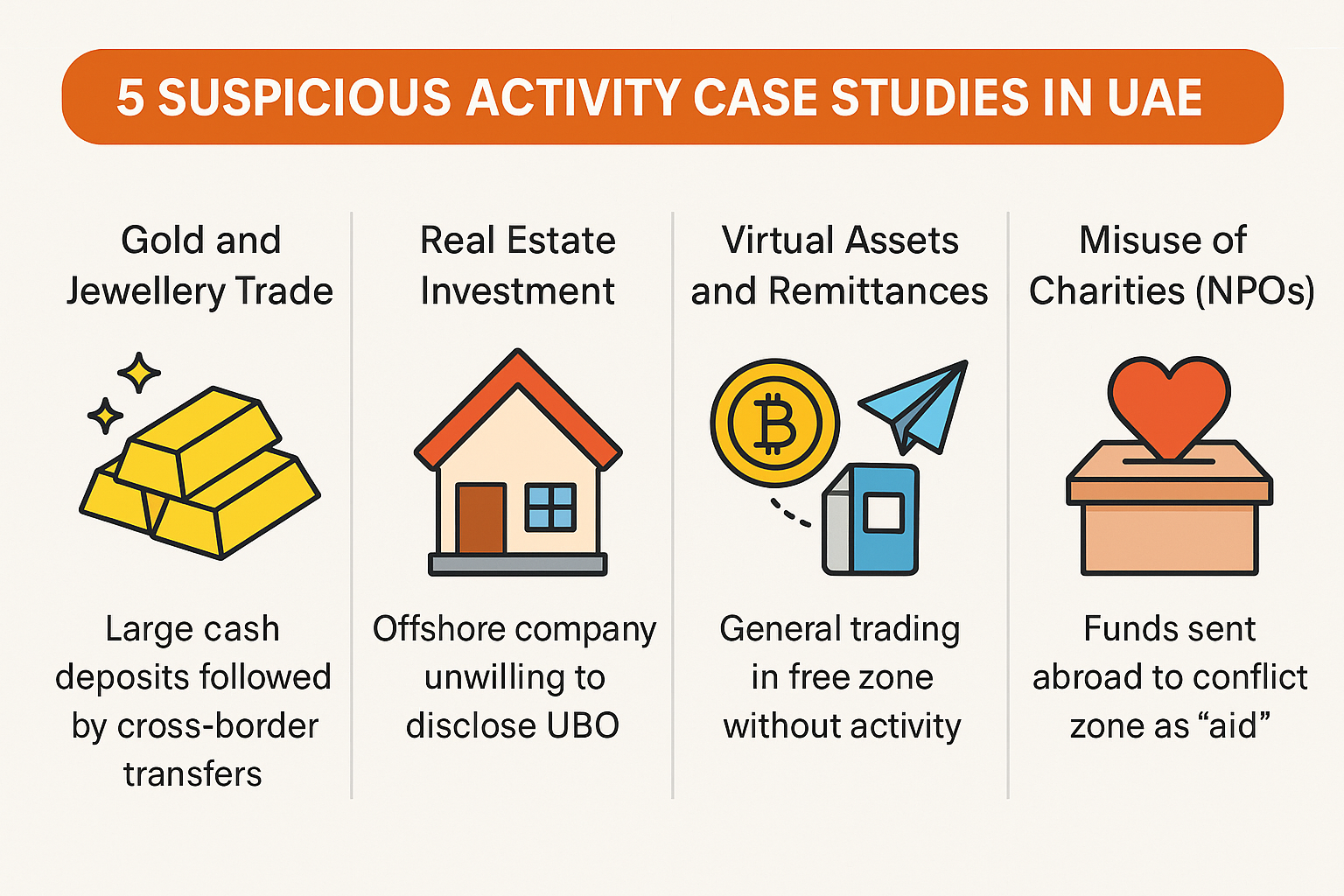
A Dubai-based jewellery trader recorded high sales volumes funded mainly through large cash deposits from unrelated third parties. Soon after, the funds were wired abroad to different jurisdictions. When regulators requested documentation, the company could not provide valid invoices or contracts.
Red Flags
• Excessive cash usage in a high-risk sector.
• Multiple unrelated depositors.
• Cross-border transfers without supporting trade documentation.
Lesson Learned
Gold and jewellery businesses must apply Enhanced Due Diligence (EDD), ensure invoicing transparency, and escalate suspicious patterns to the UAE FIU.
________________________________________
2. Real Estate Investment
Scenario
An offshore company incorporated in a secrecy jurisdiction purchased multiple luxury villas in Dubai. Payments were routed through a law firm’s client account, and the company refused to disclose its Ultimate Beneficial Owner (UBO).
Red Flags
• Offshore structure with no visible economic substance.
• Reluctance to disclose UBO.
• Use of professional intermediaries to distance true ownership.
Lesson Learned
Law firms and real estate brokers must not rely solely on intermediaries and should file Suspicious Activity Reports (SARs) when clients resist disclosure.
________________________________________
3. Virtual Assets and Remittance
Scenario
A money exchange noticed repeat transactions of just under AED 50,000 (the reporting threshold), sent to virtual asset wallets in high-risk countries. Customers used multiple IDs to disguise their activity.
Red Flags
• Structuring/smurfing transactions.
• Use of multiple identities.
• Transfers to sanctioned jurisdictions via VAs.
Lesson Learned
Exchanges and Virtual Asset Service Providers (VASPs) must integrate blockchain analytics tools and monitor small-value but repetitive transactions.
________________________________________
4. Shell Companies in Free Zones
Scenario
A “general trading” company registered in a UAE free zone claimed significant import/export activity on paper. However, physical inspections revealed no goods, no office space, and no employees.
Red Flags
• “General trading” with no clear activity.
• No staff, premises, or evidence of operations.
• High declared trade with no physical movement.
Lesson Learned
Authorities and auditors must apply Economic Substance Regulations (ESR) tests and ensure shell entities are not used to launder funds.
________________________________________
5. Misuse of Charities (NPOs)
Scenario
A charitable foundation collected large cash donations, which were quickly wired to a conflict region under the label of “humanitarian aid.” Beneficiary identities were vague and unverifiable.
Red Flags
• Heavy reliance on cash donations.
• Transfers to high-risk conflict zones.
• Weak or missing governance controls.
Lesson Learned
NPOs must ensure governance and transparency, while regulators and banks should classify them as high-risk clients requiring additional oversight.
________________________________________
✅ Conclusion
Suspicious activity often hides behind seemingly normal business operations. By analyzing these case studies, UAE businesses, DNFBPs, and financial institutions can sharpen their ability to detect red flags, apply risk-based due diligence, and report unusual transactions through goAML.
________________________________________
📌 About Us
At Sheikh Anwar Accounting & Auditing LLC, we help UAE businesses identify and mitigate suspicious activity risks through AML compliance programs, case-based training, outsourced MLRO services, and FIU reporting support.
📧 Email: info@sa-auditors.com
🌐 Website: www.sa-auditors.com