Can You Issue Backdated VAT Invoices?
Introduction
One of the common questions among VAT-registered businesses in the UAE is whether issuing backdated VAT invoices is legally permissible. While it might seem like a practical solution in cases of missed invoicing or administrative delay, the Federal Tax Authority (FTA) has clear expectations regarding invoice timing, content, and compliance.
In this article, we explain what backdated VAT invoices are, whether they're allowed, what risks are involved, and how to stay compliant.
________________________________________
✅ What Is a Backdated VAT Invoice?
A backdated invoice is an invoice that is issued after the actual supply of goods or services has taken place, but it reflects an earlier date – typically the date when the supply occurred or when it was due to be invoiced.
For example:
• You provided services on 5th May 2024
• But you issue the invoice on 20th June 2024
• You date the invoice as 5th May 2024 — this is a backdated invoice
________________________________________
🧾 Legal Requirements for VAT Invoice Timing in the UAE
According to Article 59 of the Executive Regulations to the UAE VAT Law:
• A Tax Invoice must be issued within 14 calendar days from the date of supply.
• The date of supply depends on factors like when goods are delivered, payment is received, or services are completed (Article 25–27).
🔸 For Continuous Supplies: If the contract specifies periodic payments, the date of supply is tied to those due dates.
________________________________________
⚠️ Is Backdating Allowed?
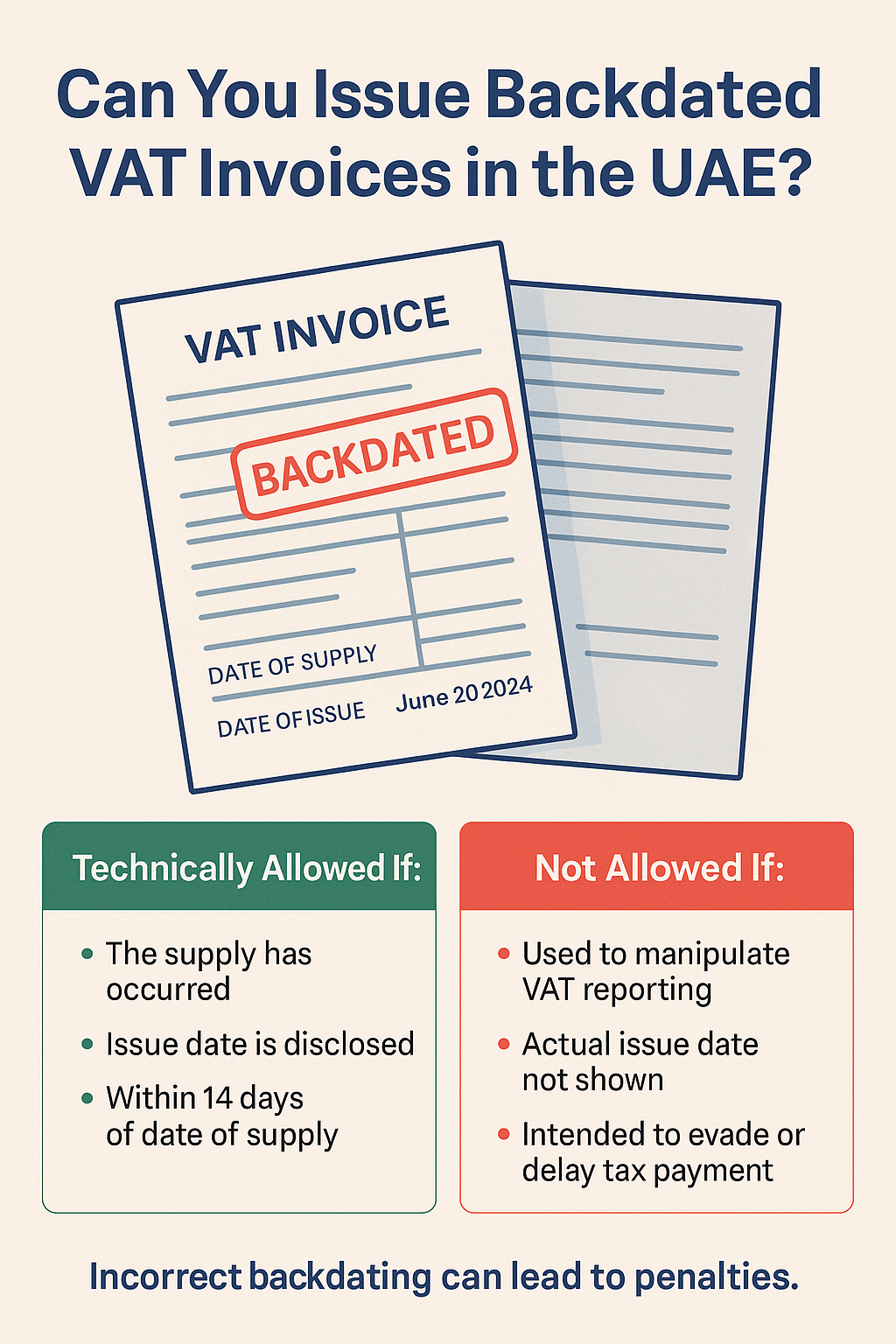
✅ Technically Allowed If:
• The supply already occurred and the invoice reflects that date for record-keeping accuracy, within legal boundaries
• You clearly mention the actual issue date along with the date of supply
• It is issued within 14 days from the date of supply
❌ Not Allowed If:
• You try to backdate the invoice to manipulate VAT return timing
• You fail to disclose the actual issue date
• You’re attempting to reduce payable VAT or delay tax payment intentionally
This could be seen as VAT evasion or misreporting, which may trigger FTA penalties.
________________________________________
🔎 Risks of Improper Backdating
1. Administrative Penalties:
Delayed issuance of invoices can lead to penalties of up to AED 5,000 per tax invoice as per Cabinet Decision No. 40 of 2017.
2. Audit Exposure:
Backdated invoices are a red flag during FTA audits and can trigger further investigation.
3. Input VAT Rejection:
If your customer claims input VAT using a backdated invoice outside the reporting period, FTA may deny their claim.
4. Cash Flow Issues:
Incorrect invoice timing can impact the expected VAT liability period and distort your cash flow forecasting.
________________________________________
📋 Best Practices to Stay Compliant
• Always issue tax invoices within 14 days of supply.
• If delayed, note both the supply date and actual issue date on the invoice.
• Keep internal records justifying the delay (e.g., service completion approval dates).
• Use automated accounting systems (like Finabooks) to track and generate VAT invoices on time.
• Reconcile VAT reporting periods with invoice dates regularly.
________________________________________
📌 How to Correct Late Invoicing
If you miss the 14-day limit:
• Do not falsify the date on the invoice.
• Issue the invoice with the actual date of issuance and correct supply date separately mentioned.
• Reflect the VAT in the return period when the invoice is actually issued.
________________________________________
🧮 Final Word
While backdating VAT invoices might seem like a harmless clerical action, it carries serious compliance risks if not handled properly. The FTA expects transparency, proper documentation, and accurate reporting.
If you’ve issued or received backdated invoices, consult with a VAT consultant or registered tax agent to assess exposure and correct the issue before it leads to penalties.
________________________________________
Need VAT compliance help?
📞 Contact Sheikh Anwar Accounting & Auditing LLC
🌐 www.sa-auditors.com
✅ Experts in FTA Audit Support, VAT Filing, and Record Review
📧 info@sa-auditors.com