Best Practices in Corporate Tax Documentation
Introduction
With the introduction of Corporate Tax (CT) in the UAE, proper documentation has become the backbone of compliance. The Federal Tax Authority (FTA) requires businesses to maintain accurate and complete records to support their tax returns, reconciliations, and transfer pricing disclosures.
Poor documentation can lead to penalties, adjustments, and increased audit risk. On the other hand, well-structured tax documentation demonstrates transparency, builds trust with regulators, and ensures businesses are always audit-ready.
Here, we outline the best practices in corporate tax documentation to help businesses establish a robust compliance framework.
________________________________________
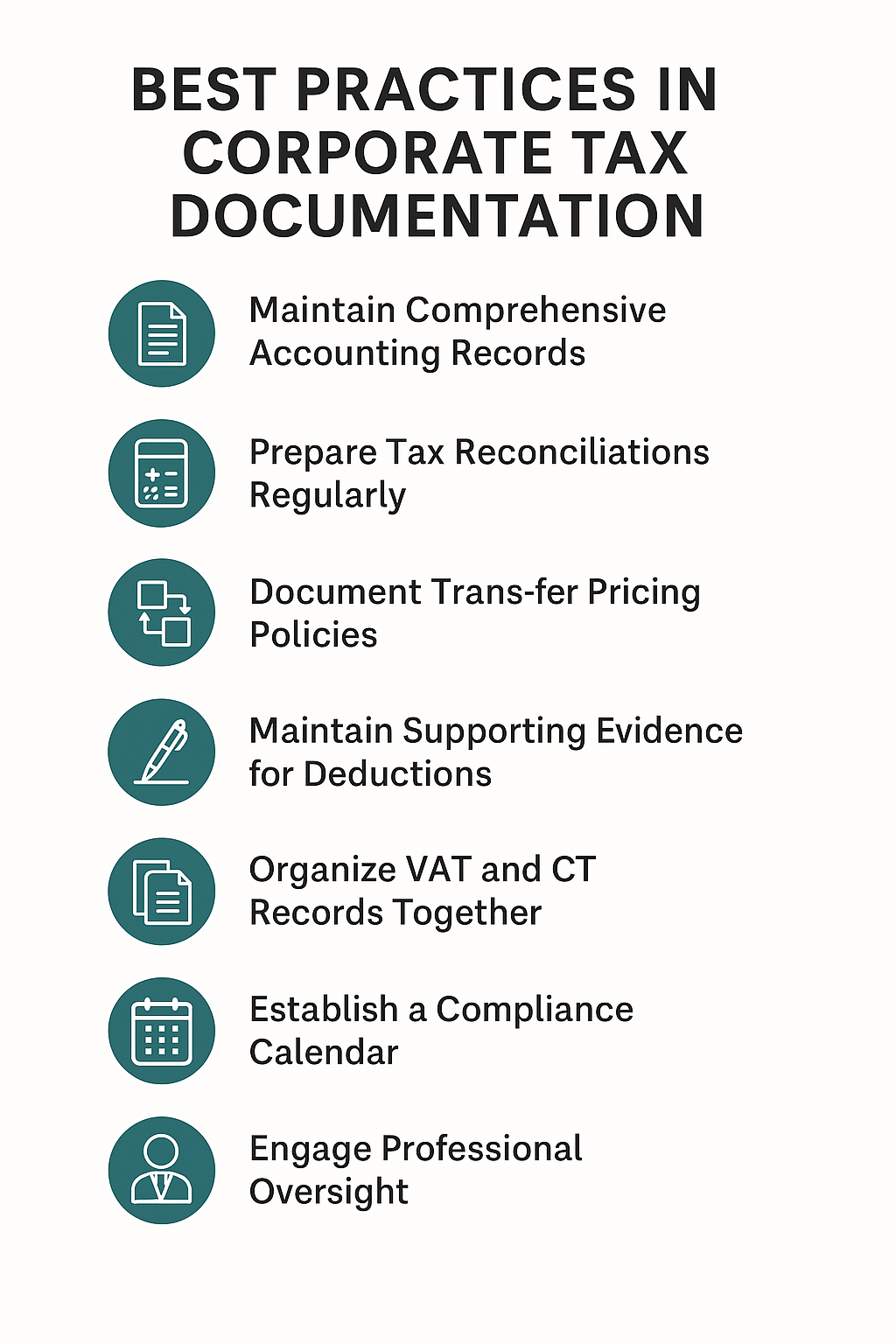
1. Maintain Comprehensive Accounting Records
Corporate Tax starts with reliable accounting data. Businesses must:
• Prepare financial statements in line with IFRS.
• Keep ledgers, trial balances, and reconciliations readily available.
• Record all journal entries with supporting documents (invoices, receipts, contracts).
Best Practice: Implement accounting software (ERP) that integrates tax modules to reduce manual errors.
________________________________________
2. Prepare Tax Reconciliations Regularly
Tax reconciliation bridges the gap between accounting profit and taxable income. To ensure accuracy:
• Identify non-deductible expenses (penalties, donations, entertainment costs).
• Adjust for exempt income (qualifying dividends, foreign PE income).
• Track timing differences (depreciation, provisions).
Best Practice: Conduct quarterly reconciliations instead of waiting until year-end to avoid last-minute surprises.
________________________________________
3. Document Transfer Pricing (TP) Policies
If your business has related-party transactions, Transfer Pricing compliance is critical. Documentation should include:
• Master File and Local File (if revenue crosses FTA thresholds).
• Benchmarking studies to justify arm’s length pricing.
• Intercompany agreements with clear terms.
Best Practice: Align with OECD guidelines and UAE CT law to avoid penalties of up to AED 500,000 for TP non-compliance.
________________________________________
4. Maintain Supporting Evidence for Deductions
Every deduction claimed in your tax return must be supported with documentation. For example:
• Interest expense → loan agreements and bank statements.
• R&D expenses → project reports, invoices, and payroll records.
• Provisions → board approvals and evidence of expected loss.
Best Practice: Keep digital and physical copies of all backup records for at least 7 years (as required by UAE law).
________________________________________
5. Organise VAT and CT Records Together
Many transactions affect both VAT and Corporate Tax. For example, sales invoices, purchase invoices, and expense claims.
• Cross-check VAT returns against CT records to ensure consistency.
• Use a single document management system to avoid duplication or mismatches.
Best Practice: Carry out periodic internal tax health checks to verify VAT–CT alignment.
________________________________________
6. Establish a Compliance Calendar
Missing filing or documentation deadlines can lead to penalties. A tax calendar should include:
• Corporate Tax registration and filing deadlines.
• VAT filing dates.
• Transfer Pricing disclosure deadlines.
• Annual audit report submission (where applicable).
Best Practice: Automate reminders through accounting software or compliance platforms.
________________________________________
7. Engage Professional Oversight
Even with strong internal processes, professional review ensures accuracy.
• Annual review of CT documentation by auditors or tax advisors.
• Independent verification of reconciliations and TP files.
• Updates on regulatory changes and their impact on documentation.
Best Practice: Invest in regular tax training and simulations for your finance team.
________________________________________
Conclusion
Corporate Tax documentation is not just a compliance requirement—it is a risk management and efficiency tool. By maintaining structured records, preparing reconciliations, documenting transfer pricing, and establishing compliance calendars, businesses can reduce risks, optimise tax positions, and be fully prepared for FTA audits.
________________________________________
How We Can Help
At Sheikh Anwar Accounting & Auditing LLC, we specialise in corporate tax documentation, reconciliations, VAT alignment, and transfer pricing compliance. Our team ensures your business is always audit-ready and compliant with UAE regulations.
📩 Contact us at info@sa-auditors.com | 🌐 www.sa-auditors.com