Best Practices for VAT Document Control
Introduction
As VAT compliance becomes increasingly critical for businesses in the UAE, having effective document control systems in place is essential. Proper management of VAT-related documents helps avoid regulatory penalties, facilitates smooth audits, and ensures accurate VAT return filing. This blog explores the best practices for VAT document control to help businesses meet their compliance obligations efficiently.
________________________________________
✅ What Is VAT Document Control?
VAT document control refers to the systematic management of all documents related to VAT, including invoices, receipts, returns, credit/debit notes, customs records, and accounting entries. It ensures these documents are:
• Accurately prepared
• Properly stored
• Easily retrievable
• Secure from unauthorized access or loss
• Readily available for FTA inspections
________________________________________
📄 Key Documents Required for VAT Compliance
UAE businesses must maintain and control the following VAT-related documents:
• Tax invoices (sales and purchases)
• Credit notes and debit notes
• VAT returns and payment receipts
• Import/export documentation (customs declarations, shipping papers)
• Trial balances and ledgers
• Input VAT and output VAT registers
• Contracts affecting tax liability
• Bank statements supporting transactions
• Audit logs of any changes to VAT records
________________________________________
🧩 Why VAT Document Control Is Important
• ✅ Ensures accurate VAT return filing
• ✅ Facilitates FTA audits and reviews
• ✅ Helps claim eligible input tax correctly
• ✅ Prevents loss or duplication of records
• ✅ Reduces the risk of penalties for non-compliance
________________________________________
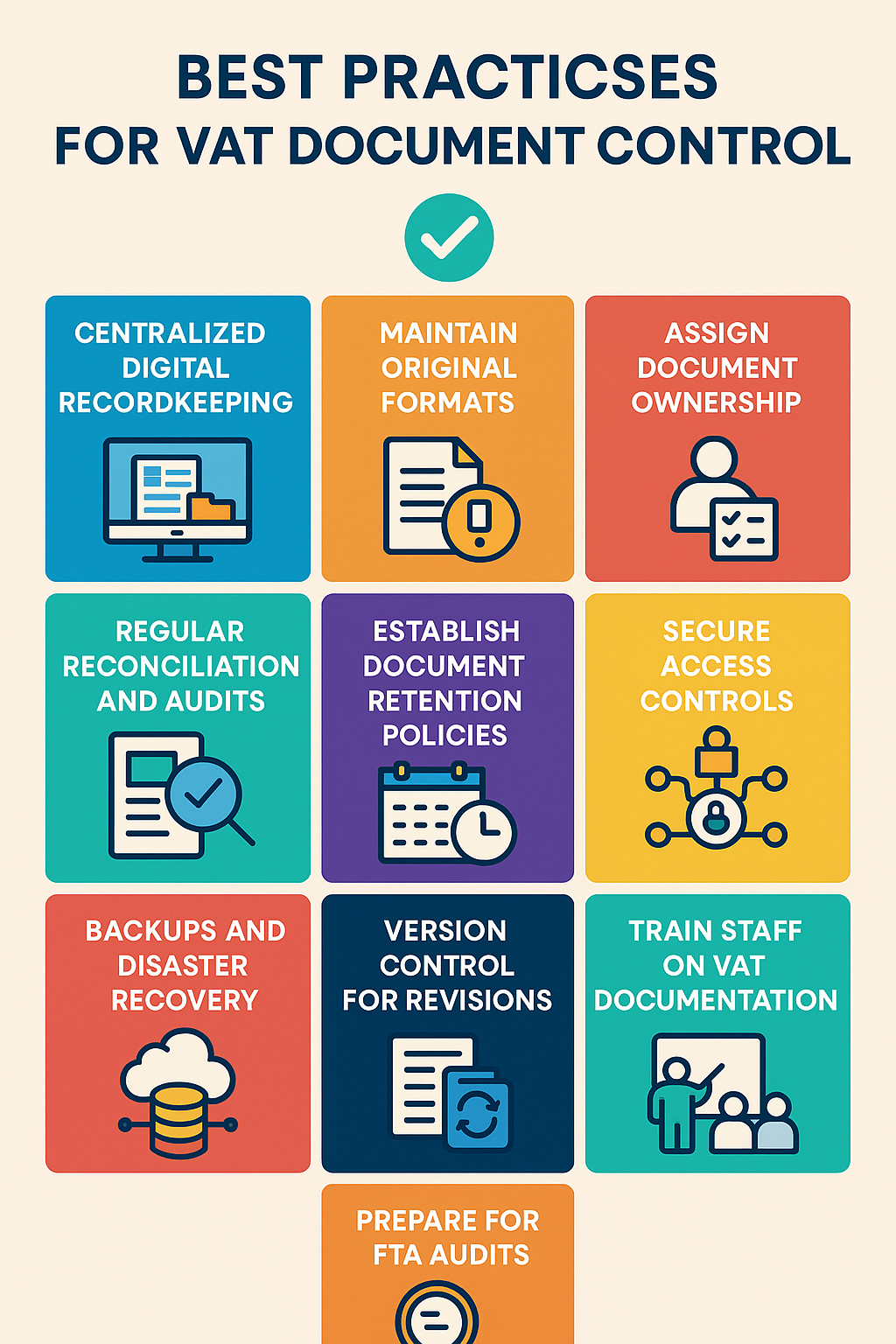
🛠️ Best Practices for VAT Document Control
1. Centralized Digital Recordkeeping
Use a document management system (DMS) or accounting software to centralize and automate the storage of VAT records. Ensure the system allows tagging, indexing, and quick retrieval.
Example: Store all invoices in cloud folders named by month/year and tag them by customer or supplier VAT number.
________________________________________
2. Maintain Original Formats
Whether physical or digital, keep the original format of invoices and receipts. Scanned copies are valid, provided they are clear and tamper-proof.
⚠️ The FTA may reject altered or low-quality scanned documents.
________________________________________
3. Assign Document Ownership
Assign responsibility to specific team members (e.g., the accountant or compliance officer) to ensure consistent and accountable control of VAT documents.
________________________________________
4. Regular Reconciliation and Audits
Periodically reconcile:
• Sales vs. output VAT
• Purchases vs. input VAT
• Invoices vs. accounting entries
Also, conduct internal audits quarterly to spot discrepancies early.
________________________________________
5. Establish Document Retention Policies
As per the UAE VAT law:
• Minimum retention: 5 years
• Real estate transactions: 15 years
Use calendar reminders or automated alerts to track retention periods.
________________________________________
6. Secure Access Controls
Protect VAT records with:
• Role-based access (limit document editing/deletion)
• Password-protected systems
• Multi-factor authentication (MFA)
This ensures data integrity and prevents fraud or loss.
________________________________________
7. Backups and Disaster Recovery
Regularly back up digital documents to multiple secure locations (e.g., local drive + cloud). Maintain a disaster recovery plan for unexpected data loss due to hardware failure or cyberattacks.
________________________________________
8. Version Control for Revisions
Use software that tracks versions or changes to VAT records. This helps retain the history of changes and supports transparency during audits.
________________________________________
9. Train Staff on VAT Documentation
Conduct regular training sessions for accounting and finance staff on:
• VAT invoice requirements
• Document preparation and storage
• FTA compliance updates
This reduces human error and strengthens compliance culture.
________________________________________
10. Prepare for FTA Audits
Always keep VAT records in an FTA-accessible format (Excel, PDF, etc.). Store them in both English and Arabic, as required by UAE law.
________________________________________
❌ Common Mistakes to Avoid
• Storing invoices in non-standard formats (e.g., WhatsApp images)
• Mixing personal and business expense records
• Failing to retain proof of reverse charge transactions
• Not filing supporting contracts or credit notes
________________________________________
🔍 Final Thoughts
Strong VAT document control is essential not only for compliance but also for sound financial management. By following the above best practices, UAE businesses can build a reliable and efficient VAT documentation framework, minimize risks, and stay audit-ready at all times.
________________________________________
💼 Need Help Setting Up Your VAT System?
Sheikh Anwar Accounting & Auditing LLC specializes in VAT compliance, audit preparation, and digital archiving solutions. Contact our team to implement best-in-class VAT document control practices in your business.
🌐 Visit us: www.sa-auditors.com
📧 Email: info@sa-auditors.com
📱 WhatsApp: +971-XX-XXXXXXX