Best Practices for Maintaining VAT Records in the UAE
Introduction
Maintaining proper VAT records isn’t just good accounting practice—it’s a legal obligation under UAE VAT Law. The Federal Tax Authority (FTA) requires businesses to keep clear, organized, and accessible records for at least five years (or 15 years for real estate transactions). Poor documentation can lead to non-compliance penalties, especially during audits or tax reviews.
In this blog, we outline the best practices for maintaining VAT records to ensure compliance and audit readiness.
________________________________________
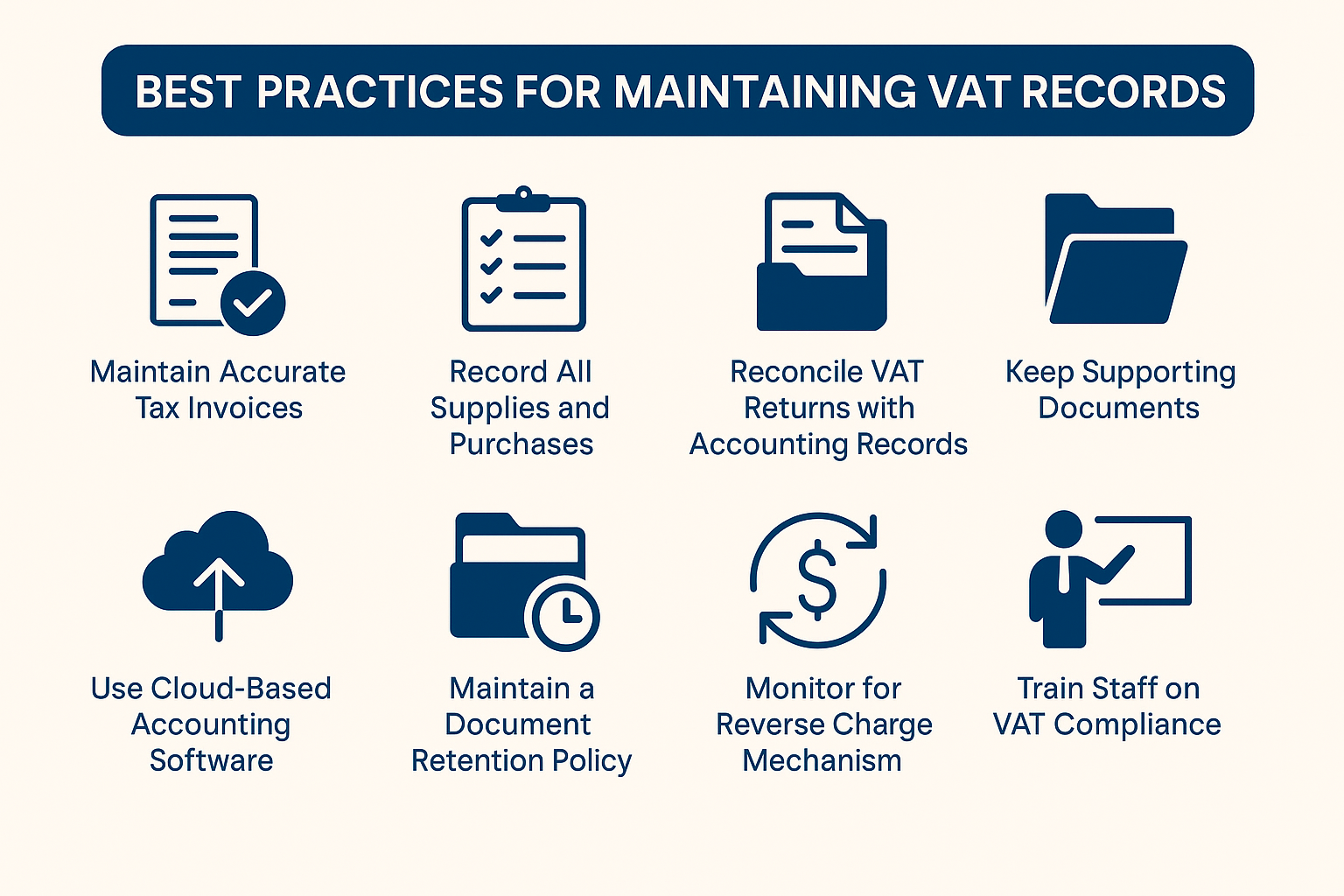
✅ 1. Maintain Accurate Tax Invoices
Ensure every tax invoice includes:
• Supplier and customer TRNs
• Invoice number and date
• Description of goods/services
• VAT rate and amount
🔍 Use automated invoicing tools that meet FTA guidelines.
________________________________________
✅ 2. Record All Supplies and Purchases
Maintain complete logs of:
• All sales (standard, zero-rated, exempt)
• All purchases with recoverable input VAT
🔁 Categorize transactions correctly for easy reconciliation.
________________________________________
✅ 3. Reconcile VAT Returns with Accounting Records
Match your VAT return figures with:
• Sales ledgers
• Purchase registers
• Bank statements
🧾 Discrepancies may lead to audits or penalties.
________________________________________
✅ 4. Keep Supporting Documents
Store all relevant backup documents, including:
• Contracts
• Import/export documentation
• Debit/credit notes
• Tax credit notes
📦 Scan and digitize paper documents for secure storage.
________________________________________
✅ 5. Use Cloud-Based Accounting Software
Adopt VAT-compliant tools that:
• Automate calculations
• Generate return-ready reports
• Back up data securely
☁️ Software like Finabooks, Zoho Books, or QuickBooks can help.
________________________________________
✅ 6. Maintain a Document Retention Policy
UAE VAT law mandates retention for:
• 5 years for general records
• 15 years for real estate businesses
📁 Define a structured archiving system by tax period.
________________________________________
✅ 7. Monitor for Reverse Charge Mechanism (RCM)
If you import goods/services, ensure:
• Proper documentation of reverse charge VAT
• Internal records reflect both input and output VAT
🔄 Apply RCM only where required.
________________________________________
✅ 8. Train Staff on VAT Compliance
Ensure your finance and operations teams are aware of:
• What documents are needed
• Record formats required by FTA
• Key VAT treatments for different transactions
👩💼 Ongoing training reduces the risk of non-compliance.
________________________________________
✅ 9. Perform Periodic Internal Audits
Regularly review:
• Record completeness
• VAT treatment accuracy
• System backups and access logs
🕵️ Helps in catching errors before FTA notices.
________________________________________
✅ 10. Stay Updated on FTA Guidelines
FTA frequently updates VAT clarifications and formats.
🌐 Follow official circulars or subscribe to compliance alerts.
________________________________________
🧠 Final Thoughts
Good recordkeeping not only reduces risk but also saves time, especially during tax inspections. Adopting the right tools and practices helps you stay compliant and audit-ready.
If you need assistance in setting up your VAT record system, accounting software, or internal audits, reach out to Sheikh Anwar Accounting & Auditing LLC.

