Bad Debts and Tax Treatment
Introduction
In business, extending credit is a common practice. However, not all debts are recoverable. When a customer defaults or becomes insolvent, businesses must write off such receivables as bad debts. Under the UAE Corporate Tax Law, the treatment of bad debts is addressed clearly, allowing businesses to claim a deduction—but only if specific conditions are met.
Sheikh Anwar Accounting and Auditing LLC provides a comprehensive guide to understanding the eligibility, documentation, and tax implications of bad debt deductions under the UAE Corporate Tax framework.
________________________________________
📘 Legal Reference
The tax treatment of bad debts is governed by:
• Federal Decree-Law No. 47 of 2022 on the Taxation of Corporations and Businesses
• Ministerial Decision No. 114 of 2023 on Determining Conditions for Deducting Bad Debts
________________________________________
✅ What is a Bad Debt?
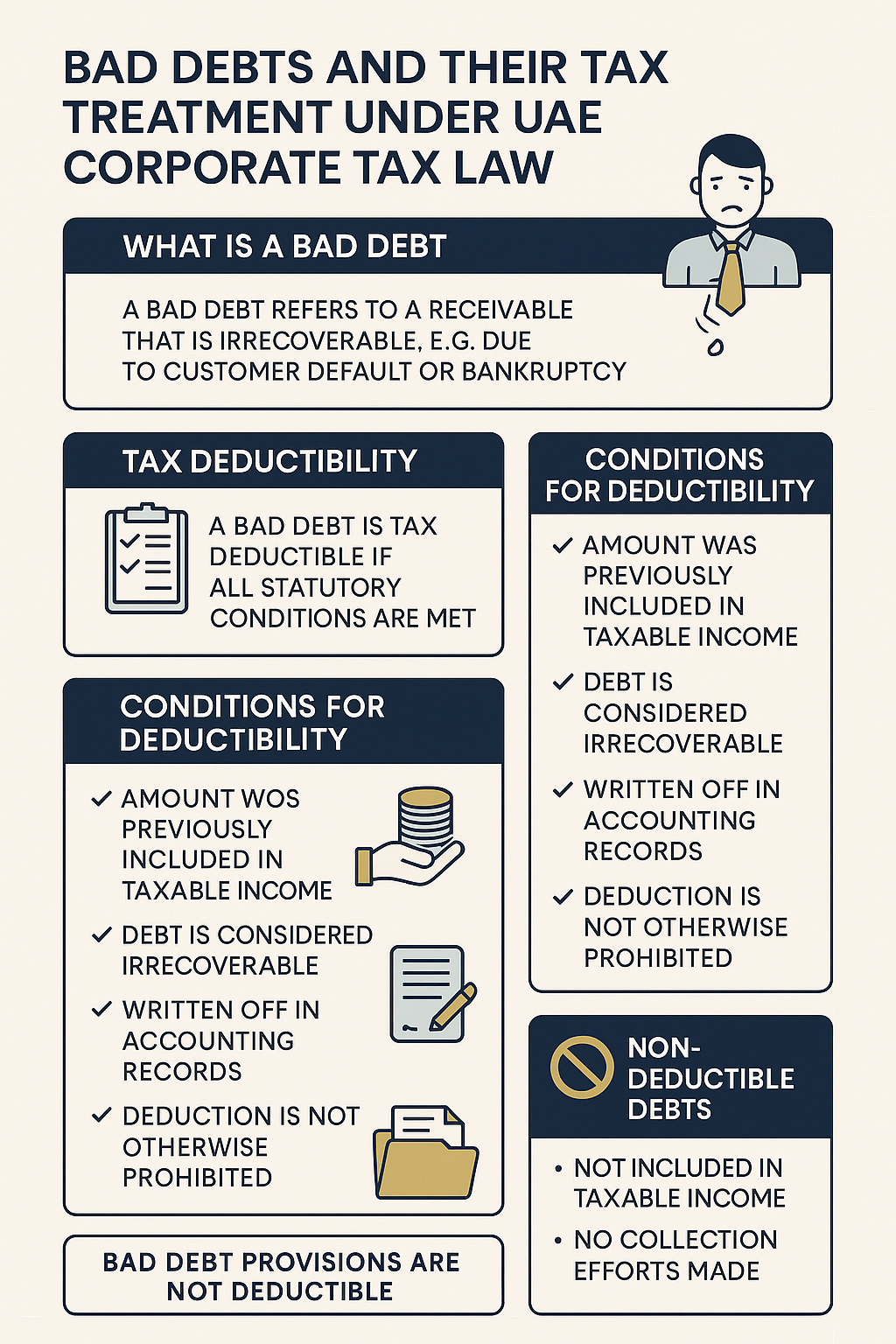
A bad debt refers to a receivable or amount owed to the business that has become irrecoverable, either due to the financial condition of the debtor or legal impossibility of collection.
Typical examples of bad debts include:
• Customer default on trade receivables
• Bankruptcy of a client
• Legal disputes that result in unrecoverable claims
• Long overdue invoices with no realistic chance of payment
________________________________________
🧾 Tax Deductibility of Bad Debts
Under UAE Corporate Tax Law, bad debts are allowed as a tax-deductible expense, provided that all statutory conditions are satisfied.
________________________________________
📌 Conditions for Deductibility
To claim a deduction for a bad debt, all of the following conditions must be met:
1. The amount was previously included in taxable income
o The bad debt must have been recognized as part of the business’s revenue in a current or previous tax period.
2. The debt must be irrecoverable
o Reasonable actions to collect the debt must have been taken, including:
Legal notices
Collection attempts
Reminders or restructuring efforts
3. The business has written off the debt in its accounting records
o A formal write-off entry should be made, reducing accounts receivable.
4. The deduction is not prohibited under other provisions
o For example, debts due from related parties or non-arm’s-length transactions may not qualify.
________________________________________
💡 Important Notes
• Provision for doubtful debts is NOT deductible.
Only actual bad debts that are written off and meet the criteria above are deductible.
• Debt settlements through asset seizure or offset must be taken into account—only the unrecovered balance qualifies for deduction.
________________________________________
🧠 Example Scenario
ABC Trading LLC has an outstanding invoice of AED 50,000 from a customer since 2022. Despite multiple follow-ups and legal notices, the customer filed for liquidation in 2024.
Criteria Status
Amount included in taxable income? ✅ Yes (in 2022 revenue)
Collection attempts made? ✅ Yes (emails, notices)
Written off in books? ✅ Yes (in 2024 accounts)
Related party transaction? ❌ No
✅ Conclusion: The AED 50,000 qualifies as a deductible bad debt in 2024.
________________________________________
📂 Required Documentation
To support the deduction in case of FTA audit, businesses must maintain:
• Copies of invoices and contracts related to the debt
• Proof of collection efforts (reminder emails, notices, legal letters)
• Accounting ledger showing the write-off
• Legal documents (if customer declared bankrupt or liquidated)
• Board resolution (if applicable)
Sheikh Anwar Accounting and Auditing LLC helps clients maintain FTA-ready documentation and accounting records for bad debt claims.
________________________________________
❌ Non-Deductible Situations
• Debts never included in taxable income
• Debts between related parties under non-arm’s-length terms
• Contingent debts or amounts not legally enforceable
• Debts written off without collection efforts
• Provisions for doubtful debts that haven’t been confirmed as bad
________________________________________
🏢 Free Zone Entities and Bad Debts
Free Zone entities subject to 9% Corporate Tax must also follow these rules. The same deductibility criteria apply when bad debts are incurred on qualifying or non-qualifying income.
________________________________________
🔍 Bad Debts vs. VAT Adjustment
Important: VAT and Corporate Tax treat bad debts differently:
Aspect VAT Corporate Tax
Adjustment allowed? Yes, via VAT return (after 6 months) Yes, as expense in tax period
Documentation required Tax invoice, proof of no payment, collection efforts Same + accounting write-off
Deadline for claim Within the statute of limitation (5 years) Within the relevant tax year
Our firm also assists clients in adjusting VAT on bad debts under Cabinet Decision No. 52 of 2017 (VAT Law).
________________________________________
📣 Final Thoughts
Bad debts can impact both your cash flow and tax position. While the UAE Corporate Tax Law allows for deductions, businesses must ensure they:
• Meet all eligibility conditions
• Maintain proper documentation
• Write off the debt correctly in accounting records
Incorrectly claimed bad debts can lead to penalties during FTA audits. Sheikh Anwar Accounting and Auditing LLC provides expert support to review bad debts, apply the proper tax treatment, and keep your filings compliant.
________________________________________
📩 Need support in claiming bad debt deductions?
🌐 Visit: www.sa-auditors.com
📧 Email: info@sa-auditors.com
________________________________________