Automation in AML Reporting – Pros & Cons
Introduction
As money laundering schemes grow in scale and sophistication, businesses in the UAE and around the world face increasing pressure to comply with strict Anti-Money Laundering (AML) regulations. Manual reporting processes are slow, error-prone, and often fail to keep pace with regulatory expectations. To address these challenges, many financial institutions and DNFBPs are turning to automation in AML reporting.
Automation, powered by AI, machine learning, and RegTech tools, streamlines the preparation and submission of reports such as Suspicious Transaction Reports (STRs), Large Cash Transaction Reports (LCTRs), and cross-border fund transfers. While the benefits are clear, automation also introduces challenges that organizations must carefully evaluate.
The Role of Automation in AML Reporting
Automation in AML involves:
Collecting and analyzing transaction data in real time.
Generating alerts for unusual activity.
Pre-filling regulatory forms such as STRs and SARs.
Submitting reports securely to portals like goAML in the UAE.
Maintaining an audit trail for regulatory inspections.
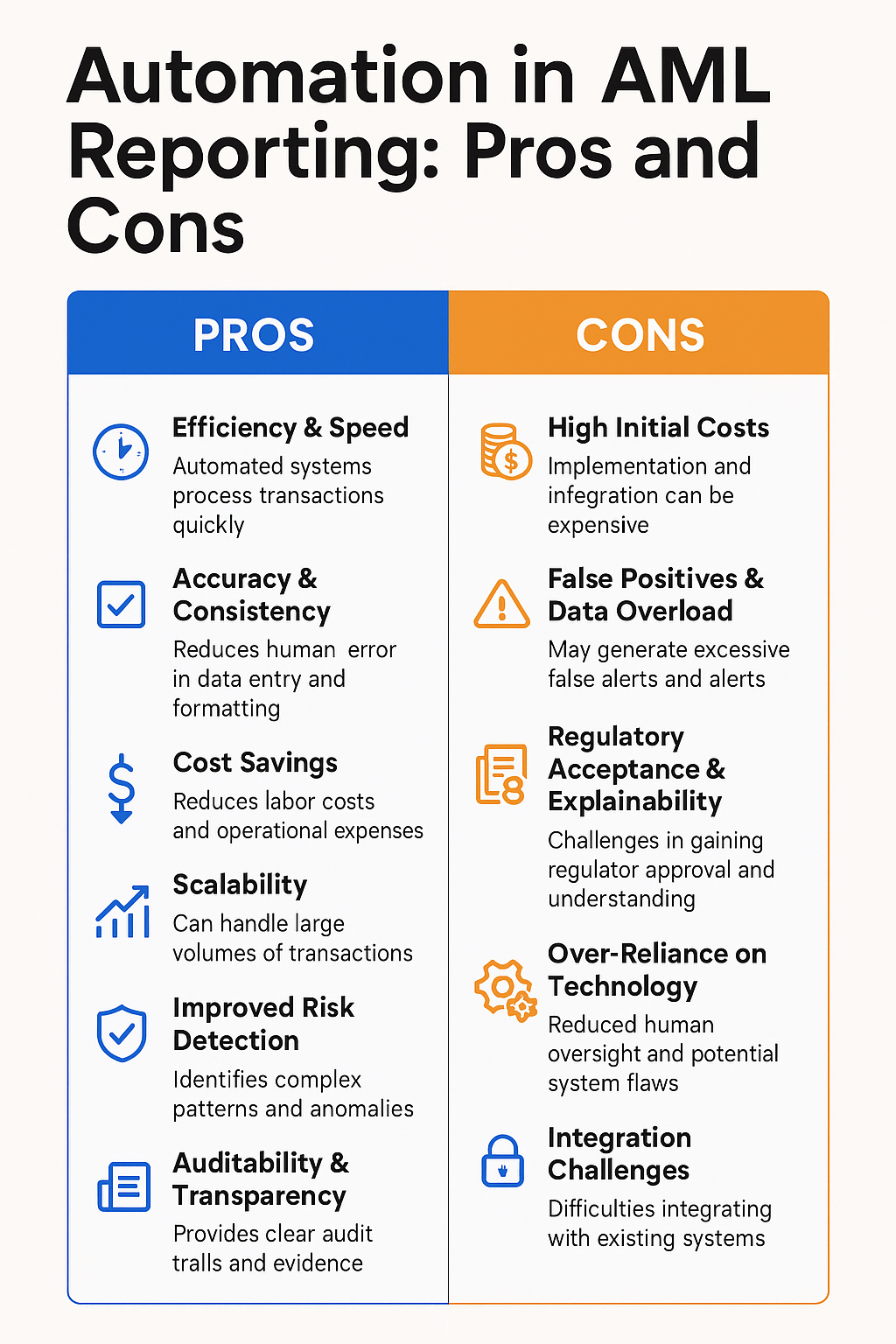
Pros of Automation in AML Reporting
1. Efficiency & Speed
Automated systems process thousands of transactions in seconds.
Suspicious activity is flagged in real time, enabling faster reporting to regulators.
2. Accuracy & Consistency
Reduces human error in data entry, formatting, or report structuring.
Ensures reports comply with regulatory templates (e.g., UAE FIU requirements).
3. Cost Savings
Minimizes the need for large manual compliance teams.
Long-term savings by reducing penalties and resource strain.
4. Scalability
Handles increasing volumes of transactions as businesses grow.
Suitable for SMEs, DNFBPs, and multinational financial institutions alike.
5. Improved Risk Detection
Machine learning models learn from historical cases to detect emerging risks.
Analytics tools identify complex patterns such as layering or smurfing.
6. Auditability & Transparency
Creates automatic logs of all alerts and reports submitted.
Provides regulators with clear evidence during inspections.
Cons of Automation in AML Reporting
1. High Initial Costs
Implementing automated AML tools and integrating them with legacy systems requires significant investment.
2. False Positives & Data Overload
While automation reduces errors, poorly tuned systems may still generate excessive false positives.
Compliance teams may struggle to prioritize alerts.
3. Regulatory Acceptance & Explainability
Regulators often demand transparency in how alerts are generated.
Black-box AI systems can be difficult to explain during inspections.
4. Over-Reliance on Technology
Excessive dependence on automation may reduce human oversight.
Criminals may adapt quickly to system patterns, bypassing detection.
5. Integration Challenges
Legacy IT systems in banks or DNFBPs may not integrate smoothly with new RegTech solutions.
Customization for sector-specific risks (gold, real estate, legal services) can be complex.
6. Data Privacy Concerns
Automated systems rely on vast customer data sets.
Strong cybersecurity measures are needed to avoid breaches.
Best Practices for UAE Businesses
Hybrid Approach – Combine automation with human judgment for STR review.
Tailored Configuration – Adjust thresholds to reduce false positives.
Continuous Model Training – Regularly update ML models with new case outcomes.
Regulator Engagement – Work with the UAE FIU and free zone authorities to ensure system alignment.
Data Security – Adopt strong encryption and access controls.
Staff Training – Train compliance officers to interpret automated outputs.
Conclusion
Automation is transforming AML reporting by making it faster, more accurate, and scalable. For UAE businesses, adopting automation means meeting FIU goAML reporting obligations with greater confidence while reducing compliance burdens. However, automation is not a silver bullet—organizations must balance efficiency with transparency, regulatory alignment, and human oversight.
When implemented thoughtfully, automation in AML reporting strengthens compliance frameworks, reduces risk exposure, and supports the UAE’s mission to maintain a secure, transparent financial ecosystem.
About Us
Sheikh Anwar Accounting and Auditing LLC helps UAE businesses integrate AML automation tools, register with goAML, and strengthen compliance programs. We provide outsourced MLRO services, AML training, and RegTech advisory solutions tailored to DNFBPs and financial institutions.
📧 Email: info@sa-auditors.com
🌐 Website: www.sa-auditors.com
☎️ Contact: +971 4 123 4567