AML Training Requirements for DNFBPs
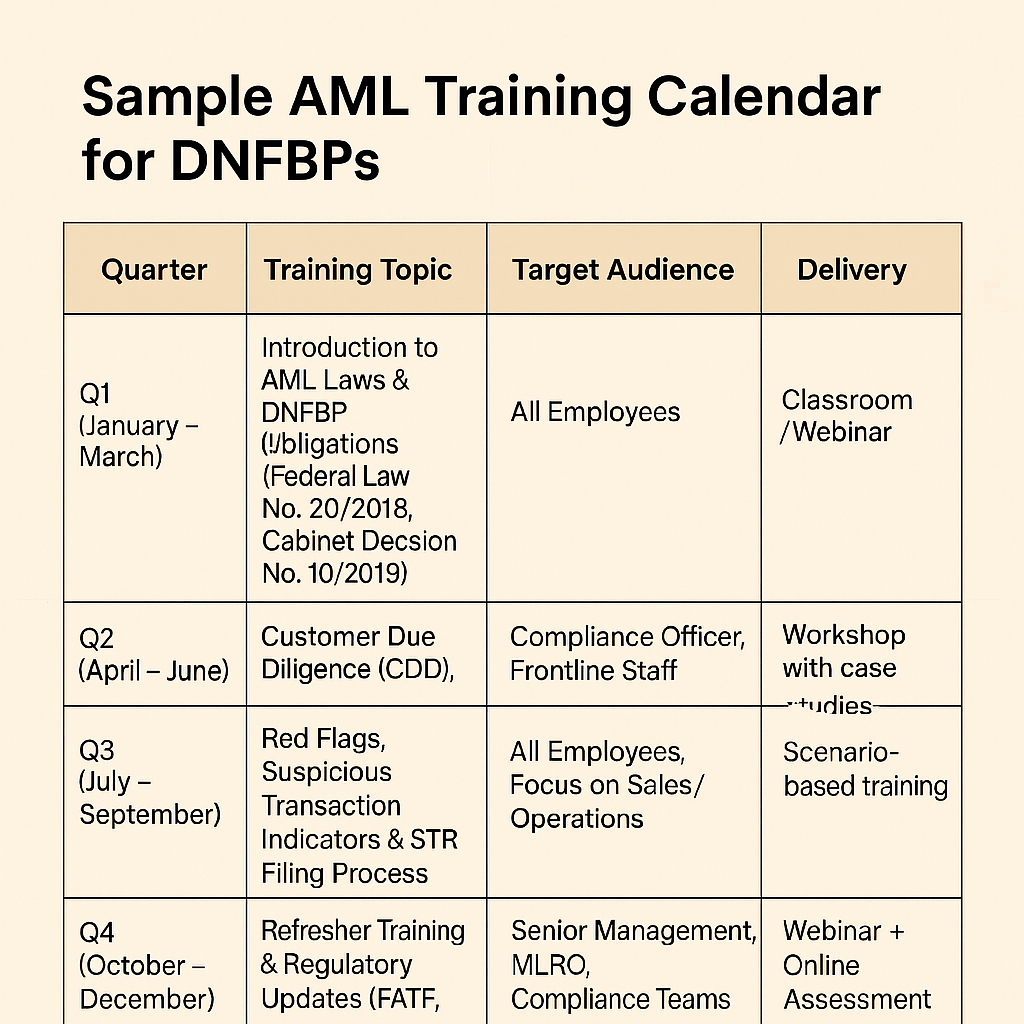
Introduction
Designated Non-Financial Businesses and Professions (DNFBPs) play a pivotal role in safeguarding the UAE’s financial system against money laundering (ML) and terrorist financing (TF). The Ministry of Economy (MOE), in line with Federal Decree-Law No. 20 of 2018 and Cabinet Decision No. 10 of 2019, mandates that DNFBPs implement robust Anti-Money Laundering (AML) and Counter-Terrorist Financing (CTF) frameworks. A critical component of these frameworks is ongoing staff training.
Training ensures employees understand their obligations, can identify red flags, and fulfil their reporting duties effectively. Failure to provide proper training can result in heavy regulatory penalties and reputational damage.
________________________________________
Who Needs Training?
AML training is not limited to compliance officers. It must extend across multiple levels of the DNFBP, including:
• Senior Management / Board Members – to understand accountability and liability.
• Compliance Officer (MLRO/Deputy MLRO) – for advanced knowledge of AML regulations and reporting obligations.
• Frontline Staff – sales, brokers, accountants, or customer-facing staff who directly interact with clients.
• Back-office and Support Teams – to ensure proper documentation, record-keeping, and escalation processes.
________________________________________
Scope of AML Training
The AML training program for DNFBPs should be tailored to the size, nature, and risk profile of the business. It typically covers:
1. Legal & Regulatory Framework
o Federal Decree-Law No. 20 of 2018.
o Cabinet Decision No. 10 of 2019.
o MOE Guidelines for DNFBPs.
o goAML registration and reporting obligations.
2. Roles & Responsibilities
o Duties of senior management.
o Obligations of MLROs and staff.
o Importance of internal escalation procedures.
3. Customer Due Diligence (CDD) & Enhanced Due Diligence (EDD)
o KYC requirements (verification of customer identity, beneficial ownership).
o Risk-based approach (low, medium, and high-risk clients).
o Ongoing monitoring of customer transactions.
4. Red Flags and Suspicious Indicators
o Unusual cash transactions.
o Structuring/smurfing techniques.
o Clients unwilling to provide information.
o High-risk jurisdictions and sanctions exposure.
5. Suspicious Transaction Reporting (STRs) and SARs
o Identifying and documenting suspicious activity.
o Reporting to the MLRO and filing through goAML.
o Importance of timeliness and confidentiality.
6. Record-Keeping Requirements
o Retention of CDD documents and transaction records for at least five years.
o Ensuring accessibility for regulators when required.
7. Sanctions & Penalties
o Administrative penalties for non-compliance (up to AED 5 million).
o Reputational damage and business risks.
________________________________________
Frequency and Format of Training
• Initial Training: Mandatory at the time of hiring or assignment to relevant roles.
• Ongoing / Annual Training: Refresher courses to ensure staff remain updated on regulatory changes.
• Ad-hoc Training: Conducted when there are major updates (e.g., new FATF recommendations, new Cabinet Decisions, or MOE circulars).
Training Methods may include:
• In-person workshops.
• Online learning modules (self-paced or instructor-led).
• Case studies and scenario-based exercises.
• Certification programs (e.g., ACAMS, ICA, or locally recognized AML certifications).
________________________________________
Role of the MLRO in Training
The Money Laundering Reporting Officer (MLRO) plays a central role in training by:
• Designing and updating AML training programs.
• Keeping staff aware of emerging risks and FATF updates.
• Ensuring training records (attendance, test results) are maintained for regulators.
• Providing specialized training to high-risk business units.
________________________________________
Best Practices for DNFBPs
• Document all training sessions (dates, participants, topics covered).
• Maintain a training calendar aligned with regulatory inspection cycles.
• Conduct knowledge assessments or quizzes to test staff awareness.
• Update training content to reflect evolving typologies and regulatory updates.
• Consider engaging external experts for specialized AML training.
________________________________________
Conclusion
For DNFBPs in the UAE, AML training is not a one-time activity but an ongoing obligation. An effective program builds awareness, strengthens compliance culture, and mitigates the risk of penalties or reputational harm. By investing in continuous training, DNFBPs can demonstrate their commitment to regulatory compliance and play their part in protecting the UAE’s financial system.
________________________________________
👉 If you’d like, I can also add practical case studies and sample training calendar templates so that your blog looks more engaging and actionable. Would you like me to expand it with that?
You said:
not like this make very professional for company also mention company detaiels below
ChatGPT said:
Got it 👍 — I’ll make it more corporate, professional, and blog-ready with proper structure, tone, and your company details at the end. Here’s the refined version:
________________________________________
AML Training Requirements for DNFBPs in the UAE
Introduction
The United Arab Emirates (UAE) has established itself as a global financial and trade hub, attracting businesses and investors from across the world. With this growth, however, comes the increased responsibility to safeguard the integrity of the financial system. To this end, the UAE has implemented a robust Anti-Money Laundering and Counter-Terrorist Financing (AML/CFT) framework, requiring compliance from both financial institutions and Designated Non-Financial Businesses and Professions (DNFBPs).
Among the key obligations imposed on DNFBPs is the requirement to establish and maintain a comprehensive AML training program. Training ensures that employees, management, and compliance officers are fully equipped to recognize, prevent, and report suspicious activities.
________________________________________
Regulatory Framework for AML Training
AML training requirements for DNFBPs are primarily guided by:
• Federal Decree-Law No. 20 of 2018 on Anti-Money Laundering and Combating the Financing of Terrorism and Illegal Organisations.
• Cabinet Decision No. 10 of 2019 concerning the Implementing Regulations of the AML Law.
• Guidance issued by the Ministry of Economy (MOE) for DNFBPs.
• International standards, such as the Financial Action Task Force (FATF) Recommendations.
These frameworks mandate that DNFBPs implement ongoing training programs tailored to their nature, size, and risk profile.
________________________________________
Who Should Receive AML Training?
AML training is not limited to compliance teams but must extend across the organization. The following groups require structured training:
• Senior Management and Board Members – to understand accountability, oversight responsibilities, and legal liabilities.
• Money Laundering Reporting Officer (MLRO) and Deputy MLRO – advanced training on regulatory requirements, suspicious transaction reporting, and goAML obligations.
• Frontline Staff – sales teams, brokers, agents, and employees dealing with customers directly.
• Back-office and Support Teams – finance, accounting, and administrative staff handling documentation and reporting.
________________________________________
Key Components of AML Training for DNFBPs
An effective training program should cover, at a minimum, the following areas:
1. Regulatory Requirements
o Federal AML Law and Cabinet Decisions.
o MOE DNFBP guidelines and sector-specific circulars.
o Obligations related to goAML registration and reporting.
2. Risk-Based Approach
o Customer risk profiling (low, medium, high risk).
o Country risk, sectoral risk, and transaction monitoring.
3. Customer Due Diligence (CDD) and Enhanced Due Diligence (EDD)
o Verification of identity and beneficial ownership.
o Ongoing monitoring of business relationships.
4. Suspicious Transaction Reporting (STRs)
o Identifying suspicious activity.
o Internal escalation and reporting to the MLRO.
o Timely filing of STRs on goAML.
5. Red Flags and Typologies
o Large or unusual cash transactions.
o Structuring/smurfing attempts.
o Dealings with high-risk jurisdictions.
6. Record-Keeping and Documentation
o Retention of CDD and transaction records (minimum five years).
o Ensuring accessibility to regulators during inspections.
7. Sanctions and Penalties
o Administrative fines of up to AED 5 million for non-compliance.
o Regulatory consequences, including business suspension or license revocation.
________________________________________
Frequency and Delivery of Training
• Initial Training – upon hiring or role reassignment.
• Annual Refresher Training – mandatory to keep employees updated.
• Ad-hoc Training – when significant regulatory updates or new typologies are introduced.
Training Delivery Methods:
• Classroom workshops.
• Online training sessions.
• Case study-based simulations.
• Industry-recognized certifications (ACAMS, ICA, etc.).
________________________________________
Role of the MLRO in Training
The MLRO/Deputy MLRO is responsible for:
• Designing and updating the AML training program.
• Monitoring attendance and ensuring compliance across all staff.
• Conducting periodic awareness sessions on new AML risks.
• Maintaining training records for regulatory inspections.
________________________________________
Best Practices for DNFBPs
• Maintain a formal training calendar aligned with regulatory inspection cycles.
• Document each training session, including attendance, topics covered, and assessments.
• Customize training content according to business activities (e.g., gold trading, real estate, legal practices).
• Periodically test staff knowledge through assessments or quizzes.
• Engage external AML specialists to deliver advanced or sector-specific sessions.
________________________________________
Conclusion
For DNFBPs in the UAE, AML training is more than a regulatory formality—it is an essential safeguard against financial crime. By ensuring all employees are well-trained and regularly updated, DNFBPs not only remain compliant with UAE laws but also build a culture of integrity and risk awareness.
A well-structured training program demonstrates the business’s commitment to compliance and reinforces trust with regulators, customers, and international partners.
________________________________________
About Us
Sheikh Anwar Accounting and Auditing LLC is a leading auditing and compliance advisory firm based in Dubai, UAE. With specialized expertise in AML compliance, corporate tax, transfer pricing, and auditing for the gold and diamond sector, we assist DNFBPs in meeting their regulatory obligations through:
• AML Policy drafting and implementation.
• MLRO/Deputy MLRO outsourcing services.
• Customized AML training programs for DNFBPs.
• goAML registration and reporting support.
• Ongoing compliance monitoring and advisory.
📍 Office: Dubai Creek Tower, M 35, Dubai, UAE
🌐 Website: www.sa-auditors.com
📧 Email: info@sa-auditors.com