AML Testing & Assurance Programs
Introduction
The UAE has established a robust regulatory framework to combat money laundering and terrorist financing, with strong emphasis on continuous testing and assurance of compliance systems. Beyond having an AML policy and program in place, regulators expect entities to demonstrate that their controls are effective, regularly tested, and independently assured.
It outlines what AML testing and assurance means, its key components, and how businesses in the UAE—especially DNFBPs and financial institutions—can implement it.
________________________________________
1. What is AML Testing & Assurance?
AML Testing & Assurance refers to the systematic evaluation of an organization’s AML framework, including policies, procedures, risk assessments, and technology. Its purpose is to:
• Verify compliance with Federal Decree-Law No. 20 of 2018, Cabinet Decision No. 10 of 2019, and sector-specific guidance (CBUAE, DFSA, ADGM, MoE).
• Identify weaknesses, gaps, or outdated practices in AML systems.
• Ensure ongoing alignment with FATF recommendations and UAE-specific typologies.
• Provide assurance to boards, regulators, and auditors that AML obligations are being met.
________________________________________
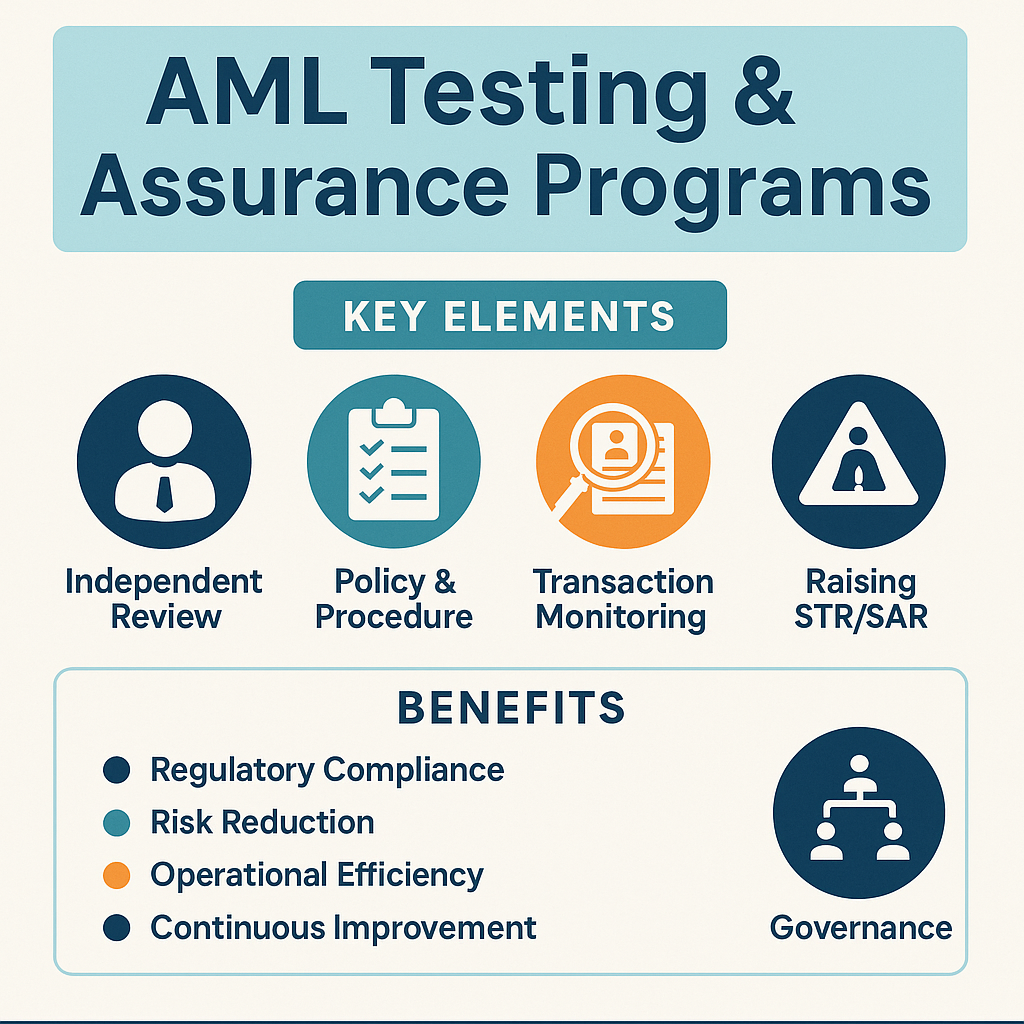
2. Core Elements of an AML Testing & Assurance Program
1. Independent Review
o Conducted by internal audit teams or external specialists.
o Ensures impartial evaluation of AML processes.
2. Policy & Procedure Testing
o Reviews whether AML manuals, customer due diligence checklists, and escalation procedures are being followed in practice.
3. KYC/CDD Effectiveness Checks
o Testing samples of customer files to confirm identity verification, risk scoring, and EDD for high-risk customers.
4. Transaction Monitoring Validation
o Evaluating whether alerts are generated correctly, thresholds are set appropriately, and false positives are managed effectively.
5. Sanctions & Screening Assurance
o Testing screening tools for accuracy with Arabic/English names, fuzzy matching, and updates against local/global watchlists.
6. STR/SAR Reporting Checks
o Ensuring suspicious activity reports are filed on time via goAML and that supporting documentation is adequate.
7. Training & Awareness Testing
o Verifying staff participation in AML training and testing their ability to recognize red flags.
8. Governance & Board Oversight
o Confirming that AML reports reach senior management and that remedial actions are tracked.
________________________________________
3. Benefits of AML Testing & Assurance
• Regulatory Compliance – Demonstrates proactive compliance during inspections by FIU, CBUAE, DFSA, ADGM, and MoE.
• Risk Reduction – Identifies vulnerabilities before criminals exploit them.
• Operational Efficiency – Fine-tunes monitoring systems, reducing false positives and wasted resources.
• Reputation Protection – Avoids penalties and enhances trust with banks, regulators, and customers.
• Continuous Improvement – Creates a feedback loop to update policies, tools, and training.
________________________________________
4. How to Implement AML Testing & Assurance in the UAE
1. Annual Independent Review – Schedule an AML audit or independent testing annually.
2. Risk-Based Testing – Focus on high-risk products (e.g., gold & diamond trading, cross-border remittances, real estate deals).
3. Technology Validation – Test AML software outputs (KYC, screening, TM alerts) against regulatory expectations.
4. goAML Simulation – Conduct mock suspicious activity reporting to check readiness.
5. Board Reporting – Present testing results to senior management with remediation timelines.
________________________________________
5. UAE-Specific Considerations
• DNFBPs must especially emphasize AML testing, as many regulators in the UAE (MoE, free zones) now require independent assurance reports.
• Financial Institutions supervised by CBUAE must provide evidence of robust model validation for transaction monitoring and screening tools.
• DIFC & ADGM firms must align assurance testing with their respective AML Rulebooks, ensuring both FIU reporting and free-zone regulator notifications are covered.
________________________________________
Final Thoughts
AML Testing & Assurance is no longer optional in the UAE. Regulators expect businesses to prove effectiveness, not just have policies on paper. Regular testing provides confidence that AML programs are working as designed and protects organizations from regulatory penalties and reputational harm.
________________________________________
📌 About Us
Sheikh Anwar Accounting and Auditing LLC – Registered Auditor (Ministry of Economy Entry No. 5817, Company Entry LC4695-01)
📍 Dubai Creek Tower, M 35, Dubai, UAE
🌐 Website: www.sa-auditors.com
📧 Email: info@sa-auditors.com
📞 Phone: +971-585621786