AML Risks in Cash-Intensive Businesses
Introduction
Cash-intensive businesses—such as retail shops, restaurants, car dealerships, travel agencies, and gold and jewelry traders—play a vital role in the UAE economy. However, their reliance on cash transactions makes them particularly vulnerable to money laundering and financial crime risks.
Criminals often prefer cash-based businesses because cash transactions are harder to trace, allowing illicit funds to be mixed with legitimate income. Recognizing this, the UAE’s AML regulatory framework places strong emphasis on monitoring and compliance for cash-intensive businesses.
________________________________________
Why Cash-Intensive Businesses Are High-Risk
1. Anonymity of Cash Transactions – Unlike electronic payments, cash does not leave a clear audit trail. This makes it easier for criminals to disguise illegal money.
2. Difficulty in Verifying Source of Funds – Large volumes of cash make it challenging to identify whether funds originate from legitimate or illicit activities.
3. Mixing of Illicit and Legitimate Income – Businesses can disguise illegal funds as genuine sales revenue.
4. Cross-Border Transactions – In countries like the UAE, with high levels of international trade and tourism, cash can move across borders with fewer restrictions if not monitored carefully.
________________________________________
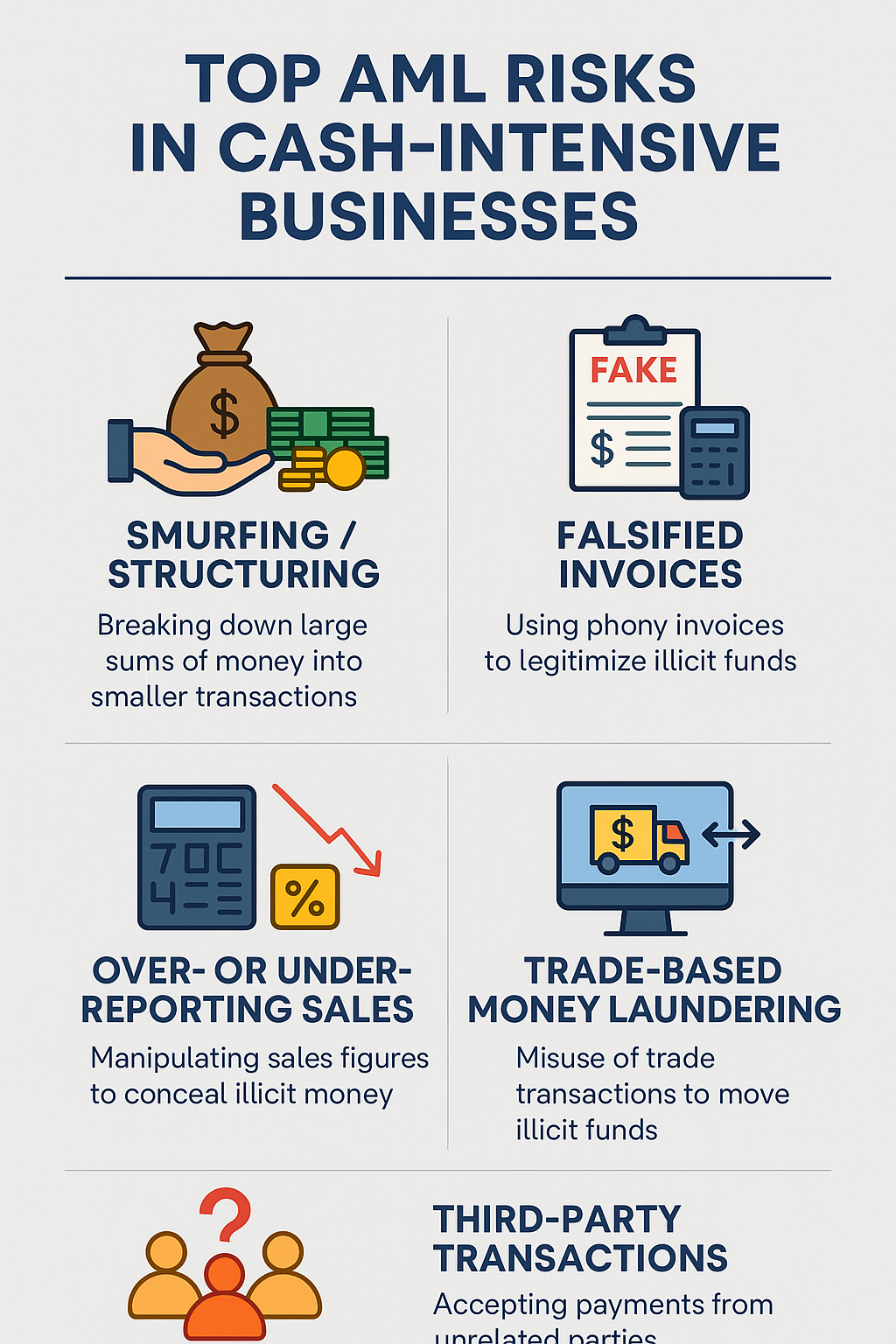
Common AML Risks in Cash-Intensive Businesses
1. Smurfing/Structuring
Breaking large amounts of illicit cash into smaller deposits to avoid detection by banks and regulators.
2. Falsified Invoices
Criminals may use fake invoices to legitimize the origin of illicit funds within cash businesses.
3. Over- or Under-Reporting of Sales
Illicit money can be disguised by inflating daily sales or underreporting to balance laundered funds.
4. Trade-Based Money Laundering (TBML)
Businesses may misuse trade invoices, customs declarations, or false shipments to move funds across borders.
5. Third-Party Transactions
Acceptance of payments from unrelated third parties without clear justification increases AML exposure.
________________________________________
UAE AML Framework for Cash-Intensive Businesses
The UAE has identified Dealers in Precious Metals and Stones (DPMS), real estate brokers, and certain DNFBPs as high-risk sectors. Regulations include:
• Federal Decree-Law No. 20 of 2018 (AML-CFT Law)
• Cabinet Decision No. 10 of 2019 (Implementing Regulations)
• Cabinet Decision No. 111 of 2022 (expanding DNFBP obligations)
Key Obligations:
• Customer Due Diligence (CDD) – Verify customer identity before high-value transactions.
• Suspicious Transaction Reporting (STRs) – File reports with the UAE Financial Intelligence Unit (FIU) via goAML.
• Record-Keeping – Maintain records for at least five years.
• Cash Transaction Reporting (CTR) – Report cash transactions exceeding regulatory thresholds.
• Employee Training – Staff must be trained to detect suspicious behavior and red flags.
________________________________________
Red Flags for Cash-Intensive Businesses in the UAE
• Customers making unusually large cash payments for goods or services.
• Frequent transactions just below the reporting threshold.
• Payments from unrelated third parties.
• Reluctance to provide identification or source of funds.
• Inconsistencies between reported sales and actual cash inflows.
________________________________________
How Businesses Can Mitigate AML Risks
1. Implement Strong Internal Controls – Daily reconciliation, dual approvals for large cash transactions.
2. Adopt AML Technology – Use software for transaction monitoring and screening.
3. Conduct Risk Assessments – Identify and assess high-risk customers and activities.
4. Regular Training – Train staff on AML obligations and suspicious behavior red flags.
5. Appoint a Compliance Officer/MLRO – Ensure oversight and proper reporting to authorities.
________________________________________
Conclusion
Cash-intensive businesses in the UAE face heightened AML risks due to the nature of their operations. However, by adopting a risk-based approach, implementing strong internal controls, and complying with UAE AML laws, these businesses can protect themselves from being exploited by criminals.
More importantly, compliance strengthens trust with customers, regulators, and global partners—safeguarding the business and contributing to the UAE’s reputation as a secure and transparent financial hub.
________________________________________
About Sheikh Anwar Accounting and Auditing LLC
At Sheikh Anwar Accounting and Auditing LLC, we specialize in assisting cash-intensive businesses—especially gold and jewelry traders, real estate firms, and DNFBPs—with AML compliance. From risk assessments and AML policies to outsourced MLRO services and staff training, we help businesses stay compliant and avoid penalties.
• 📍 Head Office: Dubai, UAE
• 🌐 Website: www.sa-auditors.com
• 📧 Email: info@sa-auditors.com