AML Risk Assessment in Real Estate Firms
Introduction
The real estate sector is one of the most vulnerable industries to money laundering activities due to its high-value transactions, complex ownership structures, and cross-border dealings. Criminals often exploit real estate transactions to disguise the origin of illicit funds by purchasing, reselling, or renting properties.
In recognition of these risks, the UAE authorities—through Federal Decree-Law No. (20) of 2018 on Anti-Money Laundering (AML) and Cabinet Decision No. (10) of 2019, supported by Cabinet Decision No. (109) of 2023—have made AML risk assessment mandatory for all Designated Non-Financial Businesses and Professions (DNFBPs), including real estate brokers, developers, and agents.
It explains how real estate firms in the UAE can conduct a comprehensive AML Risk Assessment to comply with regulatory expectations and prevent financial crime.
________________________________________
1. Why AML Risk Assessment Is Critical in Real Estate
Real estate transactions often involve:
• Large sums of money, sometimes paid in cash or through third parties,
• Offshore structures or complex ownership patterns,
• High-value assets that can be easily resold or leased, and
• Cross-border transactions involving multiple jurisdictions.
These factors create significant money laundering (ML) and terrorist financing (TF) risks.
Therefore, real estate firms are required to adopt a risk-based approach (RBA) — identifying, assessing, and mitigating potential ML/TF risks at both the entity and customer levels.
________________________________________
2. Legal and Regulatory Framework in the UAE
The AML risk assessment obligations for real estate companies arise from:
• Federal Decree-Law No. (20) of 2018 – The UAE AML/CFT Law
• Cabinet Decision No. (10) of 2019 – Implementing Regulations
• Cabinet Decision No. (109) of 2023 – Strengthened compliance controls
• Ministry of Economy (MOE) DNFBP AML Guidelines
• goAML reporting platform administered by the UAE FIU
These regulations require real estate firms to:
1. Perform periodic AML risk assessments,
2. Maintain documented policies and procedures,
3. File Suspicious Transaction Reports (STRs) when necessary, and
4. Ensure staff training and ongoing monitoring.
________________________________________
3. Key Risk Factors in Real Estate
AML risk assessment begins by identifying and analyzing risk factors that expose the business to ML/TF threats. These include:
a. Customer Risk
• Politically Exposed Persons (PEPs)
• Non-resident or foreign buyers
• Clients purchasing in the name of companies or trusts
• Complex ownership structures or nominee arrangements
b. Geographic Risk
• Buyers from or transactions involving FATF grey/blacklisted countries
• Offshore tax havens or high-corruption jurisdictions
• Properties located in free zones or high-value areas with limited oversight
c. Product/Service Risk
• Purchase or sale of high-value properties
• Cash payments or cryptocurrency transactions
• Property flipping (rapid resale for profit)
• Leasing arrangements involving large advance payments
d. Transaction Risk
• Use of third-party intermediaries or complex payment structures
• Unusual price differences or over/under-valuation
• Back-to-back transactions or sales with immediate repurchase
e. Delivery Channel Risk
• Non face-to-face transactions or remote onboarding
• Transactions via intermediaries or agents without due diligence
• Lack of digital verification systems
________________________________________
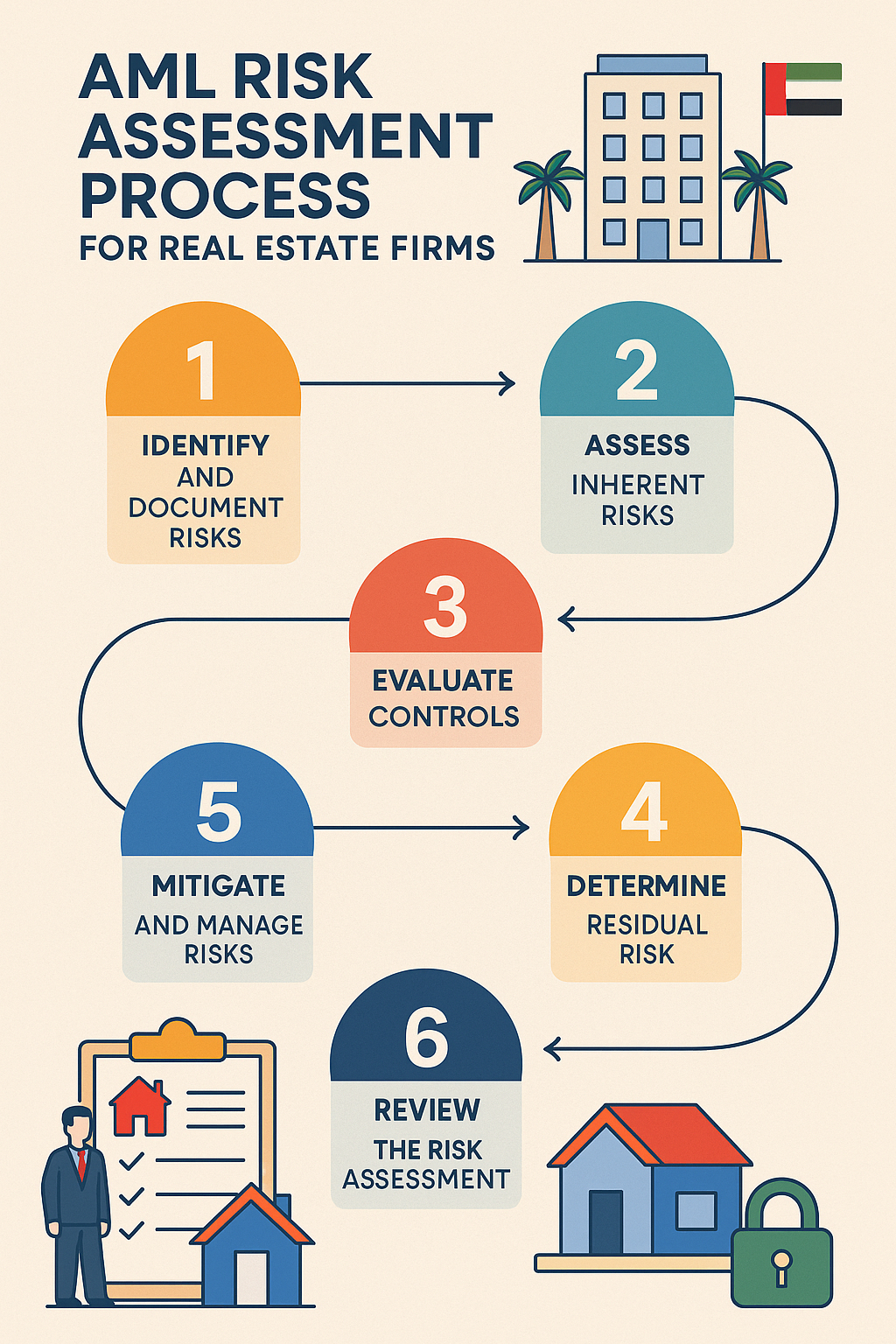
4. Step-by-Step AML Risk Assessment Process for Real Estate Firms
Step 1 – Identify and Document Risks
List all potential ML/TF risks associated with your:
• Customers
• Services (sales, leasing, property management, etc.)
• Geographic markets
• Transaction types
Use data from previous transactions, FIU alerts, and typologies reported by FATF.
________________________________________
Step 2 – Assess Inherent Risks
Assess the likelihood and impact of each risk before applying controls.
Risk Factor Likelihood Impact Inherent Risk
Non-resident high-value buyer High High High
Local salaried buyer Low Low Low
Purchase through offshore company High High High
________________________________________
Step 3 – Evaluate Existing Controls
Evaluate your current AML controls such as:
• Customer Due Diligence (CDD)
• Enhanced Due Diligence (EDD) for PEPs and high-risk clients
• Screening and sanctions checks
• Transaction monitoring and reporting
• Staff AML training and record-keeping
Determine if these controls are adequate, partially effective, or ineffective.
________________________________________
Step 4 – Determine Residual Risk
After applying controls, calculate the residual risk—the risk that remains after mitigation.
Residual risk levels may be categorized as:
• Low – Sufficient controls and minimal exposure
• Medium – Some vulnerabilities remain
• High – Controls are insufficient or risks are significant
________________________________________
Step 5 – Mitigate and Manage Risks
For high-risk scenarios:
• Apply Enhanced Due Diligence (EDD)
• Obtain source of funds/source of wealth documents
• Limit cash transactions
• Conduct senior management approval before proceeding
• Perform ongoing monitoring for unusual activity
________________________________________
Step 6 – Document and Review the Risk Assessment
Maintain a comprehensive written risk assessment report, including:
• Methodology used
• Risk categories and ratings
• Control effectiveness
• Residual risk evaluation
• Approval by management
The assessment must be reviewed annually or whenever there are material changes, such as new property launches, foreign partnerships, or new payment channels.
________________________________________
5. Common Red Flags in Real Estate Transactions
Real estate firms should be alert to the following suspicious indicators:
• Clients insisting on cash payments for high-value properties
• Frequent property flipping without economic rationale
• Purchase through offshore or shell companies
• Unexplained third-party involvement in transactions
• Overvaluation or undervaluation of property prices
• Buyer or seller unwilling to provide KYC documents
• Rapid resale or early termination of contracts
These red flags must trigger internal review and, where appropriate, Suspicious Transaction Reports (STRs) through the goAML system.
________________________________________
6. Role of Technology in Real Estate AML Compliance
Modern compliance platforms such as MyAML.io and Finabooks.com can streamline AML risk assessments by:
• Automating customer onboarding and screening
• Risk scoring customers and transactions
• Maintaining a centralized CDD database
• Monitoring transactions and generating alerts
• Preparing inspection-ready risk assessment reports
Automation ensures accuracy, efficiency, and regulatory alignment, reducing the risk of oversight or manual error.
________________________________________
7. Training and Culture
Staff at all levels—from sales agents to management—must be trained to:
• Identify ML/TF risks and red flags
• Conduct proper CDD and EDD
• Escalate suspicious activities to the MLRO
• Maintain awareness of UAE AML laws and FATF updates
A culture of compliance begins with leadership commitment and continuous education.
________________________________________
8. Key Takeaways
• Real estate is a high-risk AML sector, requiring strong internal controls.
• A risk-based approach is mandatory for all UAE real estate DNFBPs.
• Regular risk assessment and documentation are essential for inspection readiness.
• Technology-driven AML systems improve monitoring, accuracy, and compliance.
• Continuous staff training and internal audits ensure sustained compliance maturity.
________________________________________
Conclusion
An effective AML Risk Assessment helps real estate firms in the UAE safeguard their operations from misuse and comply with the nation’s robust AML/CFT framework.
By identifying vulnerabilities, applying strong controls, and leveraging technology, businesses can mitigate financial crime risks while maintaining regulatory trust and reputation.
________________________________________
Sheikh Anwar Accounting & Auditing LLC
Licensed Auditor – Ministry of Economy (Entry No. 5817)
📍 Dubai Creek Tower, Office M35, Dubai, UAE
🌐 www.sa-auditors.com
✉️ info@sa-auditors.com