AML Risk Assessment for Startups and SMEs
Introduction
In today’s regulatory environment, Anti-Money Laundering (AML) compliance is no longer limited to large financial institutions. Startups and Small & Medium Enterprises (SMEs) in the UAE are equally accountable for detecting and mitigating money laundering (ML) and terrorist financing (TF) risks under Federal Decree-Law No. 20 of 2018 and Cabinet Decision No. 10 of 2019.
Whether a business operates in gold trading, consultancy, real estate, accounting, or professional services, conducting a robust AML Risk Assessment is essential. It not only ensures regulatory compliance but also safeguards business integrity, reputation, and banking relationships.
________________________________________
1. Why AML Risk Assessment Matters for Startups and SMEs
Startups and SMEs often assume that AML requirements apply only to larger corporations. However, regulators—including the UAE Ministry of Economy (MOE) and free zone authorities like DMCC, ADGM, and DIFC—require all Designated Non-Financial Businesses and Professions (DNFBPs) to assess and manage AML risks proportionately.
Key Reasons It Matters:
• Regulatory Compliance: Avoid penalties and potential license suspension.
• Banking Access: Maintain trust with banks and financial institutions.
• Reputation Management: Build credibility with clients and investors.
• Operational Integrity: Prevent misuse of business channels for illegal purposes.
________________________________________
2. Understanding AML Risk Assessment
An AML Risk Assessment is a structured evaluation of your business’s exposure to money laundering and terrorist financing risks. It identifies who your customers are, what services you provide, where you operate, and how you deliver services, helping you apply a risk-based approach to AML compliance.
Core Objectives:
• Identify areas vulnerable to ML/TF activities.
• Evaluate the effectiveness of current controls.
• Develop targeted actions to reduce residual risks.
• Support an informed AML policy framework.
________________________________________
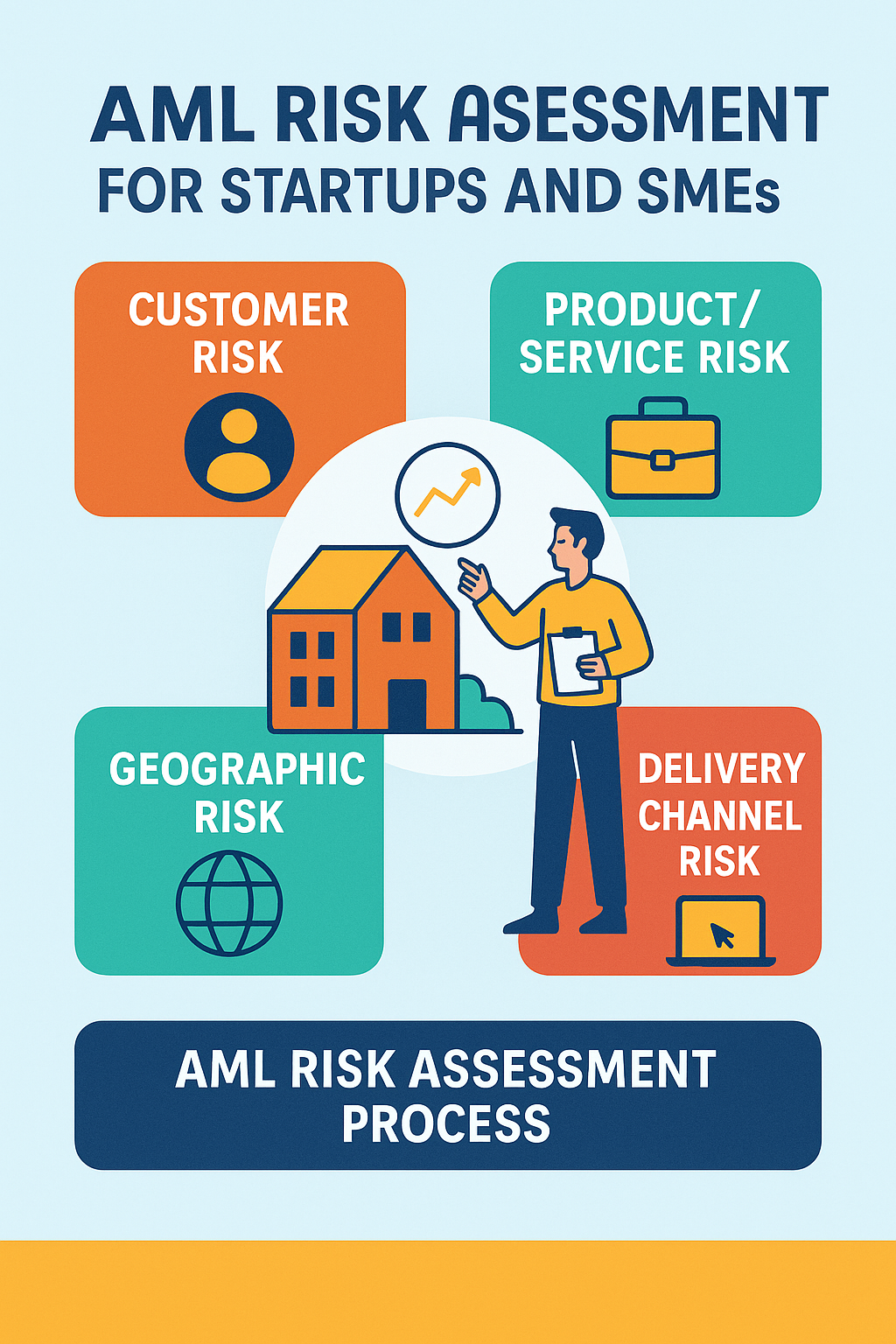
3. Key Risk Categories for Startups and SMEs
a. Customer Risk
Assess the risk profile of clients based on:
• Residency (local vs. foreign).
• Type (individual, corporate, or offshore).
• Beneficial ownership transparency.
• Politically Exposed Persons (PEPs) or sanctions exposure.
• Source of funds and wealth documentation.
b. Product/Service Risk
Certain products or services pose higher risks, especially:
• High-value goods like gold, diamonds, or luxury items.
• Corporate structuring or virtual office services.
• Real estate brokerage or investment advisory.
• Online platforms accepting global payments.
c. Geographic Risk
Startups with clients or suppliers from high-risk jurisdictions (as identified by FATF, UN, or UAE lists) face elevated exposure.
d. Delivery Channel Risk
Non-face-to-face transactions, use of intermediaries, or online payments require enhanced controls to verify identities and monitor activity.
e. Transactional Risk
Unusual transaction patterns—such as large cash payments, multiple transfers, or unexplained refunds—may signal potential ML/TF activity.
________________________________________
4. AML Risk Assessment Process for Startups
Step 1: Identify Business-Specific Risks
Map out where your business could be misused for ML/TF. For example:
• A gold trader may face risks from cash-intensive transactions.
• A corporate consultancy may risk being used for shell company setups.
Step 2: Assess Inherent Risks
Rate each risk (e.g., low, medium, high) before applying controls using a scoring matrix.
Step 3: Evaluate Controls
Review internal policies and tools such as:
• Know Your Customer (KYC) procedures.
• Sanctions and PEP screening tools.
• Transaction monitoring mechanisms.
• Staff training and reporting protocols.
Step 4: Calculate Residual Risk
Use a formula:
Residual Risk = Inherent Risk × (1 – Control Effectiveness)
This helps determine where additional controls or monitoring are required.
Step 5: Document & Review
Maintain a detailed risk assessment document, including:
• Methodology and scoring framework.
• Risk heat map and findings summary.
• Action plan with responsibilities and deadlines.
Update the assessment annually or upon major business changes.
________________________________________
5. Practical Examples for SMEs
Industry Key AML Risks Mitigation Measures
Gold & Jewellery Cash transactions, international sourcing Enhanced Due Diligence (EDD), DPMSR reporting
Real Estate Foreign buyers, high-value deals Source of funds verification, STR filing
Consultancy/Corporate Services Company formation for offshore clients Beneficial ownership checks
Auditing & Accounting Firms Handling funds or client structures Independent AML reviews
Tech Startups Cross-border online payments Automated KYC and transaction limits
________________________________________
6. Role of Technology in Simplifying AML for SMEs
Modern AML software and RegTech solutions help startups automate compliance:
• e-KYC tools for digital onboarding and ID verification.
• Sanctions & PEP screening platforms with real-time updates.
• Transaction monitoring systems to detect anomalies.
• Automated goAML integration for STR reporting.
Cloud-based solutions make compliance affordable and scalable for smaller enterprises.
________________________________________
7. Common AML Mistakes by Startups
❌ Assuming AML does not apply to small businesses.
❌ Failing to appoint a Compliance Officer (MLRO).
❌ Using manual onboarding without screening.
❌ Ignoring FATF updates or UAE MOE circulars.
❌ Not maintaining documented AML policies or EWRA.
Avoiding these mistakes helps prevent enforcement actions and protects your company’s growth trajectory.
________________________________________
8. Regulatory Expectations for Startups
Regulators such as the UAE Ministry of Economy and free zone authorities expect SMEs to:
• Register on goAML.
• Prepare and maintain AML Policy and Risk Assessment Reports.
• Conduct staff AML training.
• File STR/DPMSR reports promptly.
• Maintain documentation for at least five years.
________________________________________
9. Integrating AML into Business Growth
AML compliance should be viewed not as a cost, but as an investment in sustainable business growth.
Startups that integrate compliance from inception:
• Gain trust of investors and banks.
• Enhance corporate governance.
• Build international credibility for future expansion.
________________________________________
Conclusion
For startups and SMEs in the UAE, AML compliance is a vital part of responsible business operations. Conducting a comprehensive AML Risk Assessment ensures that your company understands its exposure, strengthens internal controls, and meets regulatory expectations.
At Sheikh Anwar Accounting & Auditing LLC, we specialize in helping startups and SMEs design and implement risk-based AML frameworks, ensuring full compliance with UAE laws and FATF standards.
________________________________________
By Sheikh Anwar Accounting & Auditing LLC
AML & Compliance Experts for Startups and SMEs in the UAE
📞 +971 4 876 9890 | ✉️ info@sa-auditors.com | 🌐 www.sa-auditors.com