AML Record Keeping Requirements
Introduction
Record keeping is one of the most critical pillars of an effective Anti-Money Laundering (AML) compliance program. Regulators in the UAE and globally emphasize the importance of accurate, complete, and retrievable records to detect, investigate, and prevent money laundering and terrorist financing activities. For Designated Non-Financial Businesses and Professions (DNFBPs) such as gold traders, real estate brokers, accountants, auditors, and lawyers, robust record keeping is not only a legal requirement but also a safeguard against reputational and operational risks.
________________________________________
1. Legal and Regulatory Framework
In the UAE, Federal Decree-Law No. 20 of 2018 on AML and CFT, and Cabinet Decision No. 10 of 2019, require entities to maintain records that enable competent authorities to reconstruct financial transactions and verify compliance. This aligns with FATF Recommendations and international best practices.
________________________________________
2. Types of Records to Maintain
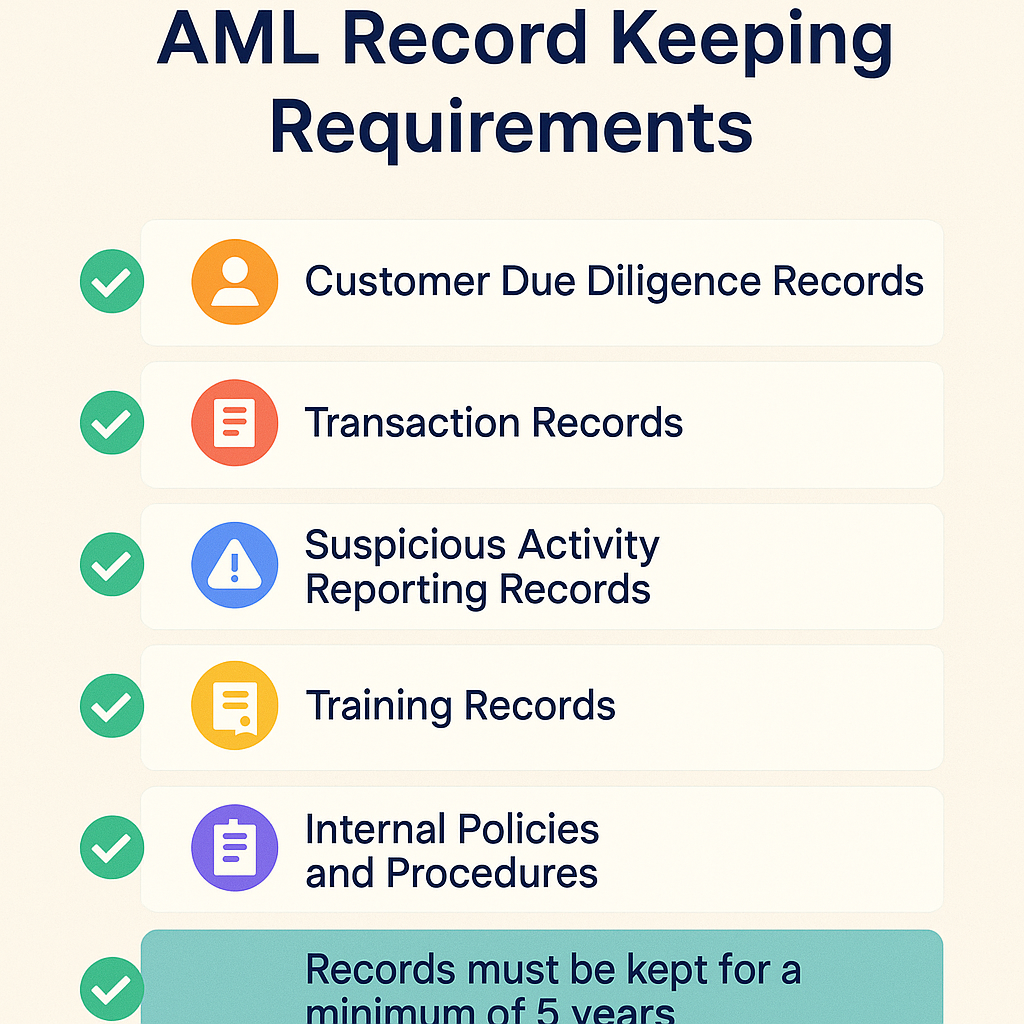
A. Customer Due Diligence (CDD) Records
• Copies of identification documents (passport, Emirates ID, trade license).
• Beneficial ownership details.
• Risk assessments conducted during onboarding.
• Ongoing monitoring results (e.g., sanctions and PEP screening logs).
B. Transaction Records
• Nature, date, and amount of each transaction.
• Origin and destination of funds.
• Supporting documents such as invoices, contracts, and receipts.
• Unusual transaction monitoring reports.
C. Suspicious Activity Reporting (SAR/STR) Records
• Copies of suspicious transaction reports filed through the goAML portal.
• Internal records of investigation and escalation.
• Communication with regulators on reported cases.
D. Training Records
• Attendance logs for AML/CFT training.
• Training material and agendas.
• Assessments or certifications obtained by employees.
E. Internal Policies and Procedures
• Approved AML policies and procedures.
• Updates and amendments history.
• Internal audit and compliance testing reports.
________________________________________
3. Record Retention Period
• In the UAE, records must be kept for a minimum of 5 years after the end of a business relationship or completion of a transaction.
• This retention period applies to both physical and electronic records.
• In cases where investigations or legal proceedings are ongoing, records must be preserved until clearance is received from authorities.
________________________________________
4. Format and Accessibility
• Records can be stored in electronic or physical formats, provided they are retrievable upon regulatory request.
• Digitalization is encouraged for efficiency but must comply with data protection laws (Federal Decree-Law No. 45 of 2021 on the Protection of Personal Data).
• Companies should maintain strong access controls, ensuring only authorized staff can view sensitive data.
________________________________________
5. Best Practices for Effective Record Keeping
1. Centralized Record Management System – Implement software that integrates CDD, transactions, and monitoring.
2. Data Integrity – Ensure information is accurate, consistent, and tamper-proof.
3. Regular Audits – Conduct periodic checks to verify compliance with retention requirements.
4. Confidentiality and Security – Protect client data from unauthorized access.
5. Training – Ensure staff understand the importance of proper documentation and reporting.
________________________________________
6. Consequences of Non-Compliance
Failure to maintain proper records can result in:
• Regulatory fines and penalties.
• Suspension of business licenses.
• Criminal liability for responsible officers.
• Damage to the company’s reputation and client trust.
________________________________________
Conclusion
AML record keeping is far more than an administrative task—it is a legal obligation and a critical defense against financial crime. Businesses must adopt structured, technology-enabled processes to ensure compliance, protect their reputation, and demonstrate accountability to regulators.
________________________________________
📌 About Us
Sheikh Anwar Accounting and Auditing LLC is a MOE-approved auditing and compliance firm in the UAE. We specialize in AML Risk Assessments, Policies, Training, goAML Reporting, and Independent AML Audits for DNFBPs and financial institutions. Our team ensures your business is fully compliant with UAE laws and international AML standards.
🌐 www.sa-auditors.com
📧 info@sa-auditors.com
📍 Dubai Creek Tower, M 35, Dubai, UAE