AML Obligations Under the Central Bank of UAE
Introduction
As the primary regulator of the financial sector, the Central Bank of the UAE (CBUAE) plays a vital role in ensuring the integrity of the country’s financial system. The CBUAE enforces strict Anti-Money Laundering (AML) and Counter-Terrorism Financing (CTF) regulations in line with Federal Decree-Law No. 20 of 2018 and global standards set by the Financial Action Task Force (FATF).
Financial institutions (FIs) under the Central Bank’s supervision—including banks, finance companies, exchange houses, and insurance firms—are subject to robust compliance obligations. It provides an overview of these obligations and why they are critical for maintaining trust and transparency.
________________________________________
Scope of the Central Bank’s Supervision
The CBUAE oversees a broad range of financial institutions, including:
• Banks (conventional and Islamic).
• Finance companies and leasing firms.
• Exchange houses and remittance providers.
• Insurance companies and brokers.
• Hawala providers (informal money transfer operators, subject to registration and regulation).
________________________________________
Key AML Obligations Under the Central Bank of UAE
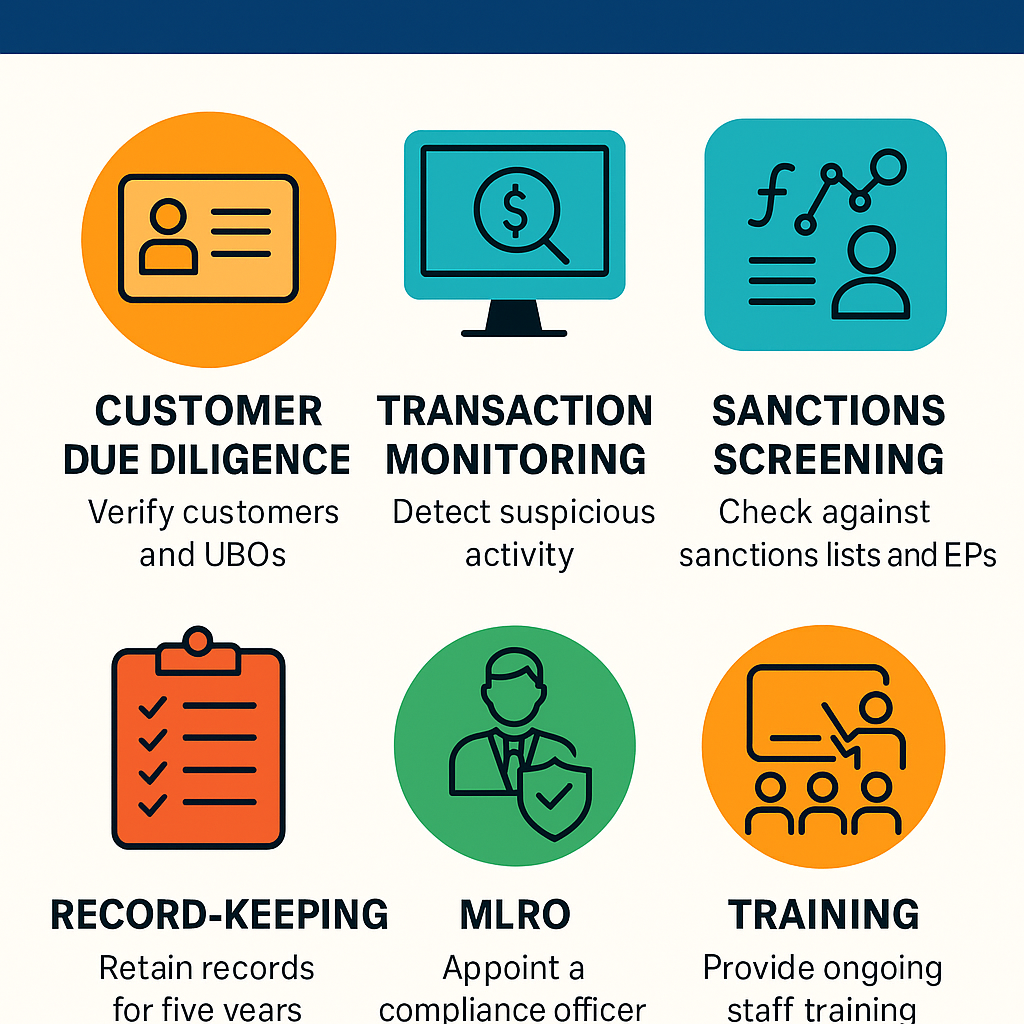
1. Customer Due Diligence (CDD) & KYC
• Financial institutions must verify the identity of customers and Ultimate Beneficial Owners (UBOs).
• Enhanced Due Diligence (EDD) is required for high-risk customers, such as politically exposed persons (PEPs) and cross-border clients.
• Ongoing monitoring of customer relationships is mandatory.
2. Transaction Monitoring & Reporting
• Institutions must implement automated transaction monitoring systems to detect unusual or suspicious patterns.
• Suspicious Transaction Reports (STRs) must be filed with the UAE Financial Intelligence Unit (FIU) through the goAML portal.
• Cash Transaction Reports (CTRs) are required for all transactions above AED 55,000.
3. Sanctions & PEP Screening
• Institutions must screen clients against UN, UAE national, and international sanctions lists.
• Screening for PEPs and close associates is mandatory to assess risks of corruption or illicit financing.
4. Record-Keeping
• Customer and transaction records must be retained for at least five years.
• Records must be readily available for inspections by regulators.
5. Risk-Based Approach (RBA)
• Institutions must implement a risk-based framework, tailoring controls based on customer type, geography, products, and services.
• Regular risk assessments must be conducted to update AML policies accordingly.
6. Internal Controls & Governance
• Appointment of a Money Laundering Reporting Officer (MLRO) or compliance officer is mandatory.
• Institutions must establish AML compliance programs, independent audits, and board-level oversight.
7. Employee Training
• Staff must receive ongoing AML and CTF training to detect red flags and ensure awareness of reporting obligations.
8. Hawala Regulation
• The Central Bank regulates informal money transfer providers, requiring them to register, maintain records, and report suspicious activity, ensuring these channels are not exploited by criminals.
________________________________________
Penalties for Non-Compliance
The Central Bank imposes strict penalties for violations of AML regulations, which may include:
• Fines ranging from AED 50,000 to AED 5 million.
• Restrictions or suspension of business activities.
• Revocation of licenses in serious or repeated cases.
• Criminal liability, including imprisonment, in cases of willful non-compliance.
________________________________________
Why Compliance Matters for UAE Financial Institutions
1. Protects Reputation – Ensures trust with customers and international partners.
2. Prevents Misuse – Stops criminals and terrorists from exploiting financial institutions.
3. Global Alignment – Strengthens UAE’s credibility in global markets and ensures FATF compliance.
4. Avoids Penalties – Prevents costly fines, license suspensions, and reputational damage.
________________________________________
Conclusion
The Central Bank of the UAE’s AML framework is central to protecting the country’s financial system from abuse. For financial institutions, AML compliance is not just a regulatory burden but a strategic necessity to maintain customer trust, international credibility, and long-term sustainability.
By implementing robust AML measures, institutions play a vital role in safeguarding the UAE’s position as a secure global financial hub.
________________________________________
About Sheikh Anwar Accounting and Auditing LLC
At Sheikh Anwar Accounting and Auditing LLC, we support financial institutions in meeting their AML obligations under the Central Bank’s regulations. Our services include:
• AML policy development and risk assessments.
• goAML reporting support (STRs & CTRs).
• MLRO and compliance officer advisory.
• Employee training tailored for financial institutions.
• Independent AML audits and reviews.
• 📍 Head Office: Dubai, UAE
• 🌐 Website: www.sa-auditors.com
• 📧 Email: info@sa-auditors.com