AML in Real Estate: Risks and Case Studies
Introduction
The real estate sector has long been recognized as one of the most vulnerable industries for money laundering (ML) and terrorist financing (TF) activities. Due to the high value of transactions, the ability to use complex ownership structures, and the global demand for property investment, real estate is a prime target for illicit financial flows.
In the UAE, real estate brokers, developers, and agents fall under the category of Designated Non-Financial Businesses and Professions (DNFBPs) and are strictly regulated under Federal Decree-Law No. 20 of 2018, Cabinet Decision No. 10 of 2019, and guidance issued by the Ministry of Economy (MOE). They are required to apply a risk-based approach (RBA), conduct Customer Due Diligence (CDD), and report suspicious activities via the goAML system.
________________________________________
Why Real Estate is High-Risk for Money Laundering
Several factors make real estate an attractive vehicle for laundering illicit funds:
1. High Value Transactions
o Properties involve large sums of money, making it easier to launder significant amounts in a single transaction.
2. Use of Complex Ownership Structures
o Criminals may hide behind shell companies, trusts, or offshore entities to obscure the true beneficial owner of the property.
3. Integration into the Legal Economy
o Once illicit funds are used to purchase real estate, the property can be sold or rented, generating “clean” income.
4. Cross-Border Investment
o Foreign buyers can exploit differences in AML regulations between jurisdictions.
5. Cash and Alternative Payments
o Use of large cash payments, cryptocurrencies, or third-party financing increases risk exposure.
________________________________________
Common Money Laundering Typologies in Real Estate
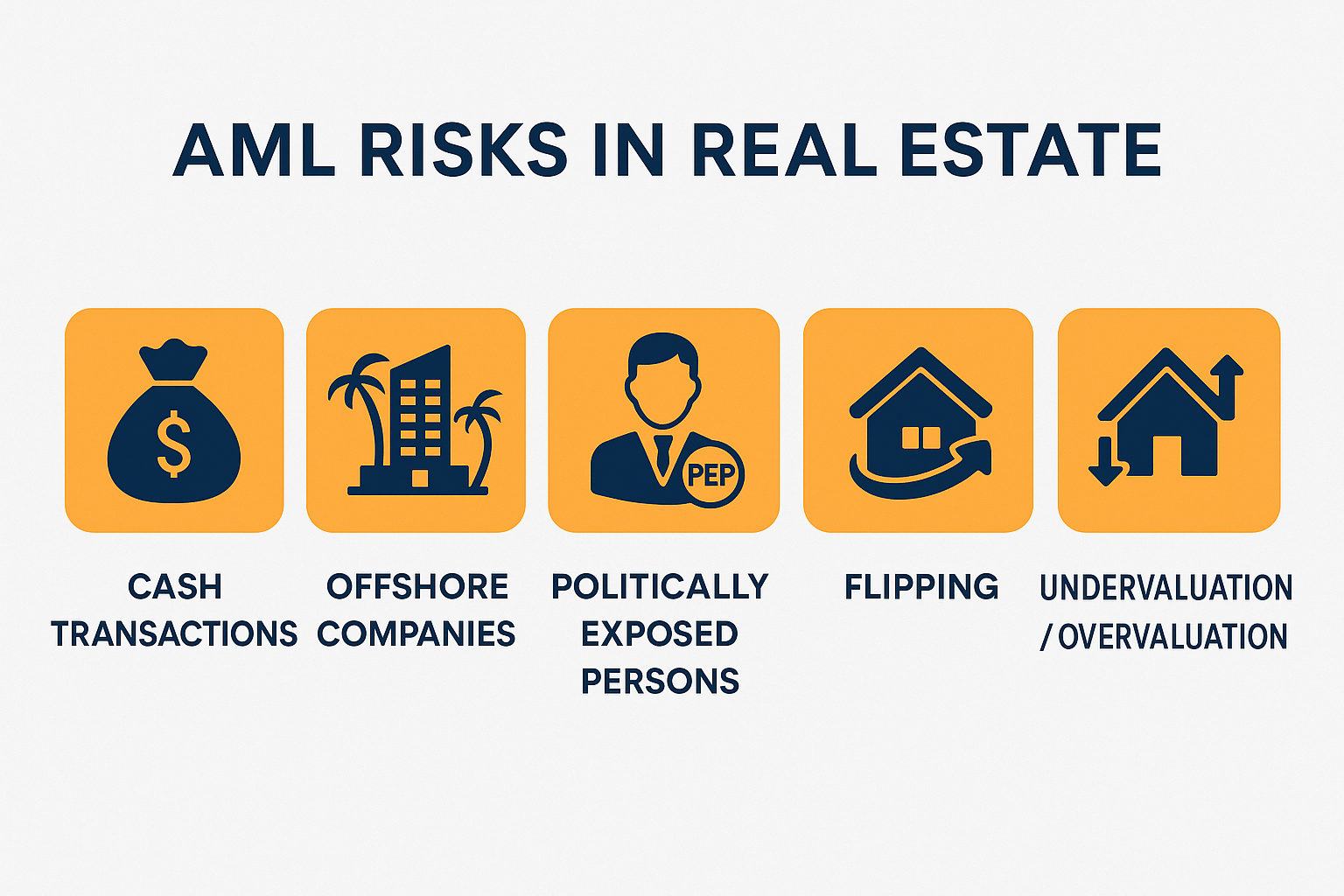
• Over/Under Valuation of Properties: Manipulating prices to disguise illicit funds.
• Rapid Buying and Selling (Flipping): Purchasing and reselling properties quickly to integrate funds.
• Third-Party Purchases: Properties bought in the name of relatives, associates, or nominees.
• Mortgage Fraud: Using illicit funds to pay off loans quickly.
• Complex Layering: Using multiple intermediaries (lawyers, brokers, corporate service providers) to obscure money trails.
________________________________________
Case Studies
Case Study 1 – Luxury Property Purchase with Cash
A foreign investor purchased several luxury apartments in Dubai Marina, paying the full amount in cash through intermediaries. The purchase price did not match the buyer’s known financial profile. Upon investigation, it was revealed that the funds originated from illicit drug trafficking.
• Red Flag: High-value cash transactions inconsistent with customer profile.
• Lesson: Real estate firms must apply Enhanced Due Diligence (EDD) and escalate unusual transactions to the MLRO for STR filing.
Case Study 2 – Use of Offshore Companies
A property was acquired by an offshore company registered in a tax haven. The beneficial ownership was unclear, and multiple nominee directors were listed. Later, the property was linked to a politically exposed person (PEP) under investigation for corruption.
• Red Flag: Complex ownership structures with no economic rationale.
• Lesson: DNFBPs must identify ultimate beneficial owners (UBOs) and apply sanctions/PEP screening before closing deals.
Case Study 3 – Real Estate Flipping to Launder Funds
A villa was bought and resold three times within a year, each time at a significantly inflated price. The rapid transactions created a perception of legitimate market activity, while illicit funds were integrated into the financial system.
• Red Flag: Rapid resale of properties at inconsistent valuations.
• Lesson: Continuous monitoring of transaction patterns is essential to detect unusual activity.
________________________________________
Regulatory Expectations for Real Estate DNFBPs in the UAE
The Ministry of Economy requires real estate DNFBPs to:
• Register on goAML and report STRs/SARs promptly.
• Conduct Customer Due Diligence (CDD) and Enhanced Due Diligence (EDD) for high-risk clients.
• Maintain records for at least five years, including contracts, payment records, and client identification.
• Provide AML training to staff on red flags and suspicious activity indicators.
• Conduct Entity-Wide Risk Assessments (EWRA) annually to identify vulnerabilities.
________________________________________
Best Practices for Real Estate DNFBPs
• Risk Profiling: Develop a risk matrix for clients (e.g., foreign buyers, cash purchasers, PEPs).
• Independent MLRO Oversight: Appoint an experienced MLRO to oversee reporting and compliance.
• Technology Use: Employ AML software for screening and monitoring.
• Regular Training: Ensure brokers, agents, and administrative staff are trained on AML obligations.
• Collaboration: Cooperate with regulators and share information when required.
________________________________________
Conclusion
The real estate sector in the UAE remains a key focus for AML regulators due to its attractiveness to money launderers. By understanding typologies, applying a risk-based approach, and reporting through goAML, real estate DNFBPs can protect their businesses, maintain compliance, and contribute to safeguarding the UAE’s financial system.
________________________________________
About Us
Sheikh Anwar Accounting and Auditing LLC is a leading compliance and audit advisory firm in Dubai, UAE. We support real estate DNFBPs by offering:
• AML risk assessments and policy drafting.
• MLRO/Deputy MLRO outsourcing services.
• AML training tailored for real estate professionals.
• goAML registration and reporting assistance.
• Compliance health checks and inspection readiness.
📍 Office: Dubai Creek Tower, M 35, Dubai, UAE
🌐 Website: www.sa-auditors.com
📧 Email: info@sa-auditors.com