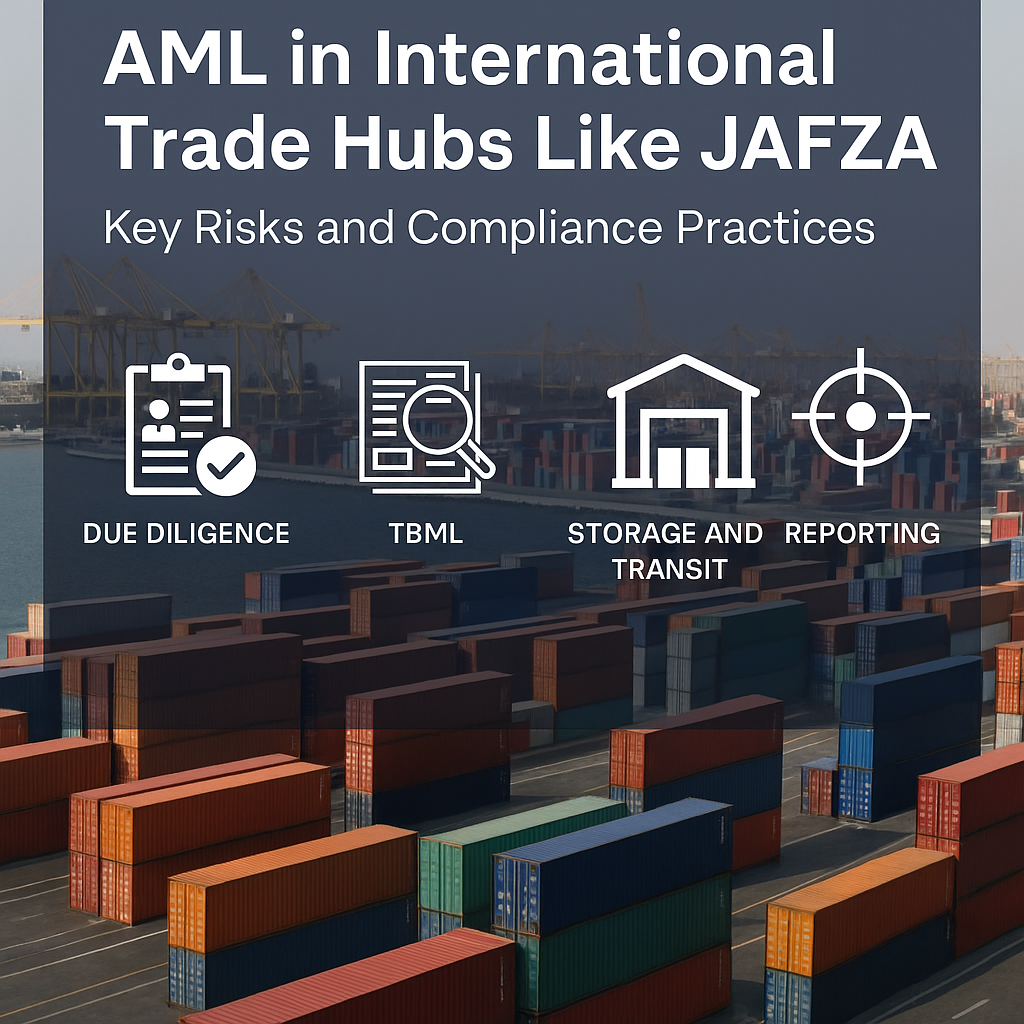
AML in International Trade Hubs Like JAFZA
Introduction
Dubai’s Jebel Ali Free Zone (JAFZA) stands as one of the world’s largest and most dynamic international trade hubs. It connects over 140 countries and facilitates thousands of global trade flows every day—ranging from manufacturing and logistics to warehousing and re-exports.
However, its global connectivity and business-friendly environment also expose it to money laundering (ML) and terrorist financing (TF) risks. The large scale of cross-border transactions, diversity of goods, and ease of company formation can make it a target for misuse by illicit actors.
It outlines the key AML risks associated with trade hubs like JAFZA and provides practical guidance on how businesses can build compliance frameworks aligned with UAE AML laws and FATF recommendations.
________________________________________
1. Ownership and Counterparty Risks
Free zones allow companies from around the world to set up operations quickly—often with minimal physical presence. While this boosts investment, it also creates risk when beneficial ownership transparency is weak.
Risks
• Use of shell or front companies to disguise the true ownership of funds or goods.
• Complex cross-border structures that obscure the identity of beneficial owners.
• Trading with counterparties that lack verifiable business backgrounds.
Mitigation
• Obtain and verify full beneficial ownership information before onboarding clients or suppliers.
• Conduct sanctions, PEP, and adverse media screening regularly.
• Request trade licenses, import/export codes, and transaction histories.
• Maintain clear KYC and due diligence files in line with UAE Cabinet Decision No. (10) of 2019.
________________________________________
2. Trade-Based Money Laundering (TBML)
JAFZA’s high-volume trade environment makes it vulnerable to TBML schemes, where illicit funds are disguised through falsified trade transactions.
Common Methods
• Over- or under-invoicing of goods.
• Misrepresentation of quantity, quality, or value.
• Circular trade chains between related entities in different jurisdictions.
• Use of free zone warehouses to mask product origins.
Mitigation
• Verify that invoice values match global market rates.
• Check whether trade routes and commodities make commercial sense.
• Maintain detailed shipping documents, bills of lading, and customs declarations.
• Train staff to detect TBML red flags such as unusual pricing, third-party payments, or vague trade descriptions.
________________________________________
3. Warehousing and Transit Risks
Free zones like JAFZA serve as logistics and warehousing hubs for goods in transit. While legitimate for global trade, these facilities can also be misused for storing or transferring illicit goods or value.
Risks
• Goods with no declared owner or ultimate consignee.
• Frequent transfer of warehouse receipts without corresponding sales.
• Long-term storage of high-value commodities (e.g., gold, electronics) without clear business purpose.
Mitigation
• Keep detailed inventory movement records for all inbound and outbound goods.
• Review storage durations and ownership changes for anomalies.
• Restrict access to warehouses and ensure proper chain-of-custody documentation.
________________________________________
4. Geographic and Jurisdictional Risks
JAFZA attracts traders from around the world, including high-risk jurisdictions identified by FATF. Cross-border trade involving such regions increases exposure to illicit financial flows.
Mitigation
• Maintain a jurisdictional risk register based on FATF grey/black lists.
• Apply enhanced due diligence for trade involving high-risk countries.
• Evaluate the legitimacy of routes used in multi-jurisdictional re-export chains.
• Consider rejecting clients or shipments from non-cooperative jurisdictions.
________________________________________
5. Payment Flow and Commodity Risks
High-value goods like gold, precious stones, and electronics are commonly traded in JAFZA. These can be exploited to move value across borders with minimal detection.
Risks
• Third-party payments not matching trade contracts.
• Large cash transactions or back-to-back transfers.
• Payments made through multiple foreign accounts for the same shipment.
Mitigation
• Align all payment flows with corresponding invoices and shipping documents.
• Prohibit acceptance of large cash payments without source verification.
• Monitor for structured payments or rapid fund movement between related entities.
________________________________________
6. AML Reporting and Regulatory Coordination
While JAFZA operates under the Dubai Free Zone Authority, AML compliance is governed by Federal Decree-Law No. (20) of 2018 and supervised by the UAE’s Ministry of Economy and Financial Intelligence Unit (FIU).
Requirements
• Conduct an Enterprise-Wide Risk Assessment (EWRA).
• Maintain records for at least five years.
• Register on the goAML portal for Suspicious Transaction Reporting (STR).
• Designate a Money Laundering Reporting Officer (MLRO).
________________________________________
7. Reputational and Operational Risks
As a globally recognized logistics hub, Dubai’s reputation depends on maintaining financial integrity. Non-compliance with AML standards can lead to heavy fines, loss of business licenses, and reputational damage.
Best Practices
• Adopt a zero-tolerance policy for undocumented or unclear transactions.
• Conduct regular AML training for management and staff.
• Engage independent compliance consultants to review AML frameworks.
• Demonstrate transparency in all dealings to enhance credibility with regulators and banks.
________________________________________
Conclusion
Trade hubs like JAFZA are the backbone of global commerce—but they are also prime targets for trade-based money laundering and sanctions evasion. Businesses operating within these zones must balance operational efficiency with strong AML governance.
A robust AML program—covering KYC, trade documentation, monitoring, and reporting—helps protect not only the company but also Dubai’s standing as a trusted international trade gateway.
________________________________________
For Expert AML and Trade Compliance Advisory
Sheikh Anwar Accounting and Auditing LLC
Licensed Auditors & AML Compliance Advisors – Ministry of Economy (Entry No. 5817)
📍 Dubai Creek Tower, Office M-35, UAE
📧 info@sa-auditors.com | 🌐 www.sa-auditors.com
📞 +971-58-562-1786