AML in Family Offices and Trusts
Introduction
Family offices and trusts are key vehicles for wealth management, succession planning, and asset protection in the UAE. With the country’s position as a global financial hub, these structures are increasingly used by high-net-worth individuals and international families to consolidate their holdings and manage intergenerational wealth.
However, their unique nature—private structures, large transactions, cross-border dealings, and complex ownership chains—makes them vulnerable to money laundering and terrorist financing (ML/TF) risks. Recognizing this, UAE regulators have placed family offices and trusts within the scope of Anti-Money Laundering (AML) and Counter-Terrorism Financing (CTF) regulations.
________________________________________
1. Regulatory Framework Governing Family Offices and Trusts
Family offices and trusts in the UAE are regulated under the federal AML laws, with specific free zone authorities adding oversight:
• Federal Decree-Law No. 20 of 2018 on AML/CTF – the core law applicable across the UAE.
• Cabinet Decision No. 10 of 2019 – implementation regulations, extending obligations to DNFBPs and trust/company service providers.
• Cabinet Resolution No. 58 of 2020 – requires disclosure and maintenance of Ultimate Beneficial Ownership (UBO) information.
• Supervisory Authorities:
o Ministry of Economy (MOE): Supervises trust and corporate service providers (TCSPs) in most free zones.
o DIFC (Dubai International Financial Centre): Regulated by the Dubai Financial Services Authority (DFSA).
o ADGM (Abu Dhabi Global Market): Regulated by the Financial Services Regulatory Authority (FSRA).
________________________________________
2. AML Obligations for Family Offices and Trusts
Family offices and trust service providers must establish robust AML compliance frameworks to address inherent risks:
a) Customer Due Diligence (CDD)
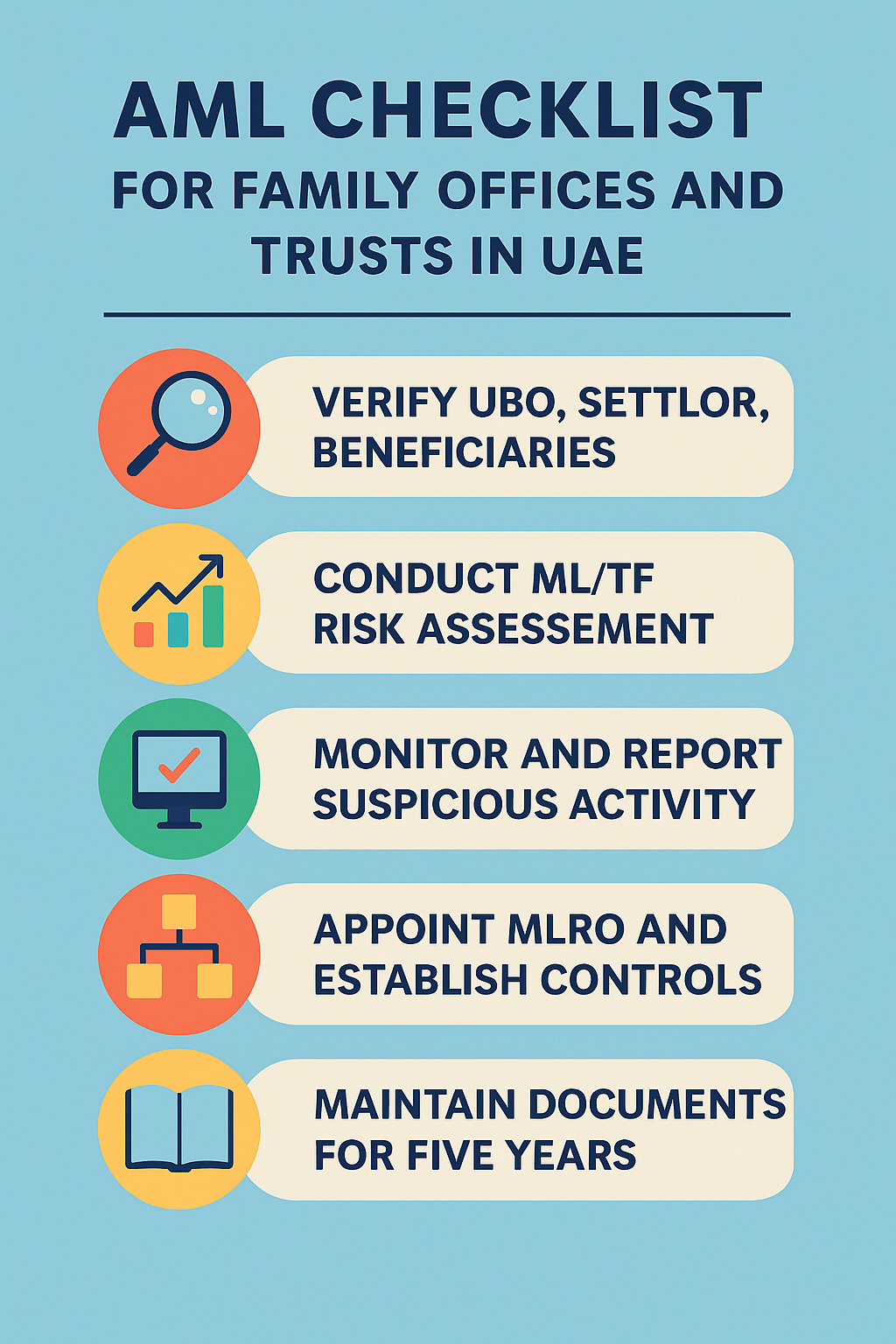
• Verify the identity of the settlor, trustee, protector, beneficiaries, and any other natural persons exercising control.
• Identify and verify the UBO of any corporate structures linked to the trust or family office.
• Apply Enhanced Due Diligence (EDD) for high-risk clients, especially Politically Exposed Persons (PEPs).
b) Risk Assessment
• Conduct an enterprise-wide ML/TF risk assessment, considering clients’ profiles, geographic exposure, and complexity of ownership structures.
• Classify clients into risk categories (low, medium, high) with tailored monitoring approaches.
c) Ongoing Monitoring
• Regularly review transactions to detect unusual activity (e.g., frequent cross-border transfers, sudden changes in asset ownership).
• Monitor beneficiaries’ activities, especially when distributions are made in high-risk jurisdictions.
d) Governance and Compliance
• Appoint a Money Laundering Reporting Officer (MLRO) or AML Compliance Officer.
• Maintain written AML policies, controls, and escalation procedures.
• Provide regular AML training for all employees involved in managing trusts and family offices.
e) Reporting Obligations
• Register on the goAML portal and report:
o Suspicious Transaction Reports (STRs) for unusual activity.
o Large Cash Transaction Reports (LCTRs) if applicable.
• File reports to the FIU (Financial Intelligence Unit) promptly.
f) Record Keeping
• Retain all client and transaction records, including trust deeds and ownership documents, for minimum five years.
________________________________________
3. Common AML Red Flags in Family Offices and Trusts
Some scenarios should alert compliance officers to potential ML/TF risks:
• Trusts involving complex cross-border structures with no clear commercial purpose.
• Sudden changes in trustees or beneficiaries without valid reason.
• Distributions to offshore accounts in tax havens or high-risk jurisdictions.
• Reluctance of clients to disclose the source of funds or beneficial ownership.
• Use of nominees or intermediaries to obscure control.
________________________________________
4. Penalties for Non-Compliance
Failure to comply with AML laws can result in severe consequences:
• Financial Penalties: AED 50,000 to AED 10 million, depending on the breach.
• Criminal Liability: Imprisonment for severe money laundering offences.
• License Suspension or Revocation: For service providers operating in free zones.
• Reputational Damage: Loss of client trust and difficulty maintaining banking relationships.
________________________________________
5. Best Practices for Family Offices and Trusts
To strengthen AML compliance and mitigate risks, family offices and trust service providers should:
• Implement comprehensive onboarding procedures with strict UBO verification.
• Develop risk-based monitoring systems tailored to wealth management structures.
• Screen all parties against sanctions and PEP lists.
• Engage in independent AML audits to test the effectiveness of compliance programs.
• Provide regular staff training to detect red flags in trust and family office operations.
________________________________________
Conclusion
Family offices and trusts in the UAE offer valuable tools for wealth preservation and succession planning. Yet, their complexity also makes them attractive vehicles for illicit activity if not properly supervised. By adopting robust AML frameworks, family offices and trust service providers can ensure regulatory compliance, protect their reputation, and contribute to the UAE’s strong standing in global financial integrity.
________________________________________
About Us
Sheikh Anwar Accounting and Auditing LLC is a Dubai-based firm specializing in AML advisory, risk assessments, corporate tax, and regulatory compliance. We support family offices, trust service providers, and DNFBPs in building effective AML frameworks that safeguard their operations while meeting UAE legal requirements.
📍 Address: Dubai Creek Tower, M 35, Dubai, UAE
📞 Contact: info@sa-auditors.com | +971-XXX-XXXX
🌐 Website: www.sa-auditors.com