AML in E-Commerce and Digital Payment Firms
1. Introduction
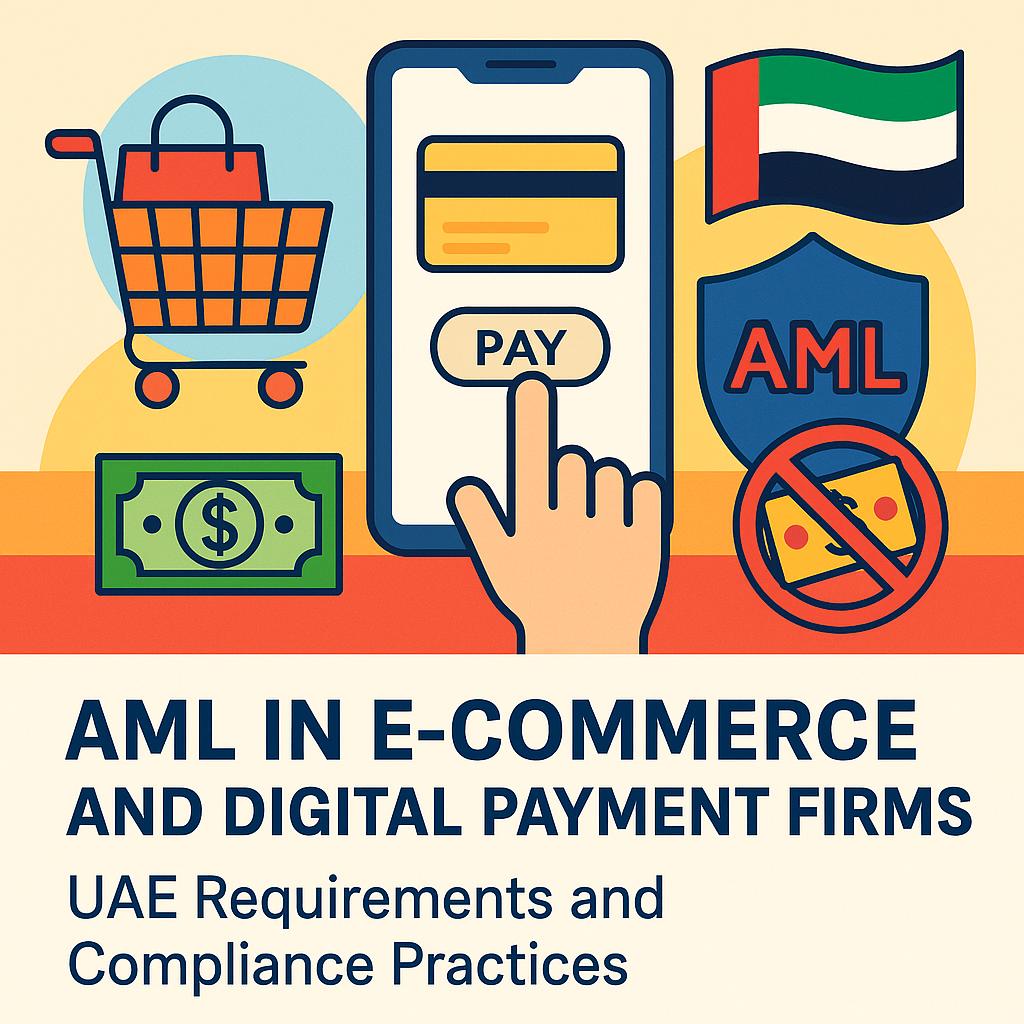
E-commerce and digital payment platforms have transformed how people in the UAE buy, sell, and transfer money. The convenience of online transactions, combined with instant cross-border transfers and virtual wallets, has accelerated economic activity — but also increased the risk of money laundering (ML) and terrorist financing (TF).
Because of these risks, the UAE authorities, led by the Central Bank of the UAE (CBUAE) and the Financial Intelligence Unit (FIU), enforce strict Anti-Money Laundering (AML) and Counter-Terrorism Financing (CTF) regulations for digital businesses. These rules ensure that fintechs, payment processors, and online marketplaces operate transparently and prevent misuse of their platforms.
________________________________________
2. UAE’s AML Legal and Regulatory Framework
Core Legislations
1. Federal Decree-Law No. (20) of 2018 – On Anti-Money Laundering and Combating the Financing of Terrorism and Illegal Organisations.
2. Cabinet Decision No. (10) of 2019 – Executive Regulation specifying obligations for Financial Institutions (FIs) and DNFBPs.
3. Cabinet Decision No. (111) of 2022 – On the Regulation of Virtual Assets and VASPs, covering crypto-linked digital payment businesses.
4. CBUAE AML & Sanctions Compliance Guidelines (2022) – Detailing AML procedures for payment service providers (PSPs), stored value facilities (SVFs), and digital banking platforms.
5. Federal Decree-Law No. (14) of 2018 – Regulating the Central Bank and Financial Institutions, defining its supervisory powers over digital finance.
Together, these laws make AML compliance mandatory for all licensed payment and e-commerce firms operating within or through the UAE.
________________________________________
3. Covered Entities
AML obligations extend to all entities facilitating or processing payments digitally, including:
• Payment Service Providers (PSPs) and Payment Gateways
• E-commerce Marketplaces handling buyer-seller payments
• Digital Wallet Operators and Stored-Value Facility (SVF) Providers
• Fintech Firms offering peer-to-peer or cross-border transfers
• Buy-Now-Pay-Later (BNPL) and digital lending platforms
• Aggregator Apps integrating multiple payment services
Even small e-commerce stores using third-party payment systems must ensure that their payment partners are CBUAE-licensed and AML-compliant.
________________________________________
4. Key AML Risks in Digital Commerce and Payments
The digital ecosystem presents unique vulnerabilities that criminals may exploit, including:
• Anonymity: Customers can use multiple accounts, IPs, or devices.
• High Transaction Volume: Thousands of low-value transactions may conceal large laundering operations.
• Refund & Chargeback Abuse: Fraudulent refunds used to “legitimize” illicit funds.
• Cross-Border Transfers: Payments to high-risk jurisdictions or unverified counterparties.
• Third-Party Processors: Lack of visibility over intermediaries’ AML controls.
• Virtual Assets Integration: Crypto payments creating additional monitoring challenges.
These risks require robust KYC and transaction monitoring controls from both payment firms and e-commerce operators.
________________________________________
5. Customer Due Diligence (CDD) and KYC Requirements
Before onboarding a customer or merchant, firms must perform Customer Due Diligence (CDD) based on a risk-based approach.
Core CDD Obligations:
1. Identify and Verify Customer Identity – Using government-issued ID or biometric verification.
2. Determine Beneficial Ownership (UBO) – For corporate clients or marketplace sellers.
3. Understand Business Relationship Purpose – Nature, volume, and frequency of transactions.
4. Apply Enhanced Due Diligence (EDD) – For Politically Exposed Persons (PEPs) or clients from FATF-listed countries.
5. Ongoing Monitoring – Continuously track patterns and detect unusual transactions.
Digital payment providers should use e-KYC systems, geolocation tracking, and device fingerprinting to improve accuracy and compliance.
________________________________________
6. Transaction Monitoring and Sanctions Screening
All firms must maintain automated transaction-monitoring systems that can:
• Detect suspicious activity in real time.
• Flag multiple small transactions (“structuring”).
• Identify cross-border payments to high-risk jurisdictions.
• Screen names and entities against UAE, UN, OFAC, and EU sanctions lists.
• Escalate alerts to the MLRO (Money Laundering Reporting Officer) for review.
Use of AI-based AML tools and machine-learning risk models is encouraged by the CBUAE for accuracy and scalability.
________________________________________
7. Reporting Obligations via goAML
All licensed digital firms must register on the UAE Financial Intelligence Unit’s (FIU) goAML platform to submit mandatory reports.
Report Type Purpose Timeline Authority
Suspicious Transaction Report (STR) Report transactions suspected to involve ML/TF Immediately FIU
Suspicious Activity Report (SAR) Report abnormal or unexplained customer behavior Promptly FIU
Threshold Transaction Report (TTR) Report cash transactions ≥ AED 55,000 Periodically FIU
Sanctions Report Report dealings with listed or frozen parties Immediately FIU / CBUAE
Late or missing reports can result in fines up to AED 5 million and potential license suspension.
________________________________________
8. Governance and MLRO Responsibilities
Each licensed payment or e-commerce company must designate a qualified Money Laundering Reporting Officer (MLRO) responsible for:
• Overseeing AML program implementation.
• Evaluating alerts and escalating reports to FIU.
• Coordinating with regulators during audits or inspections.
• Conducting internal AML risk assessments and training.
• Reporting directly to senior management or the board.
The MLRO must operate independently, with sufficient resources and authority to enforce compliance.
________________________________________
9. AML Training and Staff Awareness
Continuous staff training is a cornerstone of AML effectiveness. Employees should understand:
• AML/CTF laws applicable in the UAE.
• Red-flag indicators in online payment transactions.
• Customer onboarding and e-KYC procedures.
• Reporting obligations under the goAML system.
• Data privacy and record-keeping protocols.
Training must be documented and renewed at least once annually, or whenever new FATF or CBUAE updates are issued.
________________________________________
10. Penalties and Enforcement
The CBUAE and Ministry of Economy (MOE) have imposed heavy fines on digital firms for non-compliance, such as:
• Failure to verify customer identity or beneficial ownership.
• Delayed submission of STRs or TTRs.
• Inadequate risk assessments or missing AML policies.
• Operating without a valid CBUAE license.
Penalties may include fines up to AED 5 million, public disclosure, or even criminal prosecution for serious violations.
________________________________________
11. Conclusion
As the UAE moves toward a cashless digital economy, AML compliance in e-commerce and fintech sectors is a national priority.
Firms must integrate compliance into their core operations — from automated KYC tools to real-time monitoring — ensuring that digital innovation does not come at the cost of financial integrity.
A strong AML framework not only protects firms from regulatory risk but also enhances customer confidence and international credibility.
________________________________________
About Sheikh Anwar Accounting & Auditing LLC
Sheikh Anwar Accounting & Auditing LLC is a UAE-based audit and compliance firm offering AML advisory, regulatory audits, and outsourced MLRO services to fintechs, e-commerce platforms, and DNFBPs.
Our AML experts help businesses establish risk-based controls aligned with CBUAE, FATF, and FIU standards.
________________________________________
📞 Contact Us
Sheikh Anwar Accounting & Auditing LLC
📍 Office No. M-35, Dubai Creek Tower, Deira, Dubai, UAE
📧 info@sa-auditors.com
🌐 www.sa-auditors.com