AML Governance Structure for Businesses
Introduction
Building an effective Anti-Money Laundering (AML) governance structure is vital for businesses operating in the UAE, particularly financial institutions and Designated Non-Financial Businesses and Professions (DNFBPs) such as jewellers, real estate brokers, lawyers, accountants, and trust service providers.
Under Federal Decree-Law No. 20 of 2018, Cabinet Decision No. 10 of 2019, and supervisory regulations issued by the Ministry of Economy, DFSA (DIFC), FSRA (ADGM), and other free zone authorities, businesses are required to establish governance frameworks that demonstrate accountability, oversight, and control in their AML compliance programs.
A robust AML governance structure ensures that compliance is not an isolated function but a company-wide responsibility integrated into strategy, operations, and culture.
________________________________________
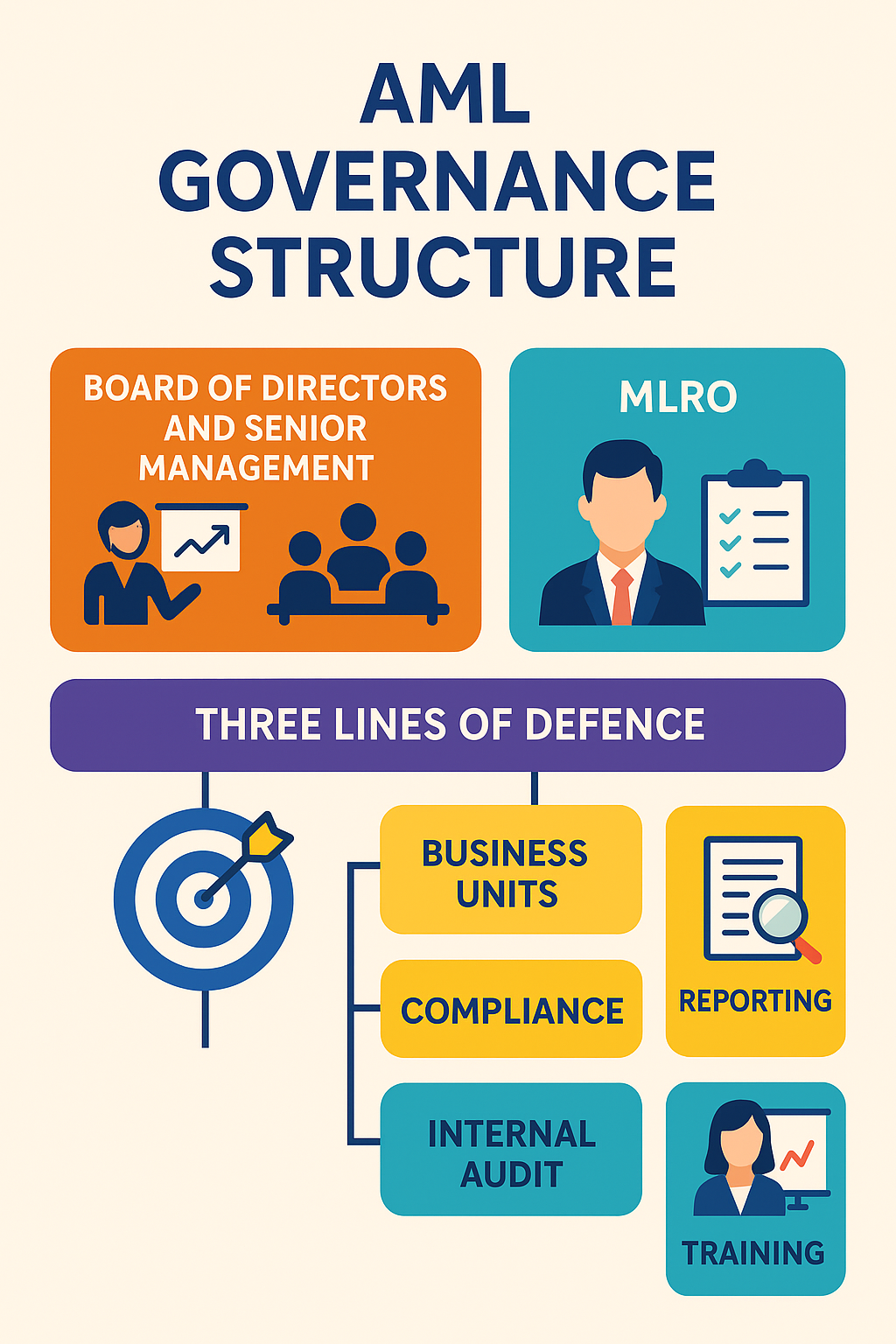
1. Board of Directors and Senior Management Oversight
• Ultimate Accountability: The board and senior management are ultimately responsible for ensuring AML compliance.
• Approval of Policies: They must review and approve AML policies, procedures, and risk assessments.
• Tone from the Top: Leadership should set the right culture of compliance, emphasizing zero tolerance for financial crime.
• Regular Reporting: Boards should receive AML compliance reports from the MLRO or Compliance Officer.
________________________________________
2. Appointment of MLRO / Compliance Officer
• Designation: Every business must appoint a qualified Money Laundering Reporting Officer (MLRO) or AML Compliance Officer.
• Independence and Authority: The MLRO must have the authority, independence, and access to resources to perform their duties effectively.
• Responsibilities: Overseeing CDD, monitoring, filing suspicious transaction reports, liaising with regulators, and training staff.
________________________________________
3. Three Lines of Defence in AML Governance
a) First Line: Business Units
• Responsible for customer onboarding, due diligence, and transaction execution.
• Must follow AML policies and escalate suspicious activity to the compliance team.
b) Second Line: Compliance / MLRO Function
• Implements AML controls, monitoring, and reporting obligations.
• Provides guidance, policies, and risk assessments.
c) Third Line: Internal Audit
• Conducts independent testing of AML frameworks.
• Ensures policies and procedures are effective and aligned with UAE regulations.
________________________________________
4. Risk Management and Internal Controls
• Establishing an enterprise-wide AML risk assessment covering customers, products, geography, and delivery channels.
• Defining risk appetite and applying appropriate mitigation measures.
• Embedding AML into internal control frameworks for monitoring and escalation.
________________________________________
5. Policies, Procedures, and Escalation
• AML Policy Manual: Written policies covering CDD, EDD, sanctions screening, reporting, and record keeping.
• Escalation Mechanism: Clear procedures for employees to escalate suspicious activity to the MLRO.
• Whistleblowing Framework: Protects staff who raise AML concerns in good faith.
________________________________________
6. Training and Awareness
• Mandatory AML training programs for all employees, tailored to their roles.
• Specialized training for customer-facing staff and senior management.
• Periodic refreshers to stay aligned with FATF and UAE updates.
________________________________________
7. Reporting and Regulatory Engagement
• Filing Suspicious Transaction Reports (STRs), Large Cash Transaction Reports (LCTRs), and sector-specific reports (e.g., DPMSR) via the goAML portal.
• Proactive engagement with supervisory authorities during inspections or audits.
• Timely response to regulatory queries and compliance requests.
________________________________________
8. Record Keeping and Documentation
• Maintaining AML-related records, including CDD files, STRs, and policies, for at least five years.
• Ensuring accessibility of records for regulators and auditors.
________________________________________
9. Continuous Improvement
• AML governance should not be static—it must evolve with:
o Regulatory updates from the UAE and FATF.
o Emerging risks (e.g., digital assets, trade-based money laundering).
o Independent audit findings and corrective actions.
________________________________________
Conclusion
An effective AML governance structure requires clear roles, accountability, and a risk-based approach. From board-level oversight to frontline compliance controls, businesses in the UAE must ensure their governance frameworks are both regulator-compliant and operationally effective.
Strong governance not only avoids penalties but also protects business reputation, builds trust with financial institutions, and positions companies as credible players in global markets.
________________________________________
About Us
Sheikh Anwar Accounting and Auditing LLC is a trusted auditing and compliance advisory firm in Dubai, specializing in AML frameworks, governance structures, outsourced MLRO services, corporate tax, VAT, and transfer pricing. We help businesses establish strong AML governance aligned with UAE laws and FATF standards.
📍 Address: Dubai Creek Tower, M 35, Dubai, UAE
📞 Contact: info@sa-auditors.com | +971-XXX-XXXX
🌐 Website: www.sa-auditors.com