AML Gap Analysis Explained
Introduction
As the UAE continues to enhance its Anti-Money Laundering (AML) and Counter-Terrorism Financing (CTF) framework, regulators expect businesses to go beyond basic compliance and demonstrate the effectiveness of their systems. One of the most effective ways to achieve this is through an AML Gap Analysis.
This explains what an AML Gap Analysis is, why it is important, and how UAE businesses—especially financial institutions (FIs) and DNFBPs—can benefit from conducting one.
________________________________________
1. What is an AML Gap Analysis?
An AML Gap Analysis is a structured review that compares a company’s existing AML program against:
• UAE AML laws and regulations (Federal Decree-Law No. 20 of 2018, Cabinet Decision No. 10 of 2019).
• Guidance issued by regulators such as the Central Bank (CBUAE), Ministry of Economy (MoE), DFSA (DIFC), and FSRA (ADGM).
• International best practices (FATF recommendations).
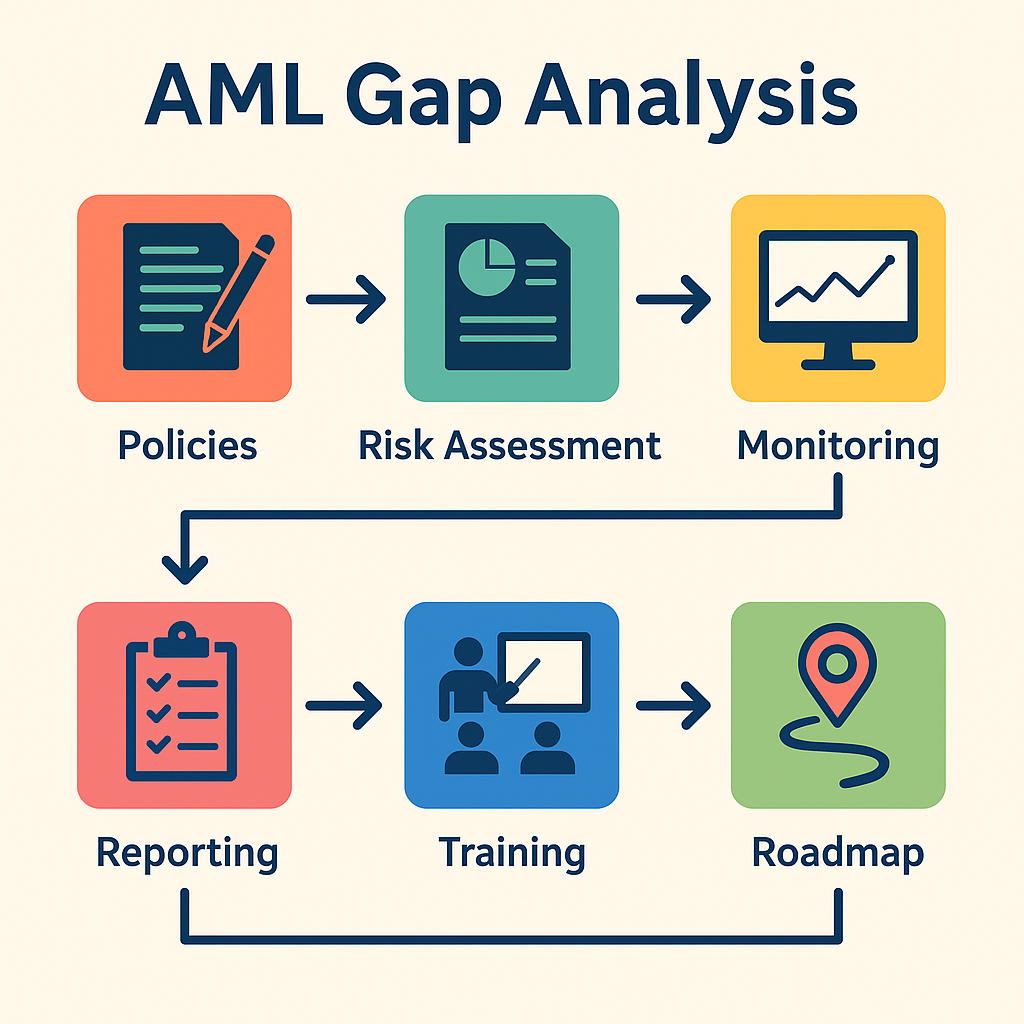
The purpose is to identify gaps, weaknesses, or non-compliance areas and provide a clear roadmap for remediation.
________________________________________
2. Why AML Gap Analysis Matters
• Regulatory Compliance – Ensures alignment with evolving UAE AML requirements.
• Inspection Readiness – Demonstrates proactive compliance during MoE, CBUAE, DFSA, or ADGM inspections.
• Risk Reduction – Identifies vulnerabilities before criminals exploit them.
• Operational Efficiency – Highlights duplication or inefficiencies in existing AML processes.
• Board Assurance – Provides senior management and boards with a clear compliance status report.
________________________________________
3. Key Components of an AML Gap Analysis
1. Governance & Oversight
o Does the company have a designated MLRO/Compliance Officer?
o Are reporting lines clear (Board → Senior Management → MLRO → Staff → FIU)?
2. Policies & Procedures
o Are AML policies up-to-date and tailored to UAE regulatory requirements?
o Do procedures cover CDD, EDD, transaction monitoring, and reporting obligations?
3. Risk Assessment
o Has the entity conducted an Entity-Wide Risk Assessment (EWRA)?
o Are sector-specific risks (gold trading, real estate, professional services, crypto) addressed?
4. Customer Due Diligence (CDD/EDD)
o Are onboarding processes effective (Emirates ID, trade license, UBO verification)?
o Is Enhanced Due Diligence applied to high-risk clients (PEPs, sanctions, cross-border customers)?
5. Transaction Monitoring & Screening
o Are monitoring tools configured to detect UAE-specific typologies (trade-based laundering, structuring)?
o Is sanctions/PEP screening effective in both Arabic and English?
6. Suspicious Activity Reporting
o Are STR/SARs filed promptly via the goAML portal?
o Are internal escalation procedures documented and staff trained?
7. Training & Awareness
o Are staff regularly trained to identify red flags?
o Are attendance and effectiveness of training tracked?
8. Testing & Assurance
o Are AML systems periodically tested for effectiveness?
o Is an independent review conducted annually?
________________________________________
4. The AML Gap Analysis Process
1. Planning & Scoping – Define objectives, gather regulatory requirements, identify relevant business lines.
2. Data Collection – Review AML policies, procedures, training records, risk assessments, and sample customer files.
3. Testing & Validation – Interview staff, test transaction monitoring scenarios, and review past STR/SAR filings.
4. Gap Identification – Highlight areas of partial or non-compliance.
5. Recommendations & Roadmap – Provide prioritized corrective actions with timelines.
6. Reporting to Management – Deliver findings to senior management and the board with action plans.
________________________________________
5. Benefits for UAE Businesses
• For Startups & SMEs (DNFBPs) – Helps build AML frameworks from scratch using a risk-based, affordable approach.
• For Financial Institutions – Validates transaction monitoring systems, reduces false positives, and ensures model governance.
• For Free Zone Firms (DIFC/ADGM) – Ensures dual compliance with both FIU reporting and free-zone regulator requirements.
________________________________________
Final Thoughts
An AML Gap Analysis is not just a compliance exercise—it’s a proactive safeguard against regulatory penalties, reputational damage, and operational risks. In the UAE’s tightening regulatory landscape, businesses that perform regular AML gap analyses demonstrate a culture of compliance, making them more resilient and trusted by regulators, banks, and investors.
________________________________________
📌 About Us
Sheikh Anwar Accounting and Auditing LLC – Registered Auditor (Ministry of Economy Entry No. 5817, Company Entry LC4695-01)
📍 Dubai Creek Tower, M 35, Dubai, UAE
🌐 Website: www.sa-auditors.com
📧 Email: info@sa-auditors.com
📞 Phone: +971-585621786