AML for Import-Export Businesses in UAE
Introduction
The United Arab Emirates (UAE) stands as a global trade hub connecting the East and West. With bustling ports in Dubai, Sharjah, and Abu Dhabi, and free zones facilitating international commerce, the UAE hosts thousands of import-export companies dealing in gold, diamonds, electronics, automobiles, textiles, and other goods.
However, the same global connectivity and high-value trade flow that make the UAE a leading business destination also make it vulnerable to money laundering and trade-based financial crime (TBML).
To mitigate this, the UAE government mandates that all import-export businesses, especially those operating in high-value goods, comply with the Anti-Money Laundering (AML) and Counter-Terrorism Financing (CFT) regulations.
________________________________________
1. Why AML Compliance Is Crucial for Import-Export Businesses
Money launderers often exploit trade transactions to disguise illegal funds by manipulating invoices, prices, and shipping documents.
This method, known as Trade-Based Money Laundering (TBML), can occur through:
• Over- or under-invoicing of goods.
• Multiple invoicing for the same shipment.
• Over- or under-shipment (misrepresentation of quantity/quality).
• Phantom shipments (non-existent goods).
Such schemes not only expose companies to financial and reputational risks but also invite severe regulatory penalties from the Ministry of Economy (MOE) and other UAE authorities.
________________________________________
2. Legal Framework for AML in the UAE
Import-export companies fall under the Designated Non-Financial Businesses and Professions (DNFBPs) category and are governed by the following regulations:
• Federal Decree-Law No. 20 of 2018 – Anti-Money Laundering and Combating the Financing of Terrorism and Illegal Organizations.
• Cabinet Decision No. 10 of 2019 – Executive Regulations.
• Cabinet Decision No. 58 of 2020 – Beneficial Ownership Regulations.
• UAE Customs and Free Zone AML guidelines (issued by MOE, DMCC, JAFZA, and other authorities).
• goAML reporting requirements of the UAE Financial Intelligence Unit (FIU).
Under these laws, every import-export business dealing in high-value goods or cross-border transactions must implement AML procedures and report suspicious activities.
________________________________________
3. Key AML Obligations for Import-Export Companies
To comply with UAE AML laws, businesses must adopt a risk-based approach to monitor trade transactions and detect anomalies.
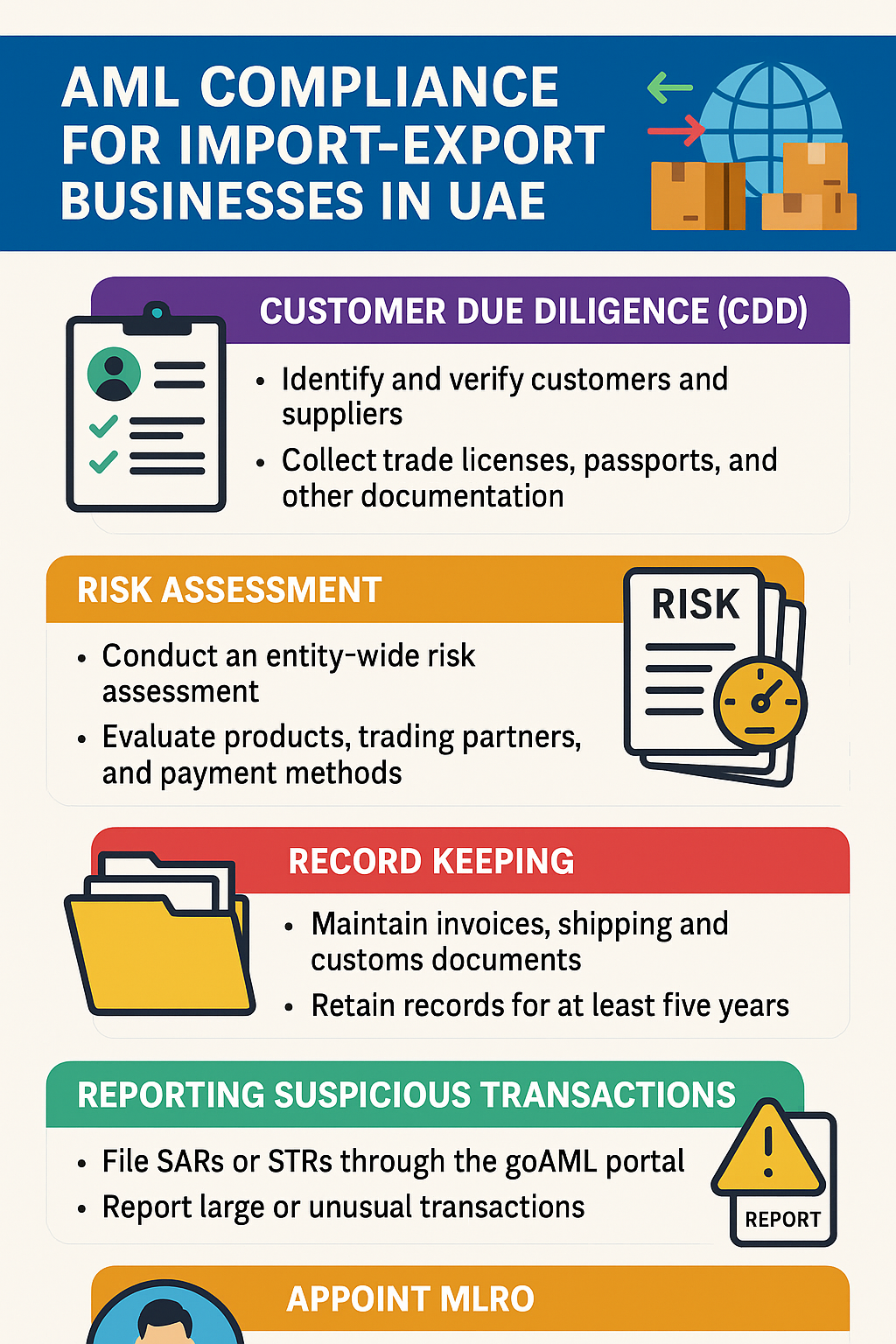
A. Customer Due Diligence (CDD)
• Identify and verify all customers, suppliers, and counterparties.
• Collect legal documentation such as trade license, VAT certificate, passports, and ownership details.
• Confirm the source of funds and purpose of the business relationship.
• Apply Enhanced Due Diligence (EDD) for high-risk jurisdictions or politically exposed persons (PEPs).
B. Risk Assessment
• Conduct an Entity-Wide Risk Assessment (EWRA) covering:
o Type of goods traded.
o Country of origin and destination.
o Payment methods and trade routes.
o Customer profile and ownership structures.
• Classify risks as low, medium, or high, and apply corresponding controls.
C. Record Keeping
• Maintain all invoices, customs documents, shipping records, contracts, and CDD files for a minimum of five years.
• Keep both digital and physical records ready for MOE or FIU inspection.
D. Reporting Suspicious Transactions
If any transaction appears inconsistent with the customer’s business profile or trade pattern, it must be reported via:
• Suspicious Transaction Report (STR) or Suspicious Activity Report (SAR) through the goAML portal.
• Large Cash Transaction Reports (LCTRs) for cash deals above AED 55,000 (where applicable).
E. Appointment of MLRO
• Designate a Money Laundering Reporting Officer (MLRO) to oversee AML implementation.
• The MLRO should ensure monitoring, training, and liaison with authorities.
F. Staff Training
• Conduct regular AML/CFT training for all employees handling trade, payments, and documentation.
• Training should cover red flags, goAML reporting, and record management.
________________________________________
4. Trade-Based Money Laundering (TBML) Red Flags
Import-export companies should be alert to the following warning signs:
• Mismatch between invoice value and market price.
• Customer insists on complex payment routes or third-party transfers.
• Unusual shipping patterns (e.g., unnecessary transshipment or routing through high-risk countries).
• Discrepancies between quantity, description, and invoice.
• Repeated transactions with unknown or unrelated suppliers.
• Payments made by entities not involved in the trade.
Identifying and investigating these patterns early can help prevent AML violations and regulatory penalties.
________________________________________
5. Penalties for Non-Compliance
The UAE has intensified AML enforcement in trade-related sectors.
Failure to comply can lead to:
• Fines ranging from AED 50,000 to AED 5 million per violation.
• Business suspension or license cancellation.
• Free zone blacklisting and reporting to international authorities.
• Criminal liability for directors or compliance officers.
________________________________________
6. Practical AML Steps for Import-Export Businesses
To safeguard your business, follow these best practices:
1. Register with the MOE and goAML platform.
2. Prepare and implement AML/CFT Policy and Procedures Manual.
3. Perform due diligence and sanctions screening on all clients and suppliers.
4. Conduct risk assessment and update it annually.
5. Report suspicious activities promptly through goAML.
6. Train staff regularly and maintain compliance records.
Using AML software like MyAML.io can simplify ongoing monitoring, KYC collection, and report submission.
________________________________________
7. How Sheikh Anwar Accounting & Auditing LLC Can Help
At Sheikh Anwar Accounting and Auditing LLC, we provide specialized AML solutions for import-export companies across the UAE, including:
✅ AML Policy & Procedure drafting
✅ Entity-Wide Risk Assessment (EWRA)
✅ MLRO appointment and support
✅ goAML registration and report filing
✅ Staff AML/CFT training
✅ Compliance audit and risk review
Our team ensures your company remains fully compliant with UAE AML regulations and avoids costly penalties.
________________________________________
8. Conclusion
As the UAE continues to strengthen its AML framework in alignment with FATF standards, import-export businesses must adopt robust systems to detect and prevent money laundering through trade.
By implementing due diligence, risk assessments, and reporting mechanisms, businesses not only protect themselves legally but also contribute to the UAE’s global reputation as a transparent and compliant trading nation.
Compliance is not just about avoiding penalties — it’s about ensuring trust, sustainability, and long-term growth.
________________________________________
📞 Contact Us:
Sheikh Anwar Accounting and Auditing LLC
📍 Office: M35, Dubai Creek Tower, Dubai, UAE
📧 Email: info@sa-auditors.com | admin@myaml.io
🌐 Website: www.sa-auditors.com | www.myaml.io
📱 Phone: +971 58 562 1786