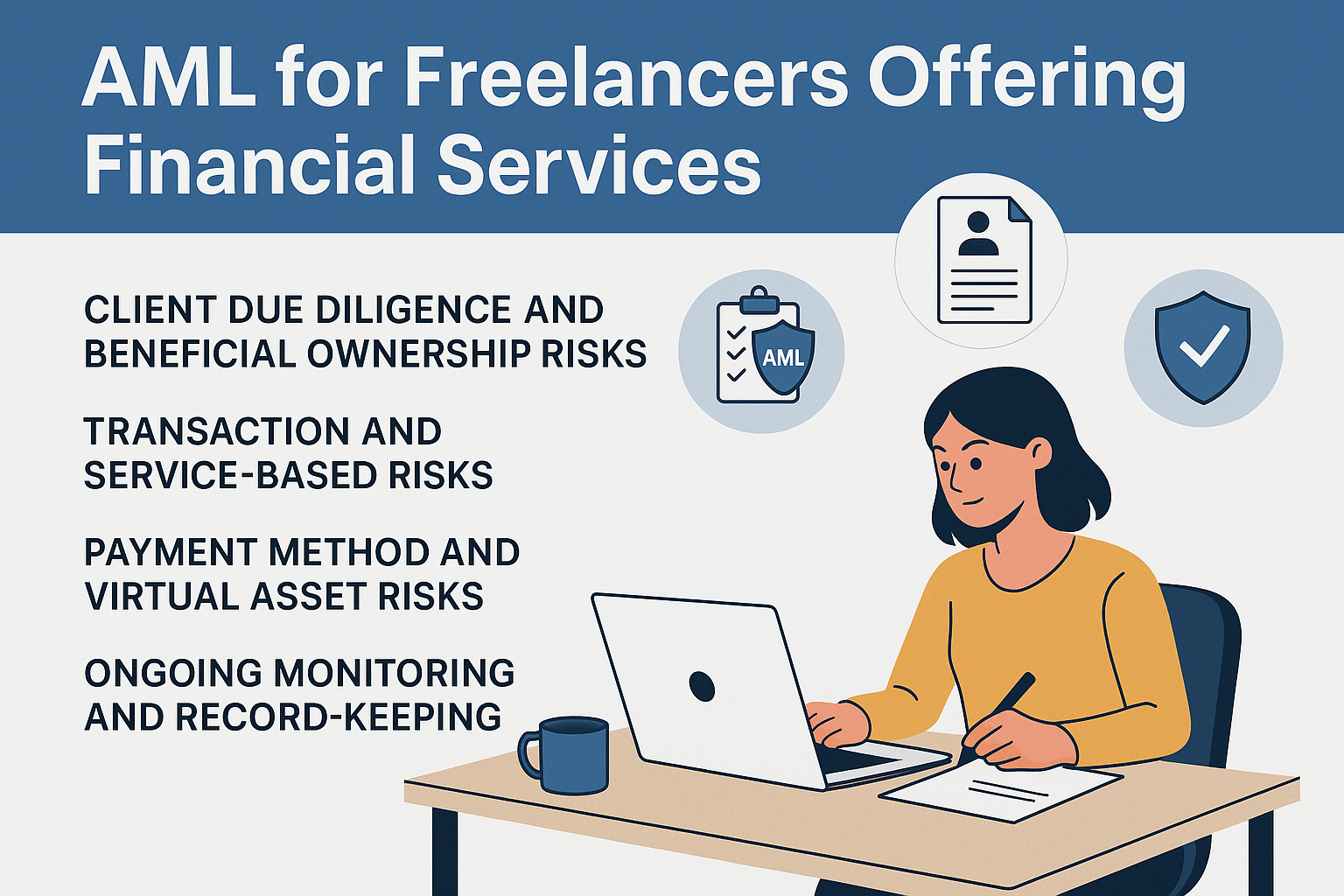
AML for Freelancers Offering Financial Services
Introduction
The rise of the freelance economy has transformed how financial services are delivered. Freelancers providing accounting, bookkeeping, tax advisory, virtual CFO, or financial consulting services play a growing role in both local and international markets.
However, these independent professionals also face increasing scrutiny under Anti-Money Laundering (AML) regulations. While many freelancers assume AML laws apply only to banks or large firms, the reality is that anyone providing financial or related services can be exploited to facilitate money laundering or terrorist financing if proper controls are not in place.
It outlines the key AML risks freelancers in financial services must be aware of and provides practical compliance strategies to mitigate them.
________________________________________
1. Client Due Diligence and Beneficial Ownership Risks
Freelancers often work with diverse clients—from small businesses and start-ups to overseas individuals. Without proper client identification and verification, they risk becoming conduits for illicit funds.
Risks
• Accepting clients with hidden beneficial owners or unclear source of funds.
• Relying on informal or incomplete KYC information.
• Engaging with high-risk clients from opaque jurisdictions.
Mitigation
• Implement a basic KYC process for all clients.
• Collect valid ID, trade license, ownership information, and proof of address.
• Screen clients and beneficial owners against PEP and sanction lists.
• Maintain proper records of all verification documents.
________________________________________
2. Transaction and Service-Based Risks
Freelancers who manage financial records, transactions, or act as intermediaries for payments can inadvertently facilitate laundering activities.
Risks
• Handling client funds or processing cross-border transactions.
• Involvement with virtual assets or unregulated payment systems.
• Providing bookkeeping or accounting services that obscure fund origins.
Mitigation
• Clearly define the scope of engagement and avoid acting as a money transmitter.
• Request transaction documents and verify parties involved.
• Be alert to unusual transaction patterns, rapid fund movements, or vague business rationales.
________________________________________
3. Jurisdictional and Geographic Risks
Freelancers often serve international clients remotely. Transactions linked to high-risk countries can expose them to AML breaches.
Mitigation
• Conduct a jurisdictional risk assessment before onboarding new clients.
• Refer to FATF’s high-risk jurisdiction lists regularly.
• Apply enhanced due diligence for clients operating in or linked to high-risk areas.
________________________________________
4. Payment Method and Virtual Asset Risks
Flexible payment options attract clients but can increase exposure if not well-controlled.
Risks
• Receiving payments through crypto wallets or unverified third parties.
• Accepting large cash payments or frequent small structured transfers.
Mitigation
• Accept payments only through verified banking channels.
• Avoid or tightly control payments in cash or virtual assets.
• Document source of funds for high-value transactions.
• Include a clause in engagement letters specifying acceptable payment methods.
________________________________________
5. Ongoing Monitoring and Record-Keeping
AML compliance is not a one-time exercise. Freelancers must maintain vigilance throughout the client relationship.
Key Actions
• Conduct periodic reviews of client risk profiles.
• Keep CDD and transaction records for at least five years.
• Watch for red flags such as inconsistent information, uncooperative clients, or unexplained transfers.
• Report any suspicious activity to the relevant FIU (e.g., UAE goAML portal).
________________________________________
6. Reputational and Legal Risks
Failing to implement AML safeguards can severely damage a freelancer’s professional credibility and lead to legal consequences.
Consequences of Non-Compliance
• Regulatory fines or penalties.
• Loss of client trust and banking access.
• Association with criminal activity due to inadequate due diligence.
Mitigation
• Document a personal AML policy and standard operating procedures.
• Stay updated through continuous professional education and AML training.
• Partner with compliance experts or use automated screening tools.
________________________________________
7. Best Practice Checklist for Freelancers
✅ Include AML clauses in your engagement letters.
✅ Onboard clients only after full KYC and risk assessment.
✅ Use official bank transfers for all payments.
✅ Maintain records for at least five years.
✅ Report suspicious activity promptly.
✅ Attend annual AML refresher courses and stay informed of regulatory changes.
________________________________________
Conclusion
Freelancers in financial services are no longer exempt from AML scrutiny. By integrating robust due diligence, transaction monitoring, and record-keeping practices, freelancers can not only remain compliant but also enhance their professional reputation.
A proactive AML framework signals trustworthiness, builds stronger client relationships, and positions freelancers as responsible professionals in an increasingly regulated market.
________________________________________
For Expert AML & Compliance Advisory
Sheikh Anwar Accounting and Auditing LLC
Licensed Auditors & AML Compliance Advisors – Ministry of Economy (Entry No. 5817)
📍 Dubai Creek Tower, Office M-35, UAE
📧 info@sa-auditors.com | 🌐 www.sa-auditors.com
📞 +971-58-562-1786