AML Compliance Tools for Cryptocurrency Exchanges
Introduction
As cryptocurrency exchanges evolve into regulated financial intermediaries, they face increasing exposure to money laundering, terrorist financing, and sanctions evasion risks.
To remain compliant and credible, exchanges must deploy robust Anti-Money Laundering (AML) frameworks supported by modern compliance technologies that can monitor both on-chain and off-chain activities.
It explains the essential AML compliance tools that every cryptocurrency exchange should implement in 2025 to meet international and UAE regulatory standards.
________________________________________
1. Why Crypto Exchanges Need Specialized AML Tools
Unlike traditional financial institutions, cryptocurrency exchanges must simultaneously analyze:
• Off-chain data: Customer identities, IP addresses, device signatures, funding sources, and fiat transactions.
• On-chain data: Blockchain wallet histories, transaction flows, and exposure to illicit or sanctioned entities.
Conventional AML software built for banks cannot interpret blockchain data. Hence, crypto-specific AML solutions have emerged to provide real-time risk intelligence aligned with FATF Recommendation 15 and Travel Rule requirements for Virtual Asset Service Providers (VASPs).
________________________________________
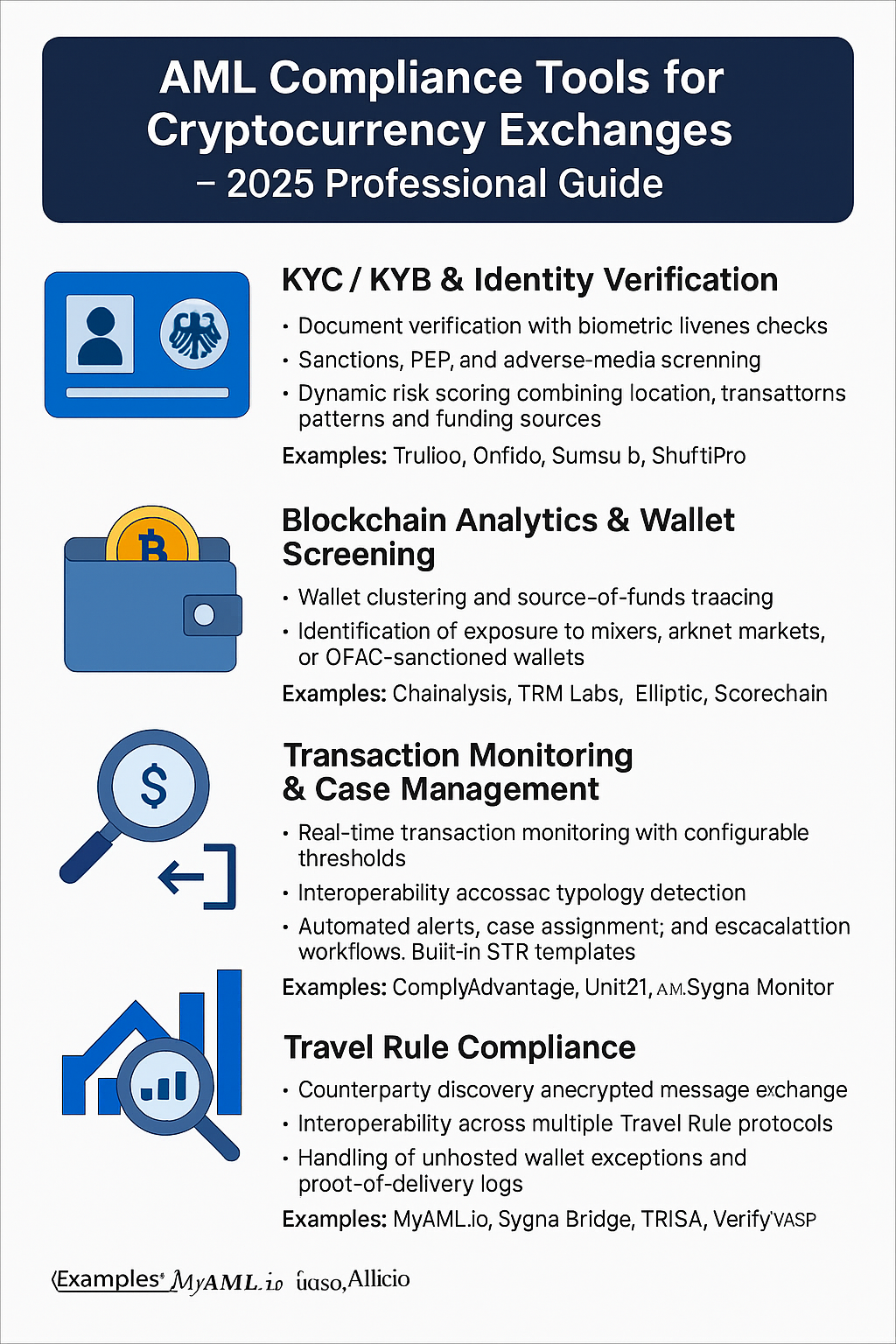
2. Core Categories of AML Tools for Crypto Exchanges
A. KYC / KYB and Identity Verification
Ensures robust customer due diligence (CDD) and perpetual screening:
• Document verification with biometric liveness checks.
• Sanctions, PEP, and adverse-media screening across global watchlists.
• Dynamic risk scoring combining location, transaction patterns, and funding sources.
• Business verification (KYB) including UBO identification.
Examples: Trulioo, Onfido, Sumsub, ShuftiPro.
________________________________________
B. Blockchain Analytics & Wallet Screening
Analyzes blockchain activity to identify tainted or suspicious wallets:
• Wallet clustering and source-of-funds tracing.
• Identification of exposure to mixers, darknet markets, or OFAC-sanctioned wallets.
• Cross-chain tracking for BTC, ETH, TRON, Polygon, and more.
• Visual transaction mapping and attribution confidence scoring.
Examples: Chainalysis, TRM Labs, Elliptic, Scorechain.
________________________________________
C. Transaction Monitoring & Case Management
Detects high-risk behaviors through automated rules and analytics:
• Real-time transaction monitoring with configurable thresholds.
• Machine-learning-based typology detection.
• Automated alerts, case assignment, and escalation workflows.
• Built-in Suspicious Transaction Report (STR) templates.
Examples: ComplyAdvantage, Unit21, AMLBot, Sygna Monitor.
________________________________________
D. Travel Rule Compliance
Facilitates secure transfer of sender and receiver details between exchanges:
• Counterparty discovery and encrypted message exchange.
• Interoperability across multiple Travel Rule protocols.
• Handling of unhosted wallet exceptions and proof-of-delivery logs.
Examples: Notabene, Sygna Bridge, TRISA, VerifyVASP.
________________________________________
E. Analytics, Governance, and Reporting
Consolidates compliance data into actionable dashboards:
• Real-time risk visualization and audit logs.
• KPI tracking for alert volumes, case resolution, and STR conversion.
• Integration with goAML, FIU portals, and regulator reporting formats.
Examples: MyAML.io, Lucinity, Alessa, SEON AML Analytics.
________________________________________
3. Key Features of a Comprehensive AML Framework
Area Key Capabilities
Data Integration Real-time streaming from trading engines, wallets, and fiat systems.
Risk Detection Rule-based + AI/ML analysis for precision alerting.
Case Management Investigations, audit trails, documentation, and evidence packs.
Regulatory Reporting Direct STR/CTR exports compatible with goAML portals.
Travel Rule Full interoperability and secure record retention.
Governance Version control, QA testing, and independent model validation.
________________________________________
4. Implementation Roadmap
Phase 1 – Risk Assessment & Vendor Selection (Weeks 1–2)
Conduct enterprise-wide AML risk assessment and identify tool vendors that meet both operational and regulatory requirements.
Phase 2 – System Integration (Weeks 3–6)
Link KYC providers, blockchain analytics, and transaction-monitoring systems into unified alert management.
Phase 3 – Testing & Calibration (Weeks 7–10)
Back-test historical data, tune thresholds, and validate rule accuracy.
Phase 4 – Go-Live & Audit Readiness (Weeks 11–12)
Train compliance staff, implement Travel Rule interoperability, and prepare regulator-ready evidence packs.
________________________________________
5. UAE and GCC Regulatory Alignment
Cryptocurrency exchanges operating in the UAE are regulated by one of the following authorities:
VARA (Dubai), FSRA (ADGM), DFSA (DIFC), or the Central Bank of the UAE.
AML systems must comply with:
• Federal Decree-Law No. 20 of 2018 (AML/CFT)
• Cabinet Decision No. 10 of 2019
• Cabinet Decision No. 109 of 2023 (Virtual Asset Regulation)
• FATF Recommendations & goAML reporting obligations
Compliance solutions must therefore support:
• Sanctions screening against UAE, UN, EU, and OFAC lists.
• STR submission in goAML XML format.
• Data residency controls ensuring storage within the UAE or GCC.
________________________________________
6. Common Mistakes to Avoid
• Performing one-time KYC instead of continuous re-screening.
• Ignoring deposits from unhosted wallets.
• No monitoring of cross-chain flows.
• Lack of Travel Rule message validation.
• Poor audit trails and missing escalation documentation.
• Over-reliance on manual processes or a single vendor.
________________________________________
7. Key AML Performance Metrics
• True-positive vs. false-positive alert ratio.
• Average investigation closure time.
• Number of STRs filed per quarter.
• Sanctions-screening refresh rate.
• System uptime and Travel Rule success rate.
________________________________________
8. Conclusion
Crypto exchanges now sit at the intersection of finance, technology, and regulation. Implementing effective AML compliance tools is no longer optional—it is a regulatory necessity and business differentiator.
By integrating identity verification, wallet analytics, transaction monitoring, and Travel Rule compliance into a single governed ecosystem, exchanges can build resilience, trust, and transparency while staying ahead of regulatory expectations.
________________________________________
About Sheikh Anwar Accounting & Auditing LLC
Sheikh Anwar Accounting & Auditing LLC (SA Auditors) is a Dubai-based professional firm (MOE Entry No. 5817) providing AML compliance, outsourced MLRO services, corporate tax, and audit solutions. Through our sister concern MyAML.io, we deliver specialized AML technology advisory for Virtual Asset Service Providers (VASPs) and DNFBPs across the UAE and GCC.
📍 Office Address: M-35, Dubai Creek Tower, Dubai, U.A.E.
📞 Phone: +971 4 250 1084
✉️ Email: info@sa-auditors.com
🌐 Website: www.sa-auditors.com | www.myaml.io