AML Compliance Programs (25)
Introduction
In today’s global regulatory environment, Anti-Money Laundering (AML) compliance programs are essential for businesses exposed to financial crime risks. In the UAE, under Federal Decree-Law No. 20 of 2018, Cabinet Decision No. 10 of 2019, and other regulatory frameworks, all financial institutions and Designated Non-Financial Businesses and Professions (DNFBPs) are required to implement structured AML programs.
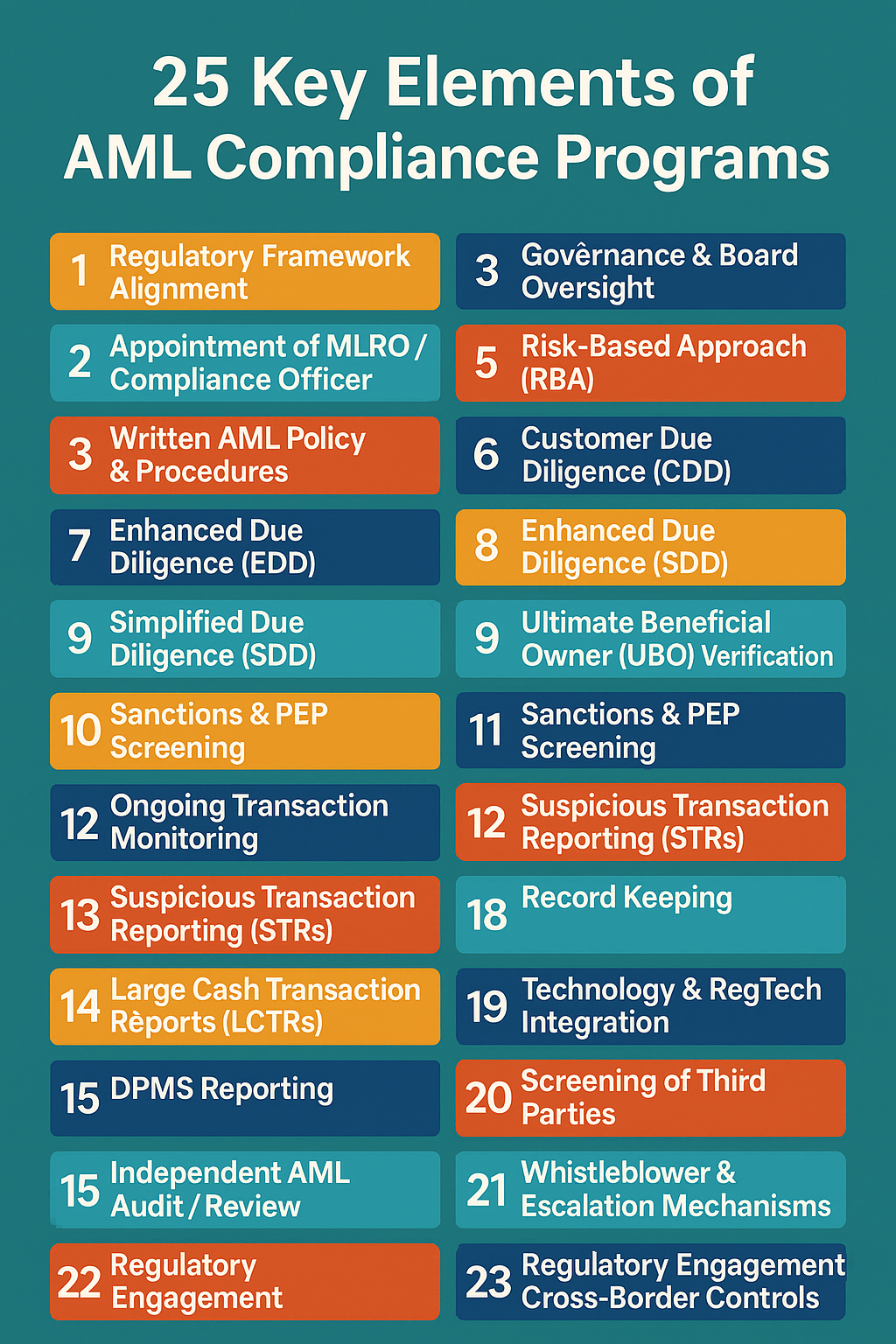
A robust AML compliance program protects businesses from penalties, enhances credibility with regulators, and strengthens customer trust. Below are the 25 essential components of an effective AML compliance program.
________________________________________
1. Regulatory Framework Alignment
Programs must be designed in line with UAE AML laws, FATF recommendations, and supervisory authority guidance.
2. Governance & Board Oversight
Senior management and the board should actively oversee the AML framework, ensuring accountability at the highest level.
3. Appointment of MLRO / Compliance Officer
A qualified Money Laundering Reporting Officer (MLRO) is mandatory to oversee compliance activities and report to regulators.
4. Risk-Based Approach (RBA)
Adopt an enterprise-wide risk assessment to identify and mitigate risks based on customers, products, geography, and delivery channels.
5. Written AML Policy & Procedures
Documented AML manuals outlining customer due diligence, reporting, monitoring, and escalation procedures.
6. Customer Due Diligence (CDD)
Verify and authenticate the identity of all customers using reliable and independent sources.
7. Enhanced Due Diligence (EDD)
For high-risk clients such as Politically Exposed Persons (PEPs) or customers from FATF high-risk jurisdictions.
8. Simplified Due Diligence (SDD)
When lower risks are identified, SDD may be applied under supervisory guidance.
9. Ultimate Beneficial Owner (UBO) Verification
Identify and verify the true owners of companies, trusts, or legal arrangements.
10. Sanctions & PEP Screening
Screen all customers against sanctions lists, UN lists, and PEP databases on an ongoing basis.
11. Ongoing Transaction Monitoring
Automated or manual review of customer transactions to detect suspicious activity.
12. Suspicious Transaction Reporting (STRs)
Prompt filing of STRs through the goAML platform with the UAE Financial Intelligence Unit (FIU).
13. Large Cash Transaction Reports (LCTRs)
Mandatory reporting of cash transactions exceeding AED 55,000 in DNFBPs (e.g., jewellers, real estate).
14. DPMS Reporting
Dealers in Precious Metals and Stones (DPMS) must file sector-specific reports when threshold transactions occur.
15. Independent AML Audit / Review
Regular independent testing of AML controls to ensure effectiveness and regulatory compliance.
16. Internal Controls & Segregation of Duties
Strong internal controls with clear roles to avoid conflict of interest or misuse.
17. Staff Training & Awareness
Periodic AML training for employees to recognize red flags and compliance responsibilities.
18. Record Keeping
Maintain all customer, transaction, and reporting records for at least five years.
19. Technology & RegTech Integration
Adoption of AI-driven transaction monitoring, e-KYC, and blockchain-based tools to enhance compliance.
20. Screening of Third Parties
Due diligence on suppliers, agents, and intermediaries to prevent indirect exposure to ML/TF risks.
21. Whistleblower & Escalation Mechanisms
Encourage employees to report suspicious activity internally without fear of retaliation.
22. Regulatory Engagement
Proactive communication with regulators, including responding to inspections and audits.
23. Cross-Border Controls
Additional oversight for transactions involving offshore entities, high-risk jurisdictions, and tax havens.
24. Periodic Program Review & Updates
AML programs must be continuously updated to reflect new FATF recommendations, UAE regulatory changes, and evolving typologies.
25. Culture of Compliance
Beyond processes, AML compliance must be embedded into the company’s culture, ensuring that all stakeholders value integrity and transparency.
________________________________________
Conclusion
An effective AML compliance program is not a static document but a living framework that evolves with regulatory changes, industry risks, and technological advancements. By implementing these 25 key elements, businesses—especially DNFBPs in the UAE—can strengthen their defense against financial crime, avoid penalties, and build long-term trust with regulators and clients.
________________________________________
About Us
Sheikh Anwar Accounting and Auditing LLC is a Dubai-based auditing and compliance firm, specializing in AML advisory, corporate tax, VAT, and transfer pricing. We assist financial institutions and DNFBPs in designing, implementing, and reviewing AML compliance programs tailored to UAE regulatory requirements and FATF standards.
📍 Address: Dubai Creek Tower, M 35, Dubai, UAE
📞 Contact: info@sa-auditors.com | +971-XXX-XXXX
🌐 Website: www.sa-auditors.com