AML Compliance for SMEs in Dubai
Introduction
In Dubai’s growing and dynamic business landscape, small and medium enterprises (SMEs) play a vital role in driving the economy. However, as financial crimes like money laundering and terrorist financing continue to evolve, Anti-Money Laundering (AML) compliance is no longer limited to banks and large corporations — SMEs are now under regulatory scrutiny as well.
________________________________________
1. What Is AML Compliance?
Anti-Money Laundering (AML) refers to the laws, regulations, and procedures designed to prevent criminals from disguising illegally obtained funds as legitimate income.
In the United Arab Emirates (UAE), AML compliance is governed by:
• Federal Decree-Law No. 20 of 2018 on Anti-Money Laundering and Combating the Financing of Terrorism and Illegal Organizations.
• Cabinet Decision No. 10 of 2019, which provides the executive regulations for AML/CFT requirements.
Every business, regardless of size, is expected to implement a risk-based approach to detect, prevent, and report suspicious activities.
________________________________________
2. Why AML Compliance Is Important for SMEs
While many SMEs believe AML laws only apply to financial institutions, in reality, Designated Non-Financial Businesses and Professions (DNFBPs) — which include real estate brokers, jewellers, auditors, accountants, dealers in precious metals/stones, corporate service providers, and law firms — are fully subject to AML regulations.
Key reasons SMEs must comply:
1. Regulatory Requirement: AML compliance is mandatory under UAE law.
2. Avoiding Penalties: Non-compliance can lead to hefty fines ranging from AED 50,000 to AED 5,000,000.
3. Reputation Protection: Compliance builds credibility with clients, banks, and regulators.
4. Sustainability: AML controls ensure long-term business integrity and regulatory trust.
________________________________________
3. Who Needs to Comply Among SMEs?
If your SME is engaged in any of the following activities, AML compliance is mandatory:
• Buying or selling real estate.
• Trading in gold, diamonds, or precious metals/stones.
• Providing auditing, accounting, or tax consultancy services.
• Acting as a company formation or nominee service provider.
• Managing or operating trust or foundation structures.
These entities must register with the Ministry of Economy (MOE) on the goAML platform and maintain an effective AML compliance program.
________________________________________
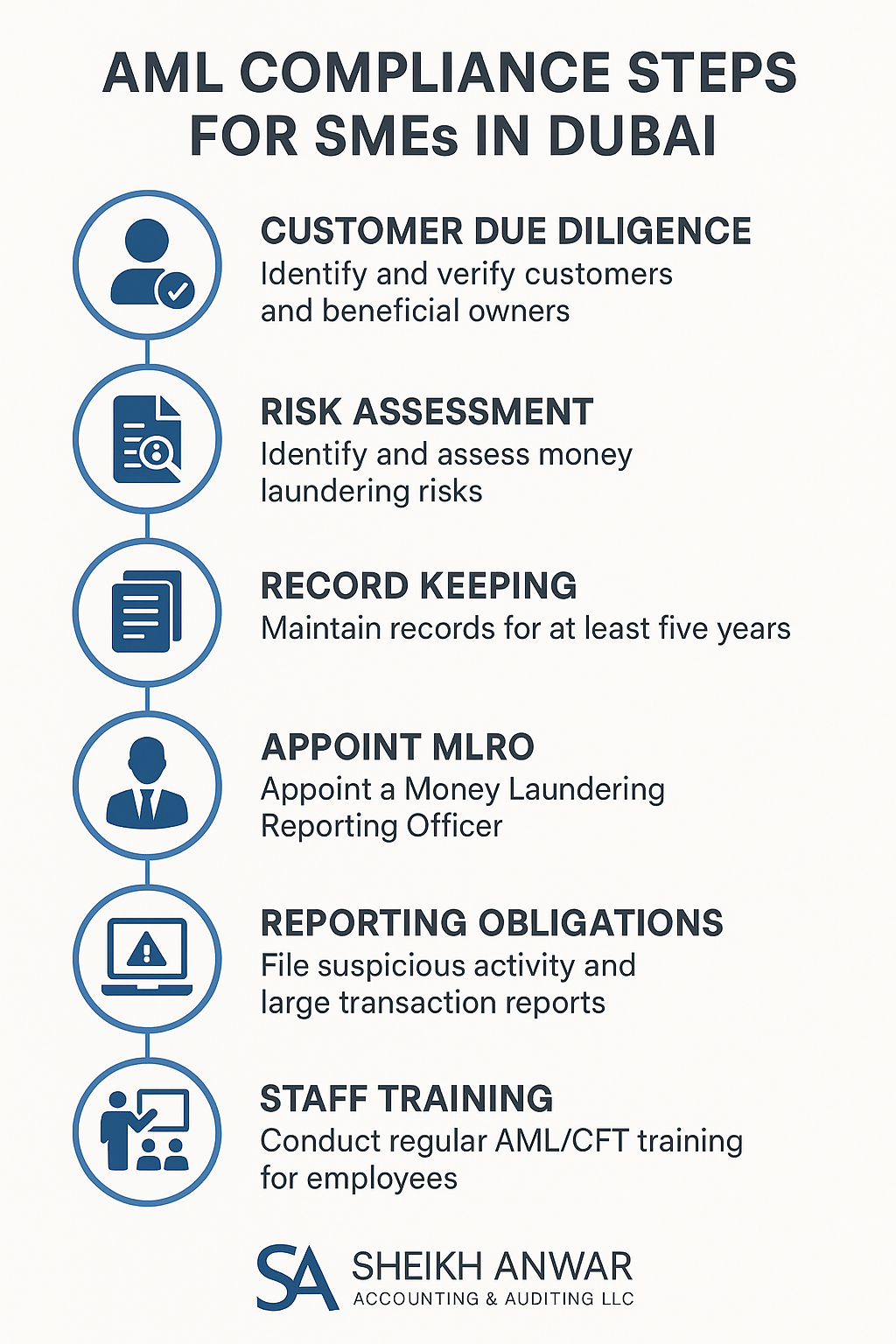
4. Core AML Requirements for SMEs
To meet AML obligations, SMEs must establish a comprehensive compliance framework that includes the following elements:
A. Customer Due Diligence (CDD)
• Identify and verify customers and beneficial owners.
• Obtain proof of identity, address, and business nature.
• Conduct Enhanced Due Diligence (EDD) for high-risk clients.
B. Risk Assessment
• Identify and assess the risk of money laundering related to your products, services, customers, and jurisdictions.
• Maintain a Risk-Based Approach (RBA) document.
C. Record Keeping
• Retain all customer and transaction records for at least five years.
• Ensure digital and physical records are easily retrievable during inspections.
D. Appoint a Money Laundering Reporting Officer (MLRO)
• The MLRO acts as the central point for handling suspicious activity reports and ensuring ongoing compliance.
E. Reporting Obligations
• File Suspicious Activity Reports (SARs) or Suspicious Transaction Reports (STRs) through the goAML portal.
• Report large cash transactions (above AED 55,000 in some sectors).
F. Staff Training
• Conduct regular AML/CFT awareness training to ensure all employees understand their obligations.
• Maintain attendance records and training materials as evidence.
________________________________________
5. Common AML Challenges for SMEs
Despite the legal requirements, SMEs often face these common difficulties:
• Limited internal resources and compliance staff.
• Lack of awareness about new AML regulations.
• Weak documentation and risk assessment systems.
• Inadequate reporting and monitoring tools.
However, with professional assistance and automation tools like MyAML.io, SMEs can simplify AML compliance with built-in risk scoring, CDD management, and automated report generation.
________________________________________
6. Consequences of Non-Compliance
Failure to comply with AML regulations can lead to:
• Administrative Fines: From AED 50,000 to AED 5 million.
• Business Suspension or License Revocation.
• Criminal Liability: In serious cases, imprisonment of responsible officials.
In addition, repeated violations may lead to blacklisting or being reported to the UAE Financial Intelligence Unit (FIU).
________________________________________
7. How Sheikh Anwar Accounting & Auditing LLC Can Help
At Sheikh Anwar Accounting and Auditing LLC, we specialize in AML compliance support for SMEs across Dubai and the UAE, including:
✅ Preparation of Entity-Wide Risk Assessment (EWRA)
✅ Drafting of AML/CFT Policy and Procedures Manual
✅ MLRO appointment and training support
✅ Registration and assistance on goAML
✅ Ongoing Monitoring and CDD reviews
✅ Suspicious Activity Reporting (SAR/STR) guidance
We also provide customized AML software solutions through www.MyAML.io for efficient CDD and risk management.
________________________________________
8. Conclusion
AML compliance is not just a regulatory formality — it is an essential safeguard that protects SMEs from financial crime, reputational risk, and penalties.
By implementing an effective AML program, SMEs in Dubai can ensure compliance, build trust, and contribute to a transparent financial ecosystem.
________________________________________
📞 Contact Us:
Sheikh Anwar Accounting and Auditing LLC
📍 Office: M35, Dubai Creek Tower, Dubai, UAE
📧 Email: info@sa-auditors.com | admin@myaml.io
🌐 Website: www.sa-auditors.com | www.myaml.io
📱 Phone: +971 58 562 1786