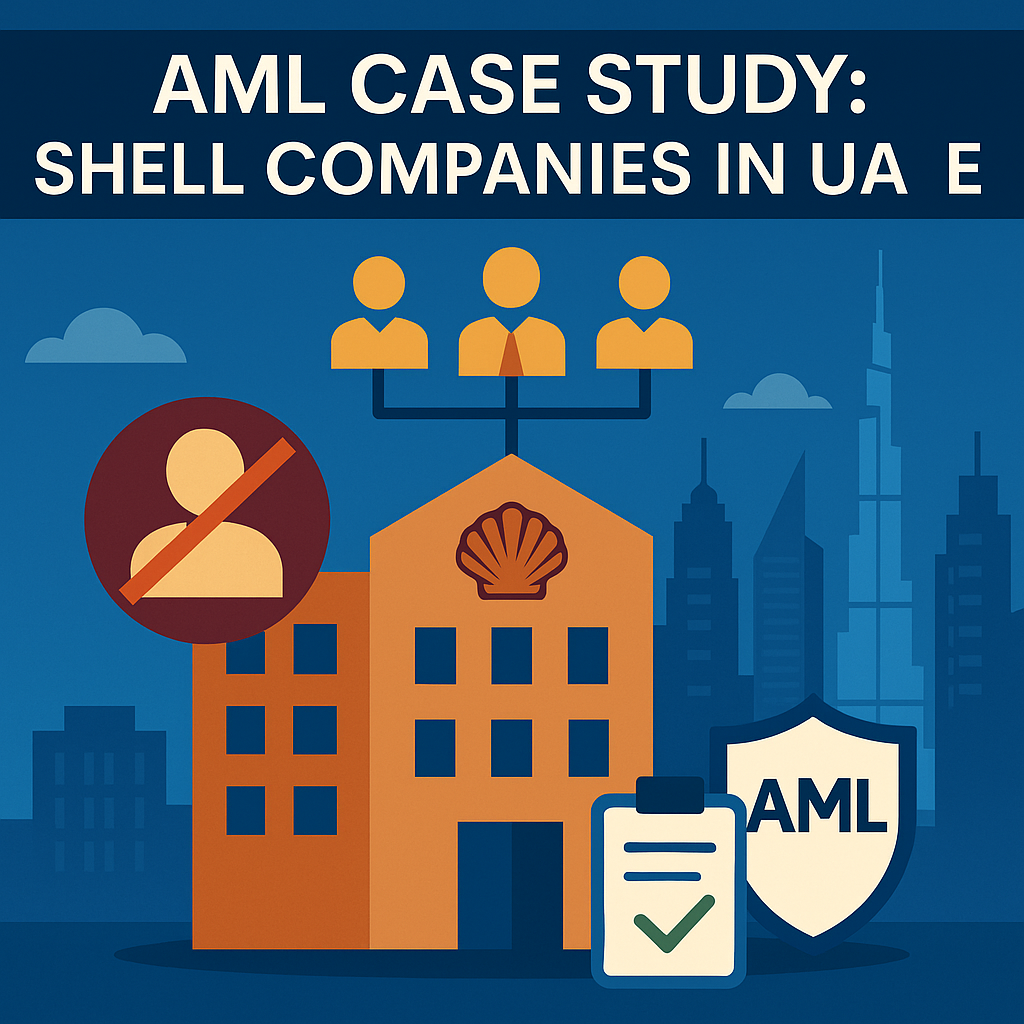
AML Case Study: Shell Companies in UAE
1. Introduction
The UAE has long been a hub for international business and trade — a position that brings both opportunity and responsibility. While the nation has made significant strides in strengthening its Anti-Money Laundering (AML) and Counter-Terrorism Financing (CFT) framework, certain vulnerabilities persist, particularly involving shell companies.
Shell companies — legal entities with no substantial operations or assets — are often used to conceal beneficial ownership, layer illicit funds, or obscure financial trails. It explores how shell companies in the UAE have been exploited for money laundering, what regulatory actions followed, and what lessons can be learned to prevent future misuse.
________________________________________
2. What Are Shell Companies?
A shell company is typically a registered legal entity that:
• Has no active business operations or significant assets;
• Exists mainly on paper;
• Is used to own assets, manage funds, or conduct limited transactions.
While not inherently illegal, shell companies become high-risk when used to:
• Conceal ultimate beneficial owners (UBOs);
• Facilitate complex ownership structures;
• Conduct cross-border transfers without economic substance;
• Evade taxes or regulatory scrutiny.
Under Cabinet Decision No. 10 of 2019 and Cabinet Decision No. 109 of 2023, UAE companies must disclose accurate beneficial ownership information and maintain transparency to mitigate such risks.
________________________________________
3. Case Background: Network of Shell Companies in the UAE
In 2023, the UAE Financial Intelligence Unit (FIU), through data gathered from the goAML platform, detected multiple interconnected shell entities involved in unusually structured transactions across free zones and mainland jurisdictions.
Key Characteristics of the Network:
• Entities registered in different emirates with similar shareholder names and common addresses.
• No physical offices or employees — only virtual offices and P.O. boxes.
• Transactions involving large cross-border remittances with no clear business justification.
• Funds received from high-risk jurisdictions and quickly transferred to other accounts abroad.
The pattern triggered alerts within the goAML system, prompting further investigation by the Ministry of Economy (MoE) and the Central Bank of the UAE (CBUAE).
________________________________________
4. Investigation Findings
a. Lack of Real Business Activity
The companies were established as “consulting” and “general trading” entities but failed to demonstrate any legitimate commercial operations. No invoices, employee records, or contracts were available for review.
b. Concealed Beneficial Ownership
Although the registered shareholders appeared unrelated, analysis revealed a single ultimate beneficial owner (UBO) controlling all companies through nominee directors and offshore holding structures.
c. Suspicious Fund Movements
The companies received multiple inward transfers totaling over AED 50 million within six months from unrelated overseas sources. Funds were then transferred to other shell entities in Europe and Asia — a clear indication of layering activity.
d. No AML Policies or Reporting
None of the entities had:
• A designated Money Laundering Reporting Officer (MLRO),
• An AML policy or risk assessment, or
• Any STR (Suspicious Transaction Report) filings via the goAML system.
e. Involvement of DNFBPs
Certain corporate service providers (CSPs) and accounting firms were found to have assisted in incorporating these entities without performing adequate Customer Due Diligence (CDD) or verifying the UBOs — violating Article 9 of Cabinet Decision No. 10 of 2019.
________________________________________
5. Regulatory Actions Taken
Against the Shell Companies
• Deregistration and license suspension by the relevant free zone authorities.
• Freezing of bank accounts under directives from the CBUAE.
• Referral to Public Prosecution for investigation under Article 27 of Federal Decree-Law No. 20 of 2018.
Against the DNFBPs Involved
• Administrative fines ranging between AED 100,000 and AED 1,000,000 for failure to perform due diligence.
• Mandatory submission of Corrective Action Plans (CAPs).
• Enhanced regulatory supervision for 12 months.
• Requirement to complete MoE-approved AML training.
These actions were part of the UAE’s broader effort to demonstrate effectiveness in risk-based supervision and AML enforcement, in line with FATF recommendations.
________________________________________
6. Lessons Learned
1. Shell Companies Are High-Risk by Nature
Entities with limited operations, unclear ownership, and offshore connections warrant enhanced due diligence (EDD). AML frameworks must flag these companies as high-risk customers.
2. Beneficial Ownership Verification Is Essential
Identifying the true UBO is a non-negotiable compliance requirement. Regulators expect businesses to trace ownership layers and document verification procedures.
3. DNFBPs Must Conduct Independent Checks
Corporate service providers, accountants, and lawyers cannot rely solely on client declarations. They must perform independent verification using official records or notarized documentation.
4. Ongoing Monitoring Prevents Abuse
Regularly reviewing transactions and customer profiles helps detect changes in behavior that may signal suspicious activity.
5. goAML Reporting Protects Businesses
Timely filing of Suspicious Transaction Reports (STRs) through the goAML system demonstrates compliance and helps authorities identify and dismantle illicit networks.
6. Coordination Between Authorities Works
The successful detection of this case resulted from collaboration between the FIU, MoE, CBUAE, and free zone regulators — illustrating the importance of cross-agency data sharing.
________________________________________
7. Best Practices for Businesses
To mitigate AML risks related to shell companies, businesses should implement the following controls:
1. Perform Enhanced Due Diligence (EDD) on entities with complex ownership or offshore links.
2. Verify UBOs through supporting documents (corporate registry extracts, passports, etc.).
3. Maintain clear records of ownership structures and control mechanisms.
4. Develop an AML policy and risk assessment framework.
5. Appoint a qualified MLRO and ensure they are registered on goAML.
6. Train staff to identify shell-company typologies and red flags.
7. File STRs immediately when suspicions arise.
8. Conduct periodic internal AML audits to test effectiveness.
________________________________________
8. Key Takeaway
This case highlights how shell companies can be weaponized to obscure illicit fund flows and evade regulatory scrutiny. For compliance officers, AML auditors, and DNFBPs, the message is clear:
“Transparency in ownership and purpose is the foundation of AML compliance.”
Businesses that invest in strong governance, AML awareness, and timely reporting not only avoid penalties but also contribute to protecting the UAE’s financial integrity and international reputation.
________________________________________
9. About Sheikh Anwar Accounting & Auditing LLC
Sheikh Anwar Accounting & Auditing LLC is a professional firm in the UAE specializing in AML compliance, corporate audits, and risk management.
Our AML services include:
• goAML Registration & Reporting Support
• AML Policy Development and Implementation
• MLRO Outsourcing Services
• Beneficial Ownership & Risk Assessment Reviews
• AML Training and Regulatory Audit Support
📞 Phone: +971 4 876 9890
📧 Email: info@sa-auditors.com
🌐 Website: www.sa-auditors.com
🏢 Office: Sheikh Anwar Accounting & Auditing LLC, Dubai Creek Tower, Office M-35, Dubai, United Arab Emirates