AML Case Management Systems for Compliance Teams
Introduction
Anti-Money Laundering (AML) compliance is one of the most critical responsibilities for financial institutions and Designated Non-Financial Businesses and Professions (DNFBPs). With regulators imposing stricter oversight and hefty penalties for non-compliance, compliance teams need efficient systems to manage investigations, reporting, and ongoing monitoring. AML Case Management Systems (CMS) provide a centralized platform that simplifies the investigation process, enhances collaboration, and ensures regulatory requirements are met with precision.
________________________________________
What is an AML Case Management System?
An AML Case Management System is a technology solution that helps compliance teams collect, track, analyze, and resolve suspicious activity cases. It connects transaction monitoring alerts, customer due diligence (CDD/KYC) information, and external watchlist screening results into a unified workflow.
Instead of handling cases manually through spreadsheets or emails, a CMS streamlines the process by:
• Assigning alerts to investigators.
• Tracking the lifecycle of suspicious activity from detection to closure.
• Facilitating Suspicious Transaction Report (STR) filings with regulators.
• Providing a comprehensive audit trail for regulatory inspections.
________________________________________
Key Features of AML Case Management Systems
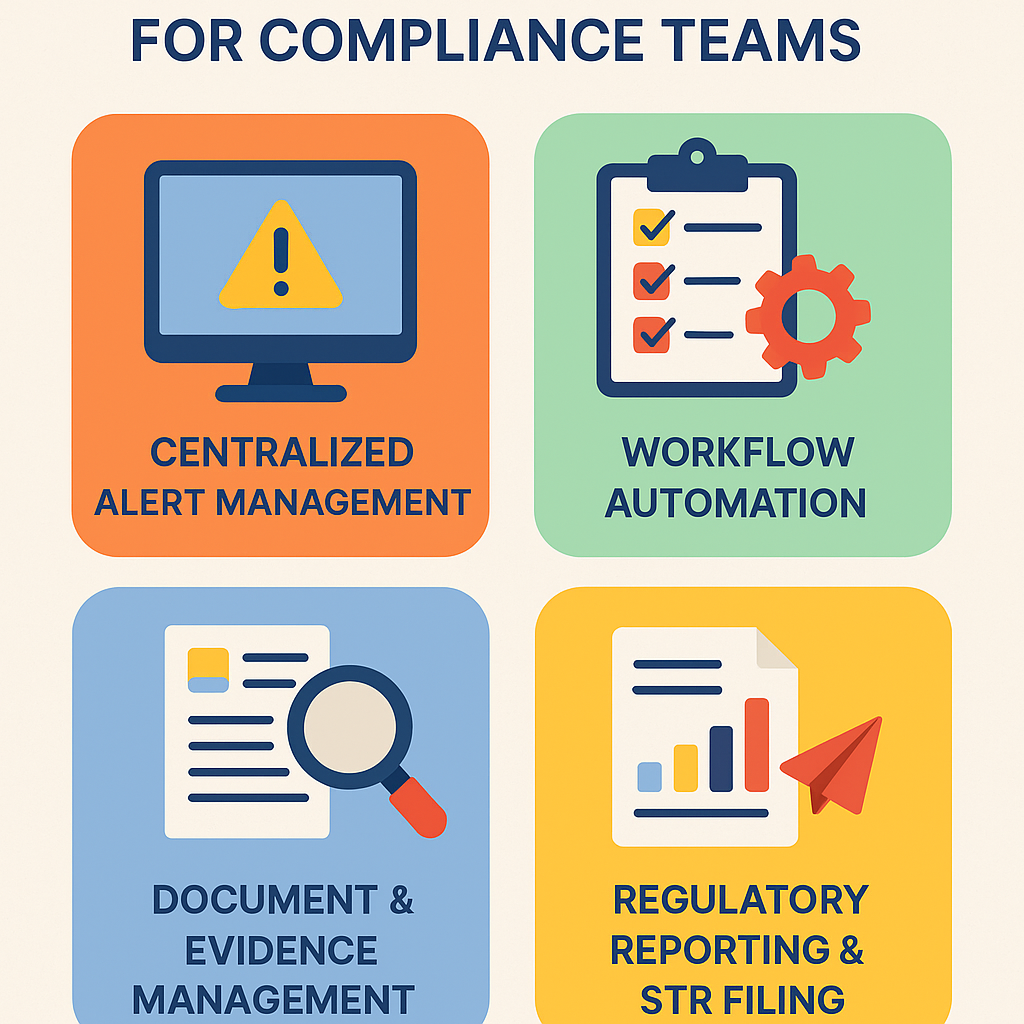
1. Centralized Alert Management
All transaction monitoring alerts, sanctions hits, and KYC red flags are consolidated into a single dashboard, reducing the risk of missed cases.
2. Workflow Automation
Cases are automatically assigned to compliance officers based on severity, workload, or expertise. This improves turnaround time and ensures accountability.
3. Document & Evidence Management
The system allows investigators to upload supporting documents, notes, and evidence. This creates a complete case file accessible for audits and regulatory reviews.
4. Integration with Monitoring Tools
Modern CMS platforms integrate seamlessly with real-time transaction monitoring, sanctions screening, and customer onboarding systems. This creates a holistic compliance ecosystem.
5. Risk Scoring & Prioritization
Cases are scored based on customer risk profiles, transaction types, and regulatory exposure. High-risk cases receive priority handling.
6. Regulatory Reporting & STR Filing
CMS platforms often include built-in templates or direct connections with regulatory portals (such as goAML in the UAE) for timely submission of Suspicious Transaction Reports.
7. Audit Trails & Compliance Analytics
Every action—case creation, investigation notes, approvals—is logged to maintain a transparent audit trail. Advanced analytics provide insights into trends, case resolution times, and compliance team efficiency.
________________________________________
Benefits for Compliance Teams
• Efficiency Gains – Reduces manual processes and repetitive work.
• Consistency in Investigations – Standardized workflows ensure all cases are handled in line with internal policies and AML regulations.
• Improved Collaboration – Multiple investigators can work on complex cases with shared visibility.
• Regulatory Readiness – Provides clean, well-documented records for supervisory inspections.
• Reduced Risk Exposure – Swift handling of suspicious activity prevents reputational and financial losses.
________________________________________
Challenges in AML Case Management
• System Complexity – Adopting new technology requires training and cultural adaptation.
• Integration Issues – Linking with legacy systems and data sources can be difficult.
• Cost Considerations – Advanced CMS platforms may be costly for SMEs and DNFBPs.
• False Positives – Without proper tuning, compliance teams may still face excessive alerts.
________________________________________
Future of AML Case Management
The future of AML case management lies in artificial intelligence, natural language processing (NLP), and predictive analytics. AI-driven CMS platforms will not only manage cases but also predict which alerts are more likely to be genuine, reducing false positives. Additionally, regulators are encouraging the use of RegTech and SupTech solutions that ensure real-time oversight, making CMS adoption even more critical.
________________________________________
Conclusion
An effective AML Case Management System is essential for compliance teams to stay ahead in a challenging regulatory environment. By centralizing investigations, streamlining workflows, and supporting STR filings, CMS solutions empower organizations to meet compliance obligations efficiently while protecting themselves from financial crime risks.
________________________________________
About Us
At Sheikh Anwar Accounting and Auditing LLC, we provide end-to-end AML compliance support, including case management advisory, transaction monitoring setup, and regulatory reporting assistance. Our expertise helps DNFBPs and financial institutions in the UAE align with both local and international AML standards.
📩 Email: info@sa-auditors.com
🌐 Website: www.sa-auditors.com