AML Beyond 2030 – What Businesses Should Expect
Introduction
The global financial landscape is evolving at an unprecedented pace, with new technologies, business models, and risks emerging every year. Anti-Money Laundering (AML) regulations and practices have always adapted to such changes, but the coming decade will bring transformational shifts. By 2030 and beyond, businesses will face a compliance environment that is smarter, faster, more interconnected, and technology-driven. Understanding these trends today is crucial for preparing tomorrow’s AML frameworks.
________________________________________
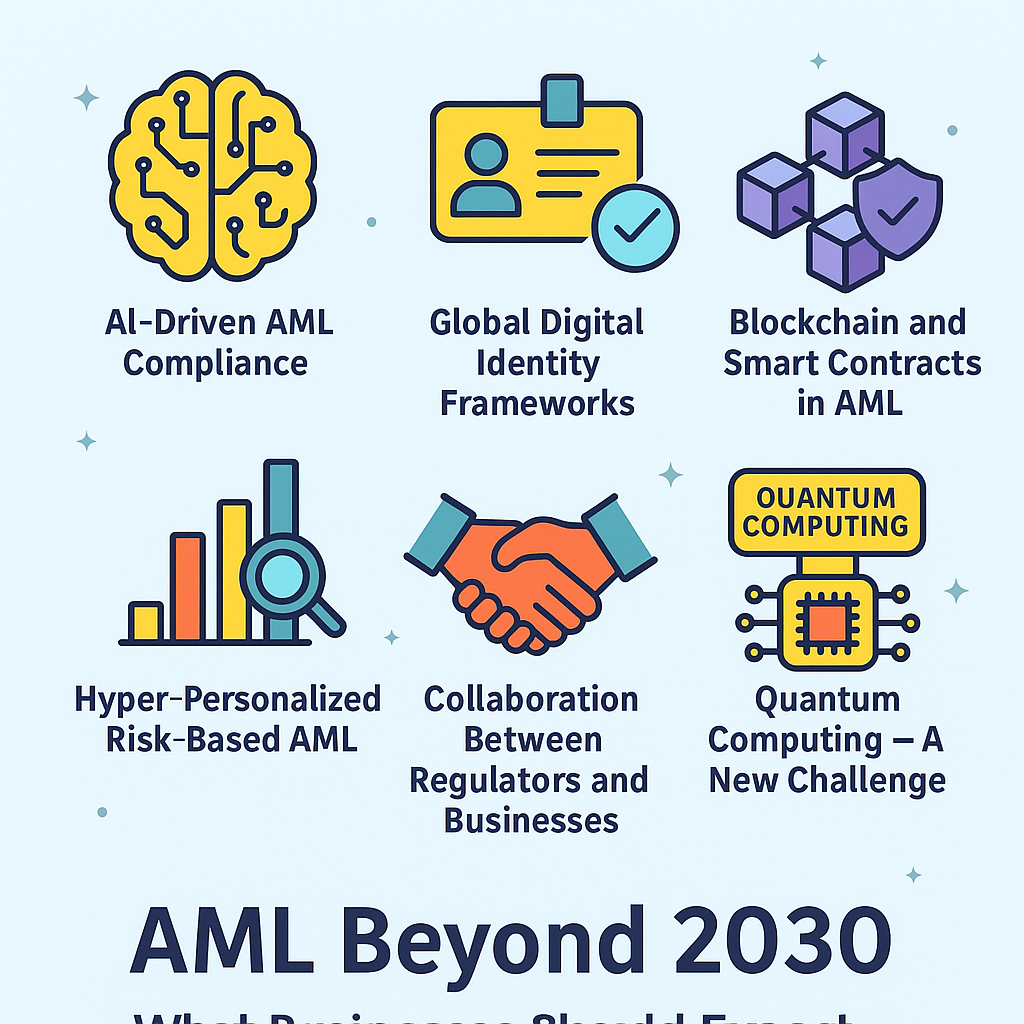
1. The Rise of AI-Driven AML Compliance
Artificial Intelligence (AI) and Machine Learning (ML) will dominate AML compliance. By 2030, most businesses will rely on AI models capable of:
• Predicting suspicious activity before it occurs.
• Detecting hidden patterns in massive transaction datasets.
• Learning from historical case files to improve risk scoring accuracy.
Traditional rules-based monitoring will be largely replaced by predictive, adaptive systems, reducing false positives and increasing efficiency.
________________________________________
2. Global Digital Identity Frameworks
The expansion of digital identity systems will redefine KYC (Know Your Customer) and CDD (Customer Due Diligence). By 2030, businesses can expect:
• Interoperable digital IDs recognized across borders.
• Biometric-driven onboarding processes.
• Real-time authentication to prevent fraud.
This will streamline compliance while strengthening defenses against identity theft and impersonation.
________________________________________
3. Blockchain and Smart Contracts in AML
Blockchain technology will reshape AML compliance by 2030:
• Transparent Ledgers: Regulators and businesses will have real-time visibility into cross-border financial flows.
• Smart Contracts: Automated AML checks embedded into financial contracts, ensuring compliance at the transaction level.
• Crypto Regulation: Virtual assets and cryptocurrencies will be tightly monitored under globally harmonized frameworks.
Businesses engaging in digital assets must prepare for continuous regulatory oversight.
________________________________________
4. Hyper-Personalized Risk-Based AML
Risk assessments will become hyper-personalized using AI and big data. Instead of categorizing clients broadly, compliance systems will calculate individual risk scores based on transaction behavior, social and economic indicators, and real-time market data.
This means businesses must shift from static compliance policies to dynamic, continuously adapting frameworks.
________________________________________
5. Collaboration Between Regulators and Businesses
Beyond 2030, regulators will adopt SupTech (Supervisory Technology) to monitor compliance in real time. Businesses will share live data feeds with regulators, moving away from periodic reporting. This proactive collaboration will:
• Reduce delays in detecting financial crimes.
• Increase regulatory transparency.
• Lower penalties for businesses that maintain strong compliance systems.
________________________________________
6. Quantum Computing – A New Challenge
The rise of quantum computing may pose a significant risk by potentially breaking current encryption methods. By 2030, AML compliance will require quantum-resistant technologies to secure sensitive customer and transaction data. Businesses that fail to prepare may face severe cybersecurity and compliance risks.
________________________________________
7. ESG and AML Convergence
AML compliance will increasingly overlap with Environmental, Social, and Governance (ESG) frameworks. Regulators will expect businesses to demonstrate not only financial transparency but also ethical and sustainable practices.
• Illicit flows tied to environmental crimes (illegal logging, wildlife trafficking) will be a major AML focus.
• Companies will need to prove that supply chains are free from criminal exploitation.
________________________________________
8. The Role of RPA and Intelligent Automation
Robotic Process Automation (RPA) combined with AI will eliminate manual compliance tasks. Case management, sanctions screening, and STR filings will be almost entirely automated, enabling compliance officers to focus on strategic decision-making.
________________________________________
Conclusion
AML compliance beyond 2030 will be technology-led, predictive, and globalized. Businesses that continue relying on manual, reactive processes will struggle to survive regulatory scrutiny. The winners will be those who embrace AI, digital identity, blockchain, intelligent automation, and collaborative compliance models. Preparing today ensures resilience in tomorrow’s fast-evolving regulatory landscape.
________________________________________
About Us
At Sheikh Anwar Accounting and Auditing LLC, we help businesses future-proof their AML frameworks by implementing cutting-edge technologies and aligning with global best practices. From AI-powered transaction monitoring to digital identity integration and AML advisory, we prepare our clients for both today’s compliance needs and the challenges beyond 2030.
📩 Email: info@sa-auditors.com
🌐 Website: www.sa-auditors.com