AML and Customer Due Diligence (CDD) Simplified
Introduction
Anti-Money Laundering (AML) regulations are designed to prevent criminals from using the financial system to launder illicit funds or finance terrorism. At the heart of every AML program is Customer Due Diligence (CDD)—a process that requires businesses to know their customers and assess the risks they pose.
In the UAE, CDD is a legal requirement under Federal Decree-Law No. 20 of 2018 and Cabinet Decision No. 10 of 2019, applicable not only to banks but also to Designated Non-Financial Businesses and Professions (DNFBPs), including real estate brokers, auditors, dealers in precious metals and stones, and corporate service providers.
________________________________________
What Is Customer Due Diligence (CDD)?
CDD refers to the verification of a customer’s identity and assessment of their risk profile before entering into a business relationship or conducting high-value transactions. It ensures that businesses do not unknowingly engage with criminals or sanctioned entities.
CDD typically involves:
• Collecting customer information (name, address, nationality, occupation, business activity).
• Verifying documents such as Emirates ID, passport, trade license.
• Assessing the purpose and nature of the business relationship.
• Identifying Ultimate Beneficial Owners (UBOs) in corporate structures.
________________________________________
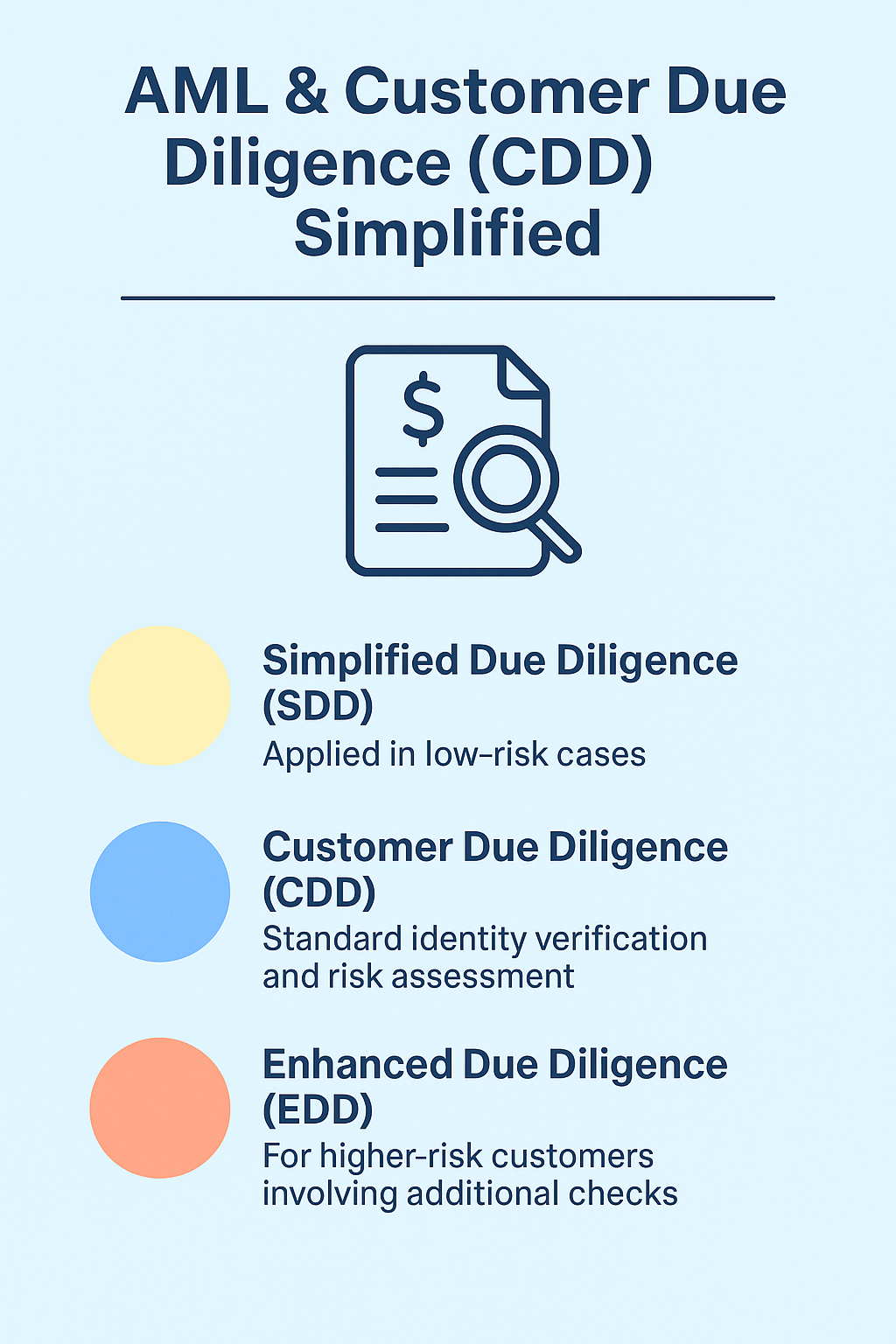
Types of CDD
1. Simplified Due Diligence (SDD)
Applied in low-risk cases, such as small transactions or customers with transparent, low-risk profiles.
2. Standard Due Diligence (CDD)
The normal level of due diligence—verifying customer identity and risk profile before conducting transactions.
3. Enhanced Due Diligence (EDD)
Applied to high-risk clients, such as politically exposed persons (PEPs), customers from high-risk countries, or unusually complex transactions. EDD requires deeper checks, additional documents, and closer monitoring.
________________________________________
Why CDD Is Important
1. Legal Compliance
In the UAE, businesses that fail to conduct CDD face penalties ranging from AED 50,000 to AED 5 million, license suspension, and even criminal liability.
2. Risk Management
CDD helps businesses avoid being exploited by criminals for money laundering, fraud, or terrorism financing.
3. Building Trust and Transparency
Strong CDD practices reassure regulators, clients, and international partners that the business operates with integrity.
4. Supporting STR Reporting
CDD provides the foundation for detecting unusual patterns and filing Suspicious Transaction Reports (STRs) when necessary.
________________________________________
When to Apply CDD in the UAE
Businesses must perform CDD in the following situations:
• Establishing a new business relationship with a customer.
• Conducting cash transactions equal to or above AED 55,000.
• Carrying out wire transfers above the regulatory thresholds.
• Suspecting money laundering or terrorism financing.
• When there are doubts about the accuracy of previously collected customer data.
________________________________________
Red Flags CDD Can Detect
• Customers reluctant to provide identification documents.
• Complex ownership structures without a clear purpose.
• Transactions inconsistent with the customer’s profile.
• High-value or frequent cash payments.
• Dealings with high-risk jurisdictions.
________________________________________
How Businesses Can Strengthen CDD
1. Use Technology – Adopt automated KYC/CDD solutions to verify documents and screen customers against sanction lists.
2. Train Employees – Ensure staff understand AML laws, red flags, and CDD processes.
3. Keep Records – Maintain customer data and verification documents for at least five years.
4. Adopt a Risk-Based Approach – Tailor CDD procedures according to customer risk profiles.
5. Appoint a Compliance Officer/MLRO – Ensure independent oversight of AML and CDD functions.
________________________________________
Conclusion
Customer Due Diligence is the foundation of AML compliance. For UAE businesses, CDD is not just a legal requirement—it is a powerful tool to reduce risks, maintain credibility, and contribute to the country’s global reputation as a transparent and trustworthy business hub.
By simplifying and embedding CDD in daily operations, companies can protect themselves from financial crime while ensuring long-term business growth.
________________________________________
About Sheikh Anwar Accounting and Auditing LLC
At Sheikh Anwar Accounting and Auditing LLC, we provide end-to-end AML solutions, including CDD framework design, risk assessments, MLRO services, training, and goAML reporting support. Our expertise ensures that your business remains fully compliant with UAE AML laws while maintaining smooth operations.
• 📍 Head Office: Dubai, UAE
• 🌐 Website: www.sa-auditors.com
• 📧 Email: info@sa-auditors.com