AI-Powered Beneficial Ownership Verification
Introduction
In today’s global financial system, identifying the real owners behind complex corporate structures is one of the biggest challenges in anti-money laundering (AML) and counter-terrorist financing (CTF) compliance. Criminals often hide illicit funds behind multiple shell companies, offshore entities, and nominee directors—making traditional Know Your Customer (KYC) methods insufficient.
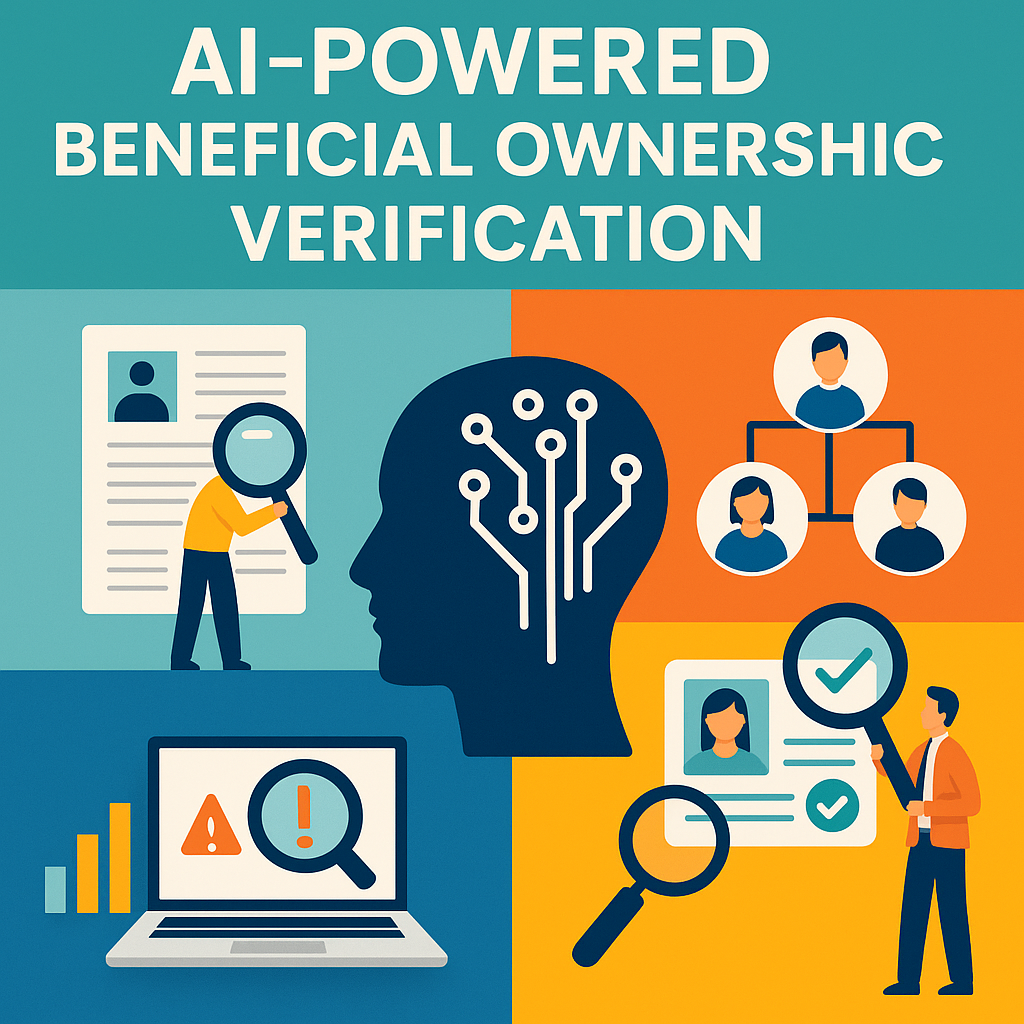
Enter AI-powered beneficial ownership verification: a technology-driven approach that leverages machine learning, natural-language processing (NLP), and big-data analytics to uncover the true beneficial owners (UBOs) behind legal entities with unprecedented accuracy and speed.
________________________________________
1. What Is Beneficial Ownership Verification?
Beneficial ownership verification refers to the process of identifying and verifying the natural person(s) who ultimately own or control a company, even if ownership is hidden through layers of intermediaries or trusts.
Under FATF Recommendations 24 & 25 and UAE Cabinet Decision No. 109 of 2023, all entities—particularly DNFBPs and Virtual Asset Service Providers (VASPs)—must maintain accurate, up-to-date beneficial ownership information.
Traditional verification involves manual collection of corporate documents, shareholder registers, and declarations. However, these methods are time-consuming, error-prone, and easy to manipulate. AI transforms this process by automating data extraction, cross-referencing, and relationship analysis in real time.
________________________________________
2. Why Beneficial Ownership Matters in AML Compliance
• Transparency: Reveals who truly profits from a company’s operations.
• Risk Management: Detects hidden connections to sanctioned or politically exposed individuals.
• Regulatory Compliance: Meets FATF, EU AMLD 6, and UAE AML CFT regulatory obligations.
• Fraud Prevention: Deters the misuse of legal persons for tax evasion, bribery, or corruption.
In the UAE, authorities like the Ministry of Economy (MOE), FSRA (ADGM), DFSA (DIFC), and VARA (Dubai Virtual Assets Regulator) require firms to maintain verified UBO data and update it within 15 days of any change.
________________________________________
3. How Artificial Intelligence Transforms Beneficial Ownership Verification
A. Intelligent Data Extraction
AI systems automatically read and parse:
• Trade licenses, MOAs, AOA s, and share certificates using OCR + NLP.
• Structured and unstructured data from global corporate registries.
• News articles, leaks, and public records to detect hidden relationships.
B. Entity Resolution & Relationship Mapping
Machine-learning models match entities across jurisdictions, even with spelling variations or transliterations.
They then construct ownership graphs, mapping directors, shareholders, subsidiaries, and trustees to visualize control hierarchies.
C. Risk-Based Scoring & Anomaly Detection
AI assesses ownership patterns against global risk indicators:
• Layered or circular ownership structures.
• Entities in high-risk jurisdictions (FATF grey / black list).
• Sudden changes in shareholder composition.
• Nominee or proxy ownership indicators.
D. Cross-Border Data Correlation
AI connects multiple data sources—registry APIs, leaks (e.g., Panama Papers), and sanctions databases—to reveal ultimate control beyond immediate shareholders.
E. Continuous Monitoring
Unlike one-time KYC checks, AI continuously re-screens ownership structures whenever:
• A new shareholder is added.
• A director changes.
• A related entity appears on a sanctions or PEP list.
________________________________________
4. Core Components of AI-Powered Beneficial Ownership Platforms
Component Functionality
Entity Resolution Engine Identifies duplicate or related entities across databases.
Graph Analytics Module Visualizes ownership hierarchies and control relationships.
Sanctions & PEP Screening Flags links to blacklisted or high-risk individuals.
Natural-Language Processing (NLP) Extracts names, roles, and share percentages from unstructured data.
Machine-Learning Risk Models Scores each owner’s risk based on geography, industry, and connections.
RegTech API Integration Connects with KYC/AML platforms (e.g., MyAML.io, Refinitiv, Dow Jones).
Audit & Reporting Layer Generates regulator-ready UBO verification reports.
________________________________________
5. Benefits for Compliance Teams
• Efficiency: Automates manual ownership verification tasks.
• Accuracy: Reduces false positives and human errors in document review.
• Scalability: Handles complex multinational corporate structures.
• Transparency: Produces clear audit trails for regulators.
• Regulatory Readiness: Provides proof of compliance during AML inspections.
________________________________________
6. Integration with AML Frameworks
AI-powered UBO verification tools seamlessly integrate with existing AML modules:
• KYC & KYB Systems – to link individual verification with corporate structures.
• Transaction Monitoring Systems – to correlate ownership with suspicious activity.
• goAML Reporting – to attach verified ownership evidence to STR / SAR submissions.
• Travel Rule Engines (for VASPs) – to ensure transparency in crypto transfers.
________________________________________
7. Challenges and Considerations
• Data Availability: Not all jurisdictions have open or reliable company registers.
• Privacy & GDPR Compliance: AI tools must ensure lawful data processing and encryption.
• Model Explainability: Regulators may demand interpretable AI decisions.
• Human Oversight: AI supports, but does not replace, compliance analysts.
• Vendor Due Diligence: AML officers must verify model quality and data provenance of third-party AI vendors.
________________________________________
8. UAE Regulatory Perspective
The UAE mandates all legal entities to maintain and submit their Real Beneficiary Register (RBR) to the licensing authority.
AI-powered verification systems simplify this by:
• Auto-updating RBR entries upon ownership change.
• Validating identity through Emirates ID, passport, and registry APIs.
• Cross-checking data against the MOE Beneficial Ownership Portal.
Applicable laws:
• Federal Decree-Law No. 20 of 2018 on AML/CFT
• Cabinet Decision No. 10 of 2019 & Cabinet Decision No. 109 of 2023
• Guidance for DNFBPs on Real Beneficiary Disclosure (Ministry of Economy)
________________________________________
9. Future Outlook
By 2026, regulators are expected to mandate AI-assisted ownership verification as part of standard AML technology stacks.
We foresee greater adoption of:
• Federated AI models for privacy-preserving cross-registry data sharing.
• Blockchain-based UBO registries for tamper-proof ownership data.
• Explainable AI (XAI) for auditability and regulatory transparency.
________________________________________
10. Conclusion
AI-powered beneficial ownership verification marks a major shift in how compliance teams uncover hidden control structures.
By merging automation, analytics, and intelligence, these tools empower regulators and institutions to expose complex ownership webs, reduce AML risk, and enhance global corporate transparency.
For financial institutions, DNFBPs, and VASPs in the UAE, now is the time to adopt AI-driven UBO verification as part of a holistic AML / CFT framework.
________________________________________
About Sheikh Anwar Accounting & Auditing LLC
Sheikh Anwar Accounting & Auditing LLC (SA Auditors) is a UAE-based professional firm (MOE Entry No. 5817) providing AML compliance, outsourced MLRO services, audit, and corporate tax advisory.
Through our compliance technology platform MyAML.io, we assist organizations in automating KYC, CDD, and UBO verification processes across the GCC.
📍 Office Address: M-35, Dubai Creek Tower, Dubai, U.A.E.
📞 Phone: +971 4 250 1084
✉️ Email: info@sa-auditors.com
🌐 Websites: www.sa-auditors.com | www.myaml.io