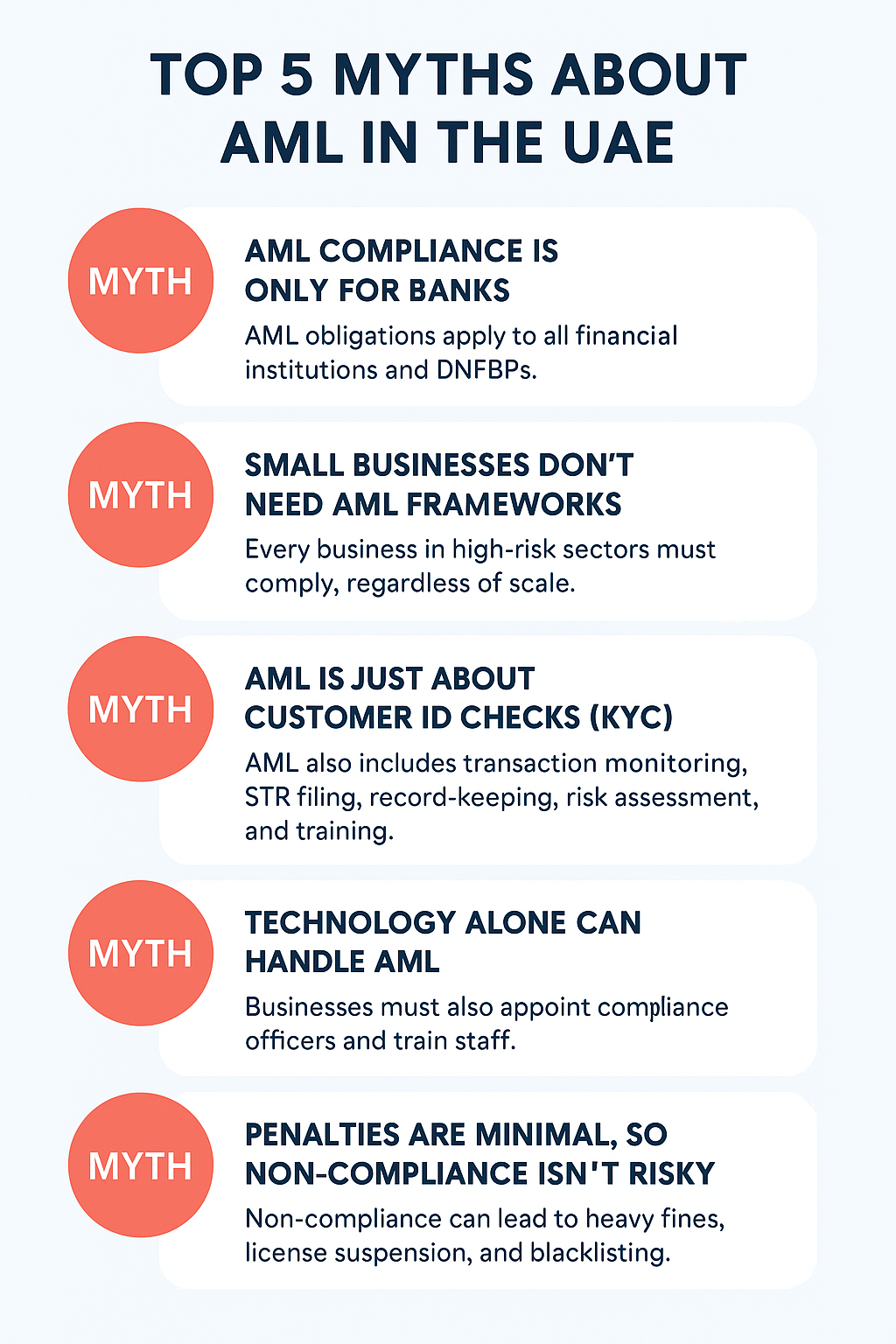
10. Top 5 Myths About AML in the UAE
Introduction
The United Arab Emirates (UAE) has positioned itself as a global hub for trade, finance, real estate, and precious metals. With this reputation comes strict regulatory requirements to prevent money laundering and terrorism financing. Despite continuous awareness campaigns by regulators such as the Ministry of Economy (MoE) and the Central Bank of the UAE (CBUAE), several myths about Anti-Money Laundering (AML) compliance persist among businesses—especially small and medium enterprises (SMEs).
Dispelling these myths is crucial to ensure businesses remain compliant and avoid hefty penalties.
________________________________________
Myth 1: “AML Compliance Is Only for Banks”
Reality: AML obligations apply to all financial institutions and DNFBPs (Designated Non-Financial Businesses and Professions).
This includes:
• Auditors and accountants
• Real estate brokers and agents
• Dealers in precious metals and stones (gold, diamond, jewelry traders)
• Corporate service providers
In the UAE, small businesses in these sectors are legally required to comply with AML laws.
________________________________________
Myth 2: “Small Businesses Don’t Need AML Frameworks”
Reality: Criminals often target small firms because they believe compliance checks are weaker. The size of your business does not reduce your obligations. Under Federal Decree-Law No. 20 of 2018 and Cabinet Decision No. 10 of 2019, every business in high-risk sectors must comply, regardless of scale.
________________________________________
Myth 3: “AML Is Just About Customer ID Checks (KYC)”
Reality: While Know Your Customer (KYC) is essential, AML goes much further. It also includes:
• Ongoing transaction monitoring
• Filing Suspicious Transaction Reports (STRs) with the Financial Intelligence Unit (FIU) via goAML
• Maintaining records for at least five years
• Conducting regular risk assessments
• Providing employee training
AML is an end-to-end framework, not a single step.
________________________________________
Myth 4: “Technology Alone Can Handle AML”
Reality: While AML software helps with screening, monitoring, and reporting, technology is not enough. Businesses must also:
• Appoint a Compliance Officer/MLRO
• Train staff regularly
• Establish strong internal controls
• Foster a compliance-first culture
Technology supports AML compliance, but human judgment and accountability remain critical.
________________________________________
Myth 5: “Penalties Are Minimal, So Non-Compliance Isn’t Risky”
Reality: Non-compliance in the UAE can lead to severe consequences, including:
• Fines up to AED 5 million
• Suspension or cancellation of trade licenses
• Blacklisting of the company
• Personal liability for managers and compliance officers
Beyond financial penalties, reputational damage can destroy years of business relationships.
________________________________________
Conclusion
AML compliance in the UAE is not just a regulatory checkbox—it is a business necessity. Myths such as “it’s only for banks” or “small businesses are exempt” put companies at serious risk. By understanding the full scope of AML obligations, businesses can protect themselves, build trust with clients, and contribute to the UAE’s reputation as a safe and transparent business hub.
________________________________________
About Sheikh Anwar Accounting and Auditing LLC
At Sheikh Anwar Accounting and Auditing LLC, we specialize in helping businesses of all sizes comply with UAE AML laws. From risk assessments and policy drafting to outsourced compliance officers and training programs, we ensure your business is fully compliant with regulatory expectations.
• 📍 Head Office: Dubai, UAE
• 🌐 Website: www.sa-auditors.com
• 📧 Email: info@sa-auditors.com
•