1. What Is Money Laundering? UAE Perspective
Introduction
Money laundering is one of the most pressing financial crimes worldwide. It involves disguising the origin of illicit funds to make them appear legitimate. The United Arab Emirates (UAE), being a global hub for trade, finance, gold, and real estate, is particularly vulnerable to money laundering activities. Recognizing this risk, the UAE has built a robust anti-money laundering (AML) legal and regulatory framework aligned with international standards.
________________________________________
Understanding Money Laundering
At its core, money laundering is the process of converting "dirty money" (proceeds from illegal activities such as fraud, corruption, organized crime, drug trafficking, or tax evasion) into "clean money" that can enter the financial system without raising suspicion.
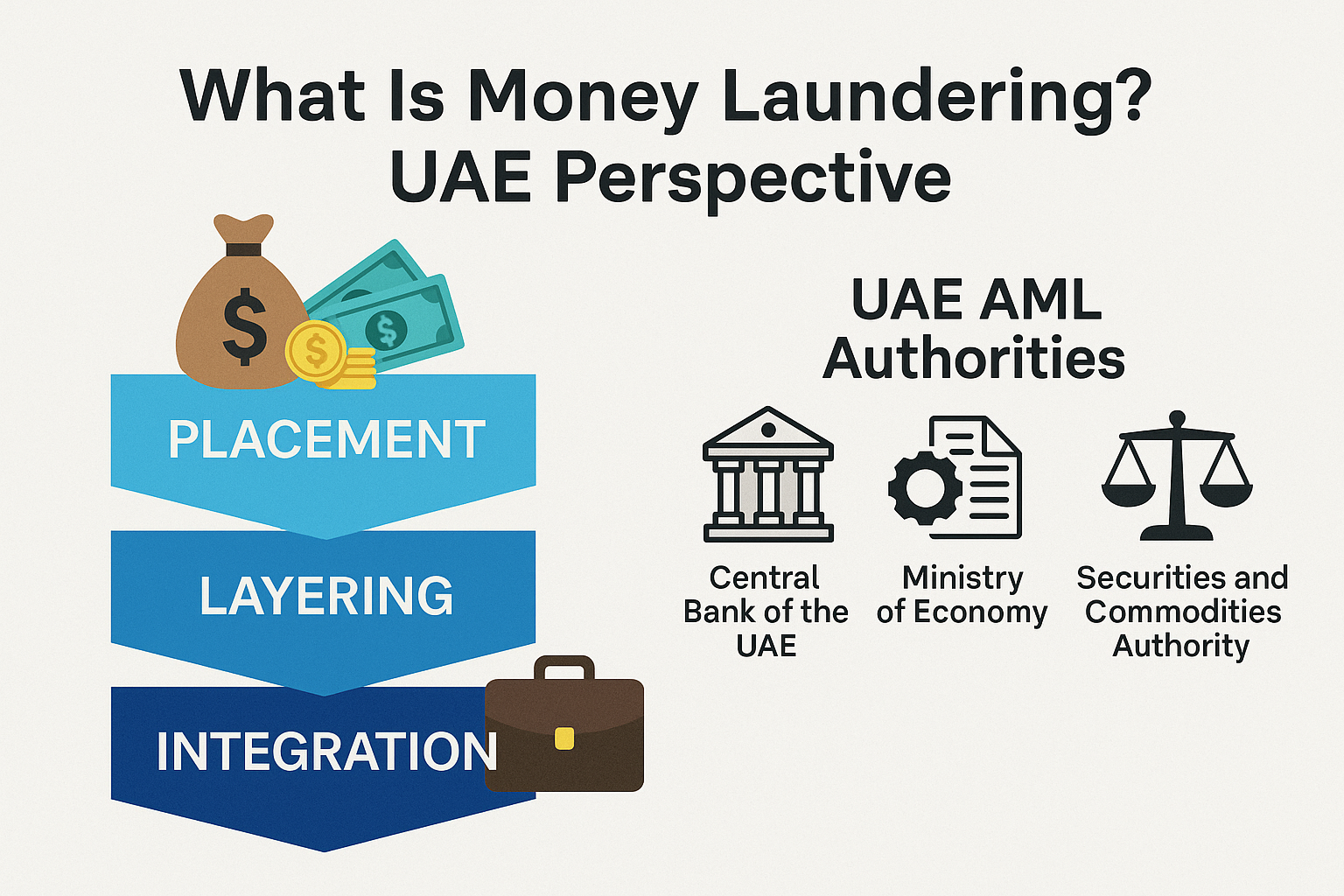
The process typically takes place in three stages:
1. Placement – Introducing illicit funds into the financial system (e.g., deposits, purchases of assets, gold, or property).
2. Layering – Concealing the origin of funds through complex transactions, cross-border transfers, or conversion into different assets.
3. Integration – Reintroducing the funds into the economy in legitimate form, such as investments, businesses, or luxury goods.
________________________________________
UAE Perspective on Money Laundering
The UAE’s strategic location and open economy make it attractive for both legitimate and illegitimate capital flows. Sectors such as gold trading, real estate, corporate services, and free zones are considered higher risk. To combat this, the UAE has developed a strong AML ecosystem.
Legal Framework
• Federal Decree-Law No. 20 of 2018 on Anti-Money Laundering and Combating the Financing of Terrorism (AML-CFT Law).
• Cabinet Decision No. 10 of 2019 – Implementing regulations providing detailed AML obligations.
• Federal Decree-Law No. 26 of 2021 – Strengthening supervisory powers and penalties.
• Cabinet Decision No. 111 of 2022 – Expanding definitions and enhancing DNFBP obligations.
Regulatory Authorities
• Central Bank of the UAE (CBUAE) – Supervises banks, finance companies, and exchange houses.
• Ministry of Economy (MoE) – Supervises Designated Non-Financial Businesses and Professions (DNFBPs) like auditors, real estate brokers, dealers in precious metals and stones, and corporate service providers.
• Securities and Commodities Authority (SCA) and Insurance Authority – Oversee their respective sectors.
Supervisory Expectations
• Customer Due Diligence (CDD) & KYC – Identifying and verifying clients before establishing business relationships.
• Suspicious Transaction Reporting (STR) – Mandatory reporting to the UAE’s Financial Intelligence Unit (FIU).
• Record Keeping – Minimum five years of records must be maintained.
• Risk-Based Approach – Companies must assess and mitigate risks based on the nature of their clients and transactions.
________________________________________
Money Laundering Risks in the UAE
1. Gold and Precious Metals – The UAE is a global hub for gold trading, making it attractive for placement and layering of illicit funds.
2. Real Estate Sector – High-value property deals can be misused for integration of funds.
3. Trade-Based Laundering – Misuse of invoices, customs declarations, and import/export trade flows.
4. Corporate Structures in Free Zones – Shell companies and complex ownership structures can obscure beneficial ownership.
________________________________________
Penalties for Non-Compliance
The UAE imposes strict penalties for money laundering and non-compliance with AML obligations:
• Imprisonment (up to 10 years for serious offences).
• Fines ranging from AED 50,000 to AED 5 million.
• Administrative sanctions such as suspension of licenses or blacklisting.
• Personal liability for compliance officers and senior management in case of negligence.
________________________________________
UAE’s Commitment to Global Standards
The UAE is a member of the Financial Action Task Force (FATF) and has undertaken significant reforms after the FATF placed it on the grey list in March 2022. Through enhanced supervision, international cooperation, and sector-specific AML guidance, the UAE continues to strengthen its financial integrity.
________________________________________
Conclusion
Money laundering poses a serious threat to economies worldwide, and the UAE’s rapid growth and open economy make it both vulnerable and proactive. Businesses operating in the UAE—especially in gold, real estate, corporate services, and finance—must prioritize AML compliance to avoid penalties and maintain international credibility.
By following a risk-based approach, ensuring proper due diligence, and reporting suspicious transactions, entities can contribute to the UAE’s fight against money laundering and protect the country’s position as a trusted global business hub.
________________________________________
About Sheikh Anwar Accounting and Auditing LLC
At Sheikh Anwar Accounting and Auditing LLC, we specialize in AML compliance, corporate tax advisory, VAT, and auditing services across the UAE. Our team has deep expertise in high-risk sectors such as gold, diamond, and real estate trading, ensuring that our clients remain fully compliant with UAE AML laws and international standards.
• 📍 Head Office: Dubai, UAE
• 🌐 Website: www.sa-auditors.com
• 📧 Email: info@sa-auditors.com
We are also registered and approved auditors with the Ministry of Economy (MOE), and recognized across multiple UAE free zones including SAIF Zone, DAFZA, and DMCC.